Introduction
Property Care & Maintenance | Owning a property comes with responsibilities that extend far beyond purchasing the building, paying utility bills, or keeping the rooms clean. Roof deterioration, hidden plumbing leaks, neglected drainage, damaged exterior finishes, and poorly maintained equipment can gradually affect a property’s safety, usability, and financial performance.
The challenge is that many property problems develop quietly. A small defect may not look serious today, but leaving it unattended can lead to additional repairs, unexpected expenses, and disruption for the people living or working in the building.
Effective property care and maintenance gives property owners a practical way to manage these risks. Instead of waiting for something to fail, owners can assess the building’s condition, plan essential work, monitor expenses, and make informed decisions about repairs and replacements.
Whether you own a family house, manage several rental units, oversee a residential building, or have recently invested in real estate, a structured maintenance strategy can help you protect your investment over time.
This guide explains how to develop a property maintenance plan, prioritize repairs, organize inspections, control operating costs, choose contractors, manage rental property responsibilities, and prepare for future maintenance expenses. It also covers common mistakes, practical checklists, and professional recommendations that help turn maintenance from an occasional headache into a manageable routine.
For more practical guidance on improving and caring for residential spaces, visit Blog Home Ideas TheHomeTrotters.
What Does Property Care and Maintenance Actually Involve?
Property care and maintenance is the ongoing process of inspecting, protecting, servicing, and repairing a building and its associated systems. It includes both everyday activities that preserve the property’s condition and planned work that helps prevent deterioration.
The purpose is to keep the building safe, functional, comfortable, and suitable for its intended use while managing the cost of ownership responsibly.
Property maintenance isn’t limited to repairing visible damage. It also involves understanding how different building components work together, identifying developing risks, and deciding when professional intervention is necessary.
What areas should a property maintenance plan cover?
A comprehensive plan generally includes several categories.
1. Structural components
These include foundations, load-bearing walls, floors, roof structures, balconies, and other elements that support the building. Maintenance involves monitoring visible changes, addressing water penetration, and obtaining professional assessments when structural concerns appear.
2. Building envelope
The building envelope separates indoor spaces from outdoor conditions. It includes roofing, exterior walls, windows, doors, flashing, sealants, and related weatherproofing details.
Damaged seals or defective roof coverings can allow moisture to enter the building, potentially affecting insulation, finishes, and other materials.
3. Mechanical and utility systems
Plumbing, electrical installations, heating, ventilation, air conditioning, water heaters, pumps, and other installed equipment require appropriate inspections and servicing.
These systems influence everyday comfort and safety, so their maintenance should follow manufacturer instructions and relevant local requirements.
4. Interior components
Flooring, ceilings, doors, cabinetry, wall finishes, sanitary fixtures, and hardware require cleaning, adjustment, and occasional repair.
Although many interior issues are cosmetic, changes such as recurring floor movement, persistent dampness, or doors that suddenly stop closing properly may indicate an underlying defect.
5. Exterior and shared areas
Driveways, paths, balconies, fences, landscaping, parking areas, common corridors, and drainage systems may also need regular attention.
For apartment buildings and managed developments, shared spaces require clear responsibilities and coordinated inspections.
6. Safety and compliance
Smoke alarms, carbon monoxide alarms where applicable, fire doors, emergency lighting, access routes, and other safety-related installations should be maintained according to applicable regulations and manufacturer instructions.
A property can look attractive while still having serious maintenance deficiencies. That’s why a reliable plan considers the whole building rather than focusing exclusively on appearance.
Why Is Planned Property Maintenance Better Than Waiting for Repairs?
Planned maintenance helps owners identify problems earlier, coordinate contractors, reduce avoidable disruption, and make repair expenses more predictable. Reactive repairs remain necessary, but relying on them exclusively can make property ownership more expensive and difficult to manage.
Consider two property owners who discover that an exterior window seal has deteriorated.
The first arranges a suitable repair after noticing the defect. The second postpones action because the window still closes and the room appears dry. Months later, rainwater enters the wall, damaging paint and internal finishes.
The original defect may have been relatively simple to correct, but the delayed response created additional work.
This example illustrates an important principle: the cost of a maintenance problem depends not only on the original defect but also on how long it remains unresolved and what it affects.
Financial benefits of planned maintenance
A planned approach allows owners to:
- Schedule non-urgent work before it becomes an emergency.
- Compare quotations without unnecessary time pressure.
- Group suitable tasks into a single contractor visit.
- Forecast major equipment replacements.
- Maintain records of previous repairs.
- Reduce avoidable damage to surrounding materials.
Planned maintenance doesn’t eliminate unexpected failures. It improves the owner’s ability to anticipate foreseeable needs and respond effectively.
Operational benefits for occupied properties
In a rental property, a failed water heater or blocked drainage system can inconvenience occupants and generate urgent communication.
Regular inspections and a clear reporting process make it easier to identify defects and coordinate repairs.
For commercial or multi-unit buildings, scheduled work can also reduce disruption by allowing managers to plan access, notify occupants, and coordinate contractors in advance.
How maintenance protects long-term property condition
Buildings age through exposure to moisture, sunlight, temperature changes, movement, material wear, and everyday use.
Appropriate maintenance helps manage these factors. For example, keeping drainage functional can reduce water accumulation, while maintaining exterior coatings according to their specifications can help protect the underlying material.
However, maintenance cannot prevent every form of deterioration. Some components eventually require replacement, and serious construction defects may need specialist correction.
The objective is to manage the property’s condition intelligently rather than assume every problem can be prevented.
What Are the Main Types of Property Maintenance?
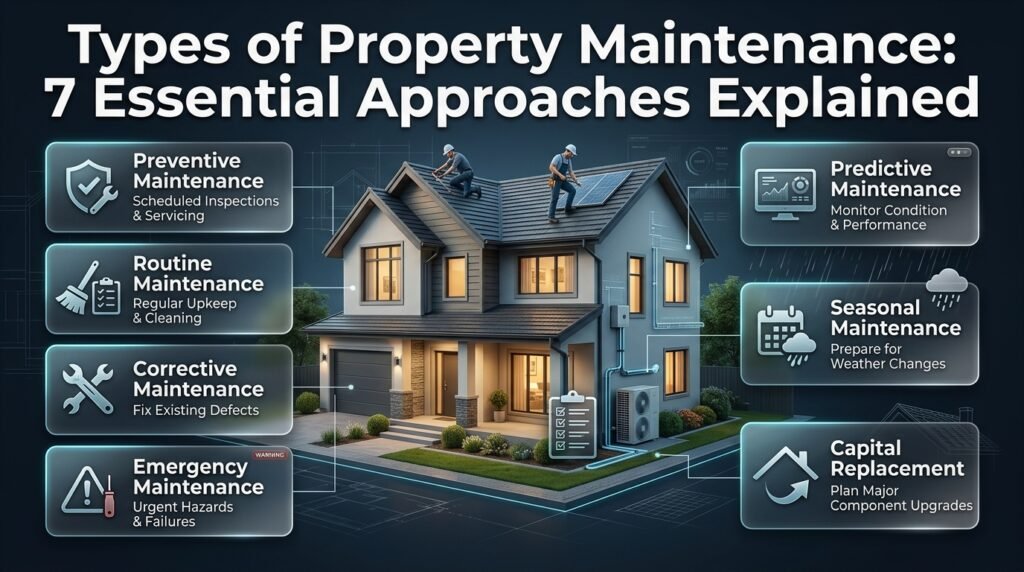
Property maintenance can be divided into several approaches based on when work occurs and why it is required. Understanding these categories helps owners decide whether a task belongs on a routine schedule, needs corrective action, or requires an immediate response.
| Maintenance type | Main purpose | Practical example |
|---|---|---|
| Preventive | Reduce the likelihood of failure | Servicing equipment at recommended intervals |
| Routine | Preserve everyday functionality | Cleaning accessible drainage points |
| Corrective | Repair an identified defect | Replacing a damaged door seal |
| Emergency | Address immediate danger or serious damage | Responding to a burst pipe |
| Predictive | Use condition information to anticipate problems | Monitoring equipment performance data |
| Seasonal | Prepare for changing environmental conditions | Inspecting drainage before heavy rainfall |
| Capital replacement | Replace major components nearing the end of useful life | Replacing a severely deteriorated roof |
Preventive maintenance
Preventive maintenance consists of planned inspections and servicing intended to reduce the risk of failure.
The schedule should reflect equipment specifications, environmental conditions, usage, age, and known weaknesses.
For example, an air conditioning system operating for long periods in a dusty environment may need more frequent filter attention than a system used occasionally in a cleaner setting.
Routine maintenance
Routine maintenance involves recurring activities that keep a property clean, usable, and in reasonable condition.
These tasks may include checking accessible plumbing, maintaining door hardware, cleaning designated drainage areas, and monitoring equipment for unusual performance.
Routine tasks are often inexpensive individually, but they become valuable when completed consistently.
Corrective maintenance
Corrective maintenance addresses defects that have already developed.
Examples include repairing a leaking pipe, replacing a broken latch, correcting a faulty drainage connection, or repairing damaged exterior sealant.
Some corrective work can be scheduled. Other defects require prompt attention because they may worsen or affect safety.
Emergency maintenance
Emergency maintenance addresses urgent hazards or failures that threaten occupants, the building, or essential services.
Examples include significant uncontrolled water leaks, suspected gas leaks, exposed live wiring, and major damage following a storm.
Occupants should be moved away from dangerous areas, and appropriate emergency services or qualified professionals should be contacted. Don’t attempt repairs beyond your training.
Predictive maintenance
Predictive maintenance uses observations, monitoring equipment, and performance data to identify signs of developing failure.
A building manager might monitor repeated pump alarms, unusual energy consumption, or changes in mechanical equipment performance.
These signals can help direct inspections, but they should be interpreted carefully. An unusual reading may have several possible causes, and monitoring systems don’t replace physical assessments.
Capital replacement planning
Some building components eventually become uneconomical to repair or reach the end of their safe service life.
Major replacements can include roofing systems, elevators, boilers, air conditioning equipment, exterior cladding, and shared plumbing infrastructure.
These projects often require substantial funding and advance planning. Treating them as predictable future obligations helps prevent sudden financial pressure.
How to Build a Property Maintenance Plan Step by Step
A useful maintenance plan doesn’t need to be complicated. It needs to identify what requires attention, determine the appropriate priority, assign responsibility, and record the outcome.
Step 1: Create a property asset register
An asset register is a record of the property’s major components and equipment.
For a house, it might include the roof, water heater, air conditioning system, electrical installation, water supply, drainage, exterior windows, and significant appliances.
For a larger building, it may also cover elevators, fire protection systems, pumps, access controls, and shared facilities.
Record useful information such as:
- Component or equipment name.
- Approximate installation date, if known.
- Manufacturer and model where relevant.
- Warranty information.
- Most recent inspection or service.
- Known defects.
- Expected future maintenance needs.
You don’t need to document every small household item. Start with components that are expensive, safety-critical, or essential to the building’s operation.
Step 2: Assess the current condition
Walk through the property and note visible defects.
Look for water stains, damaged sealant, loose fittings, unusual smells, corrosion, peeling finishes, blocked drainage, and changes in equipment performance.
Photograph relevant areas and record the date.
Don’t open electrical panels, climb onto unsafe roofs, enter confined spaces, or investigate structural defects beyond your competence. Arrange an appropriate professional assessment when necessary.
Step 3: Classify each issue by urgency
A maintenance plan should distinguish urgent hazards from ordinary deterioration.
| Priority | Typical situation | Response |
|---|---|---|
| Critical | Immediate threat to life or serious damage | Protect occupants and contact appropriate emergency services or qualified professionals |
| High | Active leak, significant deterioration, or failure of an essential system | Arrange prompt investigation and repair |
| Medium | Defect likely to worsen but not currently an emergency | Schedule corrective work and monitor appropriately |
| Low | Cosmetic wear without an identified safety or functional issue | Include in planned maintenance or improvement work |
These categories are a management aid, not a substitute for professional judgment. A seemingly minor defect may require a higher priority if it affects a safety-critical component.
Step 4: Establish maintenance intervals
Create a calendar based on the recommendations for each component.
Some tasks may be performed weekly or monthly, while others require seasonal checks, annual servicing, or inspections at intervals determined by law, equipment instructions, or professional advice.
Avoid applying one universal schedule to every property.
A recently renovated apartment and an older house with previous water damage may need very different maintenance plans.
Step 5: Assign clear responsibility
Every task should have an owner.
In a private home, that may be the homeowner. In a rental property, the responsible party may depend on the tenancy agreement and applicable law. In a managed building, a property manager may coordinate the work while specialist contractors complete it.
Record who reports a problem, who approves spending, who arranges access, and who confirms that the work is complete.
Step 6: Set a realistic budget
Estimate routine servicing, minor repairs, professional inspections, and future component replacements.
Separate essential maintenance from optional improvements so that decorative projects don’t consume funds needed for safety or essential repairs.
Where historical records exist, use actual spending to improve your estimates.
Step 7: Review and improve the plan
At regular intervals, examine completed tasks, overdue work, recurring defects, contractor performance, and actual costs.
If one component repeatedly fails, investigate the underlying cause. Repeated repairs may indicate that the original diagnosis was incomplete or that replacement is becoming the more practical option.
A maintenance plan should change as the property’s condition and needs change.
How Often Should Different Parts of a Property Be Maintained?
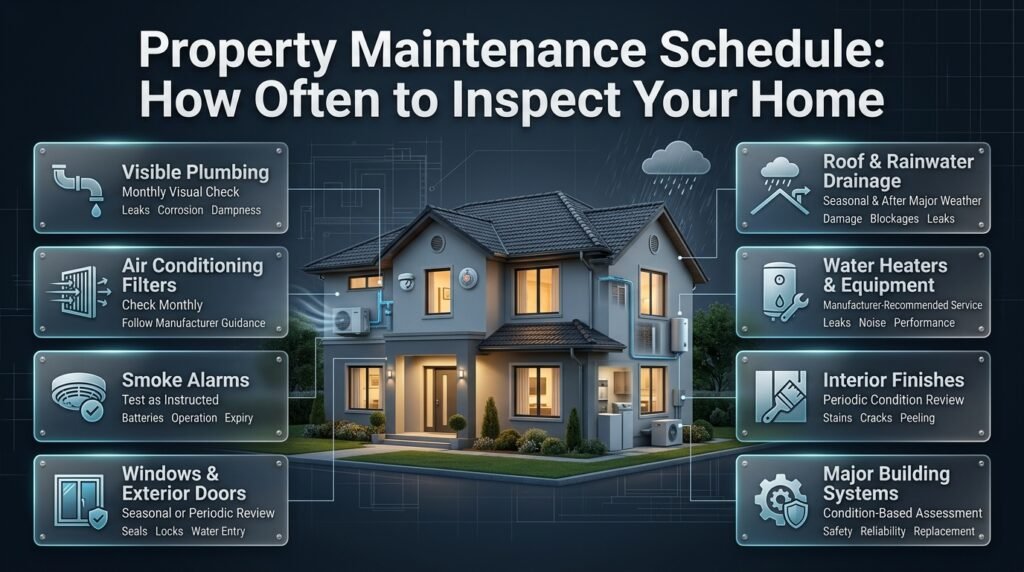
Maintenance frequency depends on the component, its condition, how heavily it’s used, and the environment in which it operates. A useful schedule combines regular observations with manufacturer-recommended servicing and professional inspections where necessary.
The following table provides a starting framework. Adjust it to suit the building rather than treating these intervals as universal requirements.
| Property component | Suggested planning interval | What to monitor |
|---|---|---|
| Visible plumbing | Monthly visual check | Leaks, corrosion, dampness |
| Air conditioning filters | Check monthly or as instructed | Dust, airflow, filter condition |
| Smoke alarms | Test according to manufacturer instructions | Operation, batteries, replacement dates |
| Windows and exterior doors | Seasonal or periodic review | Seals, locks, water entry |
| Roof and rainwater drainage | Seasonal and after significant weather events where appropriate | Damage, blockage, water penetration |
| Water heaters and mechanical equipment | Manufacturer-recommended servicing | Performance, leaks, unusual noises |
| Interior finishes | Periodic review and whenever defects appear | Stains, cracks, peeling, deterioration |
| Major building systems | Based on condition and professional recommendations | Safety, reliability, expected replacement needs |
Why should inspection frequency vary?
A property near the coast may experience corrosion differently from a building in a dry inland area. A home surrounded by trees may need more frequent attention to drainage than one with little nearby vegetation.
Similarly, an older building with a history of plumbing leaks deserves closer monitoring of affected areas than a property with no known moisture problems.
Maintenance planning should therefore consider three factors:
- Exposure: What environmental conditions affect the building?
- Condition: Are any components aging, damaged, or repeatedly failing?
- Consequence: What would happen if the component failed?
The third factor is particularly important. A minor decorative defect and a deteriorating electrical installation should never receive the same level of priority.
How to Maintain the Most Important Property Systems
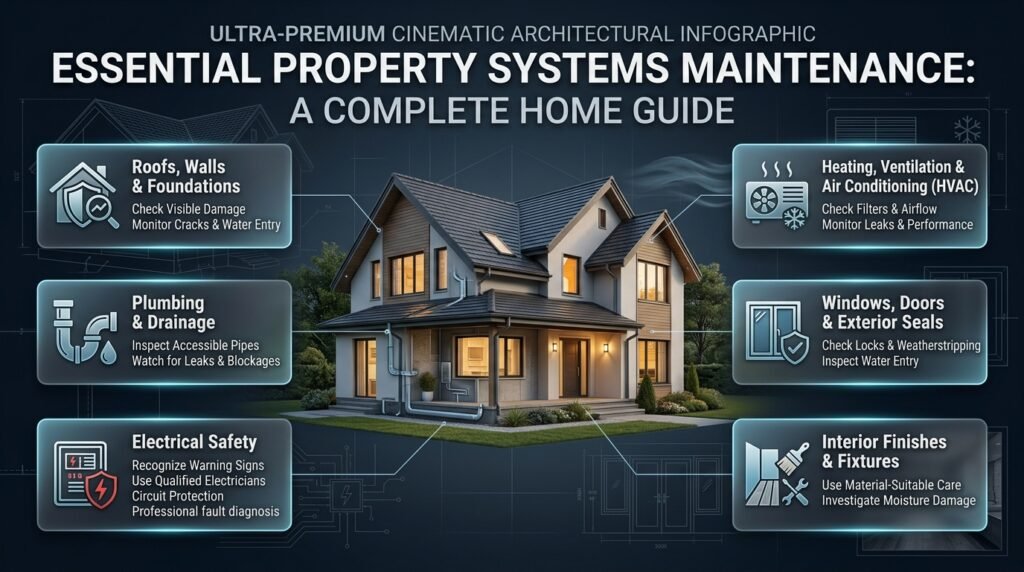
A maintenance plan becomes more effective when it addresses the needs of individual building systems. Each system has different failure signs, maintenance requirements, and risks.
Roofs, walls, and foundations
The roof and exterior structure protect the building from weather and contribute to its stability.
Owners should pay attention to new ceiling stains, missing or damaged roof coverings visible from a safe location, deteriorating exterior sealant, water pooling near the building, and changes in cracks.
Not every crack indicates a structural problem. Small cracks can result from ordinary material movement or finish shrinkage. However, cracks that widen, reappear after repairs, or occur alongside sloping floors, sticking doors, or other changes deserve professional investigation.
Recommended approach:
- Inspect visible areas after severe weather when safe.
- Record changes using dated photographs.
- Keep drainage systems functioning properly.
- Repair weatherproofing defects with compatible materials.
- Obtain specialist advice for concerning structural changes.
Don’t assume that repainting a wall resolves the underlying cause of a crack or water stain.
Plumbing and drainage
Water-related problems can affect multiple parts of a property, including cabinets, flooring, wall finishes, insulation, and electrical installations.
Routine checks should include accessible pipes, taps, toilets, appliance connections, water heaters, and visible drainage areas.
Look for unexplained dampness, reduced drainage performance, recurring blockages, unusual water pressure changes, and persistent odors.
A slow drain may be caused by a simple obstruction, but repeated blockages can indicate a deeper issue. Likewise, a leak that appears intermittently may still be damaging concealed materials.
If a significant leak develops, protect people from affected areas, isolate the water supply if it is safe and appropriate, and arrange repairs promptly. Water near electrical equipment requires particular caution.
Electrical systems
Electrical maintenance should prioritize safety rather than cosmetic appearance.
Warning signs include repeated circuit-breaker trips, burning smells, discolored outlets, buzzing sounds, damaged cables, or unusually warm electrical components.
Don’t ignore these symptoms or repeatedly reset a breaker without investigating the cause.
A qualified electrician should assess electrical faults, wiring changes, damaged circuits, and work involving electrical panels. Owners should also ensure that required inspections and safety checks are completed under local regulations.
Simple activities, such as replacing a compatible light bulb, may be suitable for a homeowner when the manufacturer’s instructions and safe working practices are followed. More complex work should be left to qualified professionals.
Heating, ventilation, and air conditioning
HVAC systems influence indoor comfort, ventilation, and energy use. Poor maintenance can contribute to reduced airflow, inadequate cooling or heating, drainage problems, and equipment failures.
The appropriate maintenance routine depends on the system type and operating environment.
Useful practices include:
- Checking filters at the recommended intervals.
- Keeping accessible supply and return vents unobstructed.
- Monitoring unusual sounds, smells, or performance changes.
- Checking for visible condensate leaks.
- Arranging professional servicing as recommended.
- Keeping outdoor equipment clear of obstructions where applicable.
If the system stops cooling properly, don’t assume that cleaning the filter will solve every problem. Refrigerant issues, blocked drainage, electrical faults, and mechanical defects may require professional diagnosis.
Windows, doors, and exterior seals
Windows and doors contribute to security, weather protection, privacy, and indoor comfort.
Inspect locks, hinges, handles, frames, glazing, and visible weatherstripping. Look for drafts, difficulty closing, damaged sealant, or signs of water entering around the frame.
A deteriorated seal may be relatively straightforward to replace, but recurring water entry can indicate a problem with flashing, installation, or surrounding construction.
Use materials compatible with the frame and surrounding surfaces. Incorrect sealant application can obstruct drainage openings or conceal a larger defect.
Interior finishes and fixtures
Walls, ceilings, flooring, cabinetry, and sanitary fixtures require care suited to their materials.
For example, abrasive cleaning products can damage delicate finishes, excessive water can harm some timber products, and unsuitable sealants may fail to adhere correctly.
Follow manufacturer instructions for cleaning and maintenance. When damage appears, determine whether it is superficial or related to moisture, movement, or another underlying issue.
The same principle applies to bathroom fixtures: replacing deteriorated sealant may help, but the area must be properly prepared, and persistent moisture should be investigated before the surface is resealed.
How Do Weather and Building Design Affect Maintenance Needs?
The environment surrounding a property influences how quickly materials deteriorate and which systems require the most attention.
A maintenance plan that works well for one building may be unsuitable for another because construction methods, weather exposure, ventilation, and drainage conditions differ.
Hot and dusty climates
In hot environments, air conditioning may operate for extended periods. Dust can accumulate on filters and equipment, while intense sunlight can affect exposed finishes, sealants, and some roofing materials.
Useful priorities include monitoring cooling performance, maintaining filters according to instructions, inspecting exposed sealants, and checking that condensate drainage functions correctly.
Wet and humid climates
Frequent rainfall and high humidity increase the importance of drainage, roof integrity, ventilation, and moisture control.
Pay attention to recurring condensation, damp cupboards, peeling paint, musty smells, and water entering around windows.
The solution should address the source of moisture rather than simply covering the affected surface.
Cold climates
Properties exposed to freezing temperatures may need additional attention to exposed pipes, heating systems, exterior drainage, and vulnerable water connections.
Owners should follow suitable winterization procedures and seek professional advice when the building has plumbing or heating systems that could be damaged by freezing.
Properties with unusual layouts or construction
Building design also influences maintenance access and the complexity of repairs.
A house with a complicated roofline, large glazed areas, concealed service routes, or multiple extensions may require a more detailed inspection plan than a simple building with easily accessible components.
When planning a new build or substantial alteration, the Residential Architecture Ideas resource can provide related context on residential design and building considerations.
From a maintenance perspective, the important questions are practical:
- Can essential components be inspected safely?
- Are service points accessible?
- Can water drain away from vulnerable areas?
- Are suitable replacement materials available?
- Will future repairs require specialist access equipment?
A design that looks impressive but makes routine servicing unnecessarily difficult can increase the cost and complexity of ownership.
How Should Property Owners Manage Contractors and Repair Work?
Contractor management is an important part of property maintenance, particularly when the work involves multiple trades, occupied buildings, or significant expenditure.
The objective is to ensure that the defect is correctly identified, the work is clearly defined, and the completed repair meets the agreed requirements.
Describe the problem clearly
When requesting a quotation, provide the contractor with a clear description of the issue.
Include when it began, whether it happens continuously or intermittently, what areas are affected, and whether any previous repairs have been attempted.
Photographs and videos can help explain visible symptoms, although they don’t replace an on-site assessment where one is needed.
For example, instead of reporting only that a bathroom ceiling needs painting, explain that a stain has appeared beneath an upstairs bathroom and that its size changes after the shower is used.
This gives the contractor more useful information about the possible source of the problem.
Request a clear quotation
A detailed quotation should explain the scope of work, materials, labour, exclusions, expected timing, and applicable warranty terms.
For larger projects, confirm whether the quotation includes removing damaged materials, disposing of waste, restoring affected surfaces, and testing the repaired system.
Ask questions before approving work if the scope is unclear.
Verify qualifications and insurance where relevant
Check that the contractor holds the qualifications, licences, registrations, and insurance required for the work and jurisdiction.
For specialist jobs, ask who will perform the work and whether any subcontractors are involved.
Don’t assume that a low quotation means a contractor is unqualified, but don’t select a contractor on price alone.
Agree on access and communication
For occupied properties, establish suitable working hours, access arrangements, noise expectations, and any necessary precautions.
Residents should know when essential services may be interrupted and whom to contact if the problem worsens.
For complex repairs, agree on how changes to the original scope will be approved and documented.
Check the completed work
When the job is finished, review the agreed scope and ask the contractor to explain any testing, follow-up monitoring, or maintenance requirements.
Keep the invoice, warranty information, photographs, and relevant technical documents.
If the defect returns, contact the contractor promptly and refer to the original scope and records.
How Can Property Owners Manage Maintenance Across Multiple Properties?
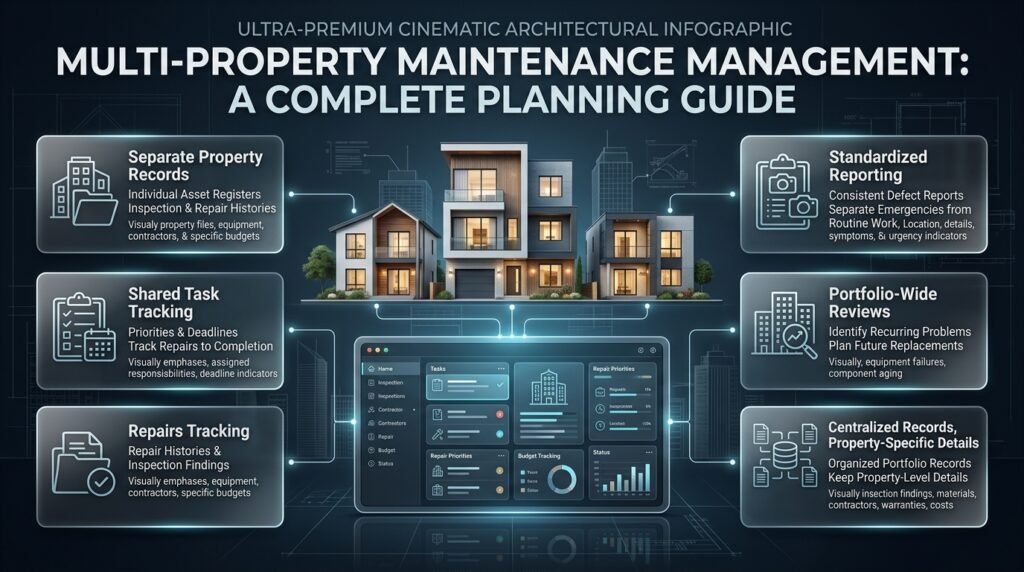
Managing several properties introduces a different challenge: the owner must keep track of different buildings, equipment, contractors, deadlines, and budgets at the same time.
The most effective solution is a consistent system that still accounts for the condition of each individual property.
Create a separate maintenance record for each property
Each property should have its own asset register, inspection history, contractor information, outstanding repairs, and maintenance budget.
This prevents information about one building from being confused with another.
Use a shared task-tracking system
A spreadsheet or property management platform can track:
- Property address or internal identification.
- Reported defect.
- Priority level.
- Date reported.
- Person responsible.
- Contractor assigned.
- Expected completion date.
- Current status.
- Final cost and completion notes.
The system should make overdue work easy to identify.
Standardize the reporting process
Occupants, tenants, and staff should know how to report maintenance problems.
A useful report identifies the location, describes the symptoms, explains when the issue started, and includes photographs when appropriate.
The process should also distinguish ordinary requests from emergencies so urgent hazards are not left waiting in a general queue.
Review patterns across properties
Repeated issues may reveal a broader problem.
If several properties experience similar plumbing failures, for example, it may be worth reviewing the age of the equipment, installation quality, water conditions, or contractor workmanship.
A portfolio-wide review can also help owners identify components that are approaching replacement age and plan expenditure before multiple failures occur.
Keep centralized records without losing property-specific details
Centralization makes administration easier, but it shouldn’t replace detailed records for individual buildings.
A roof repair, for instance, should remain linked to the specific property, inspection findings, materials used, contractor, and warranty.
This creates a more useful history for future budgeting and decision-making.
How Should You Budget for Property Maintenance and Future Repairs?
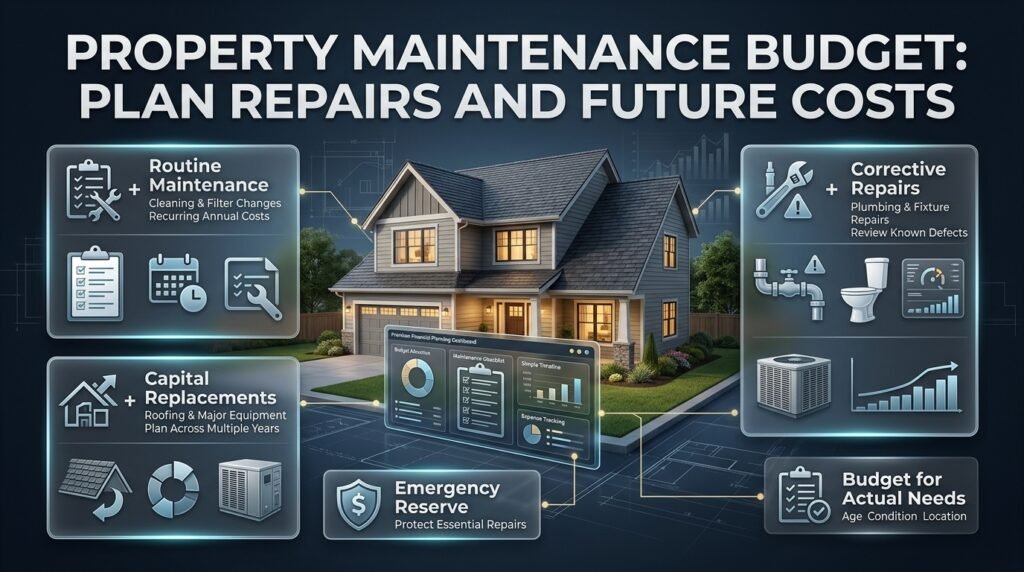
A maintenance budget should cover routine upkeep, expected repairs, professional inspections, and major replacements. The right amount depends on the property’s age, size, condition, construction, location, and maintenance history.
There is no universal figure that guarantees sufficient funding for every property. Instead, build a budget from the work the building actually needs.
Separate routine costs from major replacements
A useful property budget has three categories.
| Budget category | Examples | Planning approach |
|---|---|---|
| Routine maintenance | Cleaning, filter changes, minor adjustments | Estimate recurring annual costs |
| Corrective repairs | Plumbing repairs, damaged fixtures, defective seals | Review previous spending and known defects |
| Capital replacements | Roof, major HVAC equipment, elevators | Forecast replacement needs over several years |
Keep emergency funds separate from planned improvements where possible. This helps prevent a decorative renovation from consuming money needed to repair an essential system.
How can you estimate future replacement costs?
Start by identifying expensive components and assessing their condition.
For each item, record its age if known, recent repair history, current performance, and any professional recommendations. Obtain realistic local quotations when a major replacement may be approaching.
You can then estimate when funding may be needed and review the estimate as new information becomes available.
For example, if an inspection identifies significant roof deterioration, the owner should investigate the likely repair or replacement scope rather than assume that routine maintenance alone will resolve the issue.
Should you always repair instead of replace?
No. The decision should consider safety, reliability, repair costs, remaining useful life, and the likelihood of repeated failure.
A simple repair may be sensible when a component is otherwise in good condition. Replacement may be more practical when the component is unreliable, parts are unavailable, or the cost of repeated repairs is becoming disproportionate.
Ask a qualified professional to compare the options for expensive or safety-critical systems.
How can you reduce unnecessary maintenance spending?
- Compare quotations that cover the same scope of work.
- Investigate recurring defects rather than repeatedly patching symptoms.
- Follow equipment maintenance instructions.
- Combine compatible tasks into a single visit where practical.
- Keep accurate records of warranties and previous repairs.
- Avoid unnecessary upgrades while essential defects remain unresolved.
- Review contractor performance and the quality of completed work.
The goal isn’t to spend as little as possible every year. It’s to spend appropriately, reduce avoidable damage, and prepare for foreseeable expenses.
What Are the Responsibilities of Landlords, Tenants, and Property Managers?
Property maintenance responsibilities depend on the jurisdiction, tenancy agreement, building type, and nature of the problem. Owners and occupants should understand their respective obligations rather than assume that every repair belongs to one party.
What should landlords do?
Landlords should understand and meet their legal obligations regarding property safety, essential services, repairs, and the condition of rented accommodation.
A practical system includes:
- Providing a clear maintenance reporting process.
- Responding appropriately to urgent repair requests.
- Arranging required inspections and professional repairs.
- Keeping records of reported defects and completed work.
- Communicating access arrangements and expected repair dates.
- Reviewing recurring problems and outstanding maintenance.
Legal requirements differ by location, so landlords should verify the applicable rules rather than rely on general advice alone.
What should tenants do?
Tenants can support property care by using fixtures appropriately, keeping the property reasonably clean, reporting defects promptly, and following relevant safety instructions.
They should report problems such as water leaks, malfunctioning essential equipment, damaged locks, or suspected electrical hazards without unnecessary delay.
Tenants should not attempt hazardous repairs themselves or assume that a problem is their responsibility simply because it occurs inside the rented property.
What should property managers do?
Property managers typically coordinate maintenance requests, contractor appointments, approvals, inspections, and records according to their management agreement and legal responsibilities.
They should ensure that urgent problems receive appropriate attention and that ordinary requests are tracked until completion.
A request should not be considered resolved merely because a contractor was contacted. The manager should confirm what happened, record the outcome, and arrange further action if necessary.
Common Property Maintenance Mistakes and How to Avoid Them
Even owners who understand maintenance basics can make decisions that increase long-term costs. The following mistakes are particularly important to avoid.
1. Treating every defect as equally urgent
A scuffed wall and an active plumbing leak require different responses.
Why it happens: Owners may use one general list without distinguishing safety risks from cosmetic work.
Why it matters: Important repairs can be delayed while time and money are spent on less urgent tasks.
How to avoid it: Classify defects according to safety, potential damage, urgency, and consequences of failure.
2. Ignoring maintenance documentation
Without records, owners may forget when equipment was serviced or whether a recurring defect has already been investigated.
Why it happens: Small tasks seem easy to remember.
Why it matters: Important follow-up work may be missed, and repair decisions become less informed.
How to avoid it: Record dates, costs, findings, photographs, and recommendations after every significant inspection or repair.
3. Choosing contractors only by price
The cheapest quotation may exclude important work or specify unsuitable materials.
Why it happens: Owners naturally want to control costs.
Why it matters: Poor-quality repairs can fail prematurely or leave the original defect unresolved.
How to avoid it: Compare the scope, qualifications, materials, warranty, and expected outcome, not just the total price.
4. Delaying repairs because the property still works
A system may continue operating despite deteriorating components.
Why it happens: Owners assume that visible failure is the only reason to arrange maintenance.
Why it matters: A defect may worsen before it becomes obvious.
How to avoid it: Follow recommended inspections and respond to unusual performance, recurring moisture, and other warning signs.
5. Spending the maintenance budget on cosmetic upgrades
Fresh paint and new fixtures can improve appearance, but they don’t compensate for an unsafe or deteriorating building.
Why it happens: Decorative improvements offer immediate visual results.
Why it matters: Essential repairs may become more expensive if postponed.
How to avoid it: Fund safety-related work, active defects, and essential systems before optional upgrades.
6. Assuming one checklist works for every building
Different buildings have different maintenance requirements.
Why it happens: General checklists are convenient.
Why it matters: Important local risks or property-specific defects may be overlooked.
How to avoid it: Use a general checklist as a starting point, then adapt it to the property’s design, equipment, climate, age, and history.
Professional Recommendations for Better Long-Term Property Care
Experienced maintenance planning relies on a few consistent principles: understand the asset, document its condition, act on meaningful warning signs, and make decisions based on evidence.
Prioritize the building envelope
Roofing, exterior walls, windows, doors, and drainage protect the building from weather and moisture. Defects in these areas can affect several interior components at once.
Inspect visible areas safely and investigate water penetration promptly. Where the cause is uncertain, seek a professional assessment before repairing cosmetic damage.
Make access part of maintenance planning
Essential systems should be accessible for inspection and servicing.
When renovating or upgrading a property, consider access to plumbing connections, equipment filters, valves, drainage points, and service panels. Concealing every component behind permanent finishes may make future repairs more difficult.
Planning access during construction or renovation can reduce unnecessary disruption later.
Use evidence to decide when to replace equipment
Avoid replacing every component based only on its age. Equally, don’t keep repairing an unreliable component simply because it hasn’t reached an assumed service-life limit.
Use inspection findings, repair history, operating performance, safety considerations, and professional recommendations to make a balanced decision.
Address the cause, not just the visible damage
Recurring stains, peeling finishes, repeated drain blockages, and persistent odors can all indicate underlying problems.
A professional should investigate when the source is uncertain or when previous repairs haven’t solved the issue.
A lasting solution is generally more useful than repeatedly restoring the visible surface.
Review maintenance performance annually
At the end of each year, examine what was completed, which tasks were missed, how much was spent, and which defects returned.
Ask yourself:
- Which repairs could have been identified earlier?
- Which systems need closer monitoring?
- Did contractor work meet the agreed requirements?
- Are major replacements approaching?
- Does the budget reflect actual property needs?
- Should the inspection schedule change?
This review turns maintenance history into a practical planning tool.
For further guidance on planning property improvements alongside long-term ownership decisions, visit Blog Home Ideas TheHomeTrotters. You can also explore its Property and Real Estate Guide for related property topics.
How Often Should a Property Be Inspected and Maintained?
A property should be inspected regularly throughout the year, with the frequency depending on its age, condition, location, and the type of systems installed. Monthly visual checks can help identify visible leaks, damaged fixtures, unusual odors, and other developing problems. Seasonal inspections are useful for preparing the building for changing weather, while annual reviews can provide a broader assessment of its overall condition. However, properties with older plumbing, previous water damage, or known structural concerns may require more frequent professional inspections.
A reliable maintenance schedule should also follow manufacturer recommendations for equipment servicing and any applicable legal inspection requirements. Rather than waiting for an annual review to discover a problem, property owners should investigate new warning signs as soon as they appear.
Practical maintenance recommendations:
Inspect accessible plumbing, windows, doors, and visible interior surfaces regularly.
Arrange professional servicing for essential equipment according to its maintenance requirements.
Check roofs and drainage systems seasonally and after significant weather events when appropriate.
Record inspection dates, defects, repair costs, and recommended follow-up work.
Adjust the maintenance schedule whenever the property’s condition or usage changes.
What Are the Most Important Property Maintenance Tasks to Prevent Expensive Repairs?
The most important maintenance tasks are those that protect the building from safety hazards, water damage, structural deterioration, and failures of essential systems. Water leaks, blocked drainage, damaged roof coverings, neglected air conditioning equipment, and electrical faults can create problems that extend beyond the original defect. Addressing these issues early can reduce disruption and help control repair expenses.
Property owners should pay particular attention to areas where a small defect can affect several building components. For example, water entering around a window may damage the surrounding wall, interior finishes, and insulation if the underlying seal or installation problem remains unresolved. Similarly, repeatedly resetting a circuit breaker without investigating the cause can leave a potentially serious electrical fault unaddressed.
High-priority maintenance tasks include:
Repairing active leaks and investigating persistent dampness.
Monitoring visible roof, wall, and foundation changes.
Maintaining plumbing, drainage, and air conditioning systems appropriately.
Responding promptly to electrical warning signs and other safety concerns.
Checking safety devices according to manufacturer instructions.
Investigating recurring defects instead of repeatedly applying temporary fixes.
The best approach is to prioritize work according to safety, the likelihood of further damage, and the consequences of failure. Cosmetic improvements can usually wait when essential repairs remain outstanding.
How Much Should I Budget for Property Care and Maintenance Each Year?
Annual property maintenance costs vary according to the building’s size, age, condition, location, construction materials, and installed equipment. A newer property in good condition may require relatively little corrective work in a typical year, while an older building with deteriorating roofing, aging plumbing, or unreliable mechanical systems may need a substantially larger budget. For this reason, there is no single annual amount that suits every property.
A practical budget should be based on actual maintenance history, current inspection findings, local contractor quotations, and the expected replacement needs of major components. Owners should distinguish recurring expenses, such as routine servicing, from unpredictable repairs and larger future projects. Keeping these categories separate makes it easier to understand where the money is going and prepare for significant expenses.
A practical way to organize your maintenance budget:
Routine expenses: Regular servicing, cleaning, minor adjustments, and basic maintenance supplies.
Repair expenses: Plumbing problems, damaged fixtures, faulty equipment, and other corrective work.
Replacement reserves: Future expenditure on major components such as roofing, water heaters, or air conditioning systems.
Emergency allowance: Funds available for unexpected failures that cannot reasonably be scheduled.
Review the budget at least annually and update it whenever an inspection identifies new risks. Avoid postponing essential repairs simply to remain within an unrealistic spending target. A realistic budget should reflect the property’s actual condition and help you make informed decisions about both immediate repairs and long-term ownership costs.
Should I Handle Property Maintenance Myself or Hire a Professional?
The right choice depends on the task’s complexity, safety risks, your experience, and any applicable licensing requirements. Many everyday activities, such as cleaning accessible surfaces, checking visible plumbing for leaks, replacing a compatible light bulb, or maintaining an accessible air conditioning filter, may be suitable for homeowners who follow the manufacturer’s instructions. These tasks can help keep the property in good condition without requiring a contractor for every minor issue.
However, work involving electrical wiring, gas installations, structural components, significant plumbing failures, or repairs at dangerous heights requires greater caution. Attempting a complex repair without the necessary knowledge can create safety hazards, cause further damage, or lead to problems with warranties and regulatory compliance. Professional diagnosis is especially valuable when a defect keeps returning or its underlying cause is unclear.
Use these guidelines when deciding between DIY and professional maintenance:
Handle simple, low-risk tasks only when you understand the correct procedure.
Hire qualified professionals for specialist work and regulated installations.
Request detailed quotations for substantial repairs so the scope and costs are clear.
Check relevant qualifications, insurance, and warranty terms where appropriate.
Keep receipts and service records for important repairs.
Seek professional advice when a problem affects safety or continues after an attempted repair.
DIY maintenance can be useful, but saving money should never come at the expense of safety or repair quality. For complicated or potentially hazardous problems, a qualified professional is usually the more responsible choice.
How Can Regular Property Maintenance Protect Resale Value and Rental Income?
Regular property maintenance helps preserve the building’s condition, functionality, and appearance, which can influence how prospective buyers and tenants evaluate it. Properties with functioning essential systems, well-maintained exterior surfaces, clean interiors, and documented repair histories are generally easier to present than properties with visible deterioration and unresolved defects. Maintenance can also help reduce avoidable interruptions caused by equipment failures or urgent repairs.
For landlords, a reliable maintenance process supports tenant satisfaction by helping ensure that reported problems receive appropriate attention. For homeowners preparing to sell, resolving important defects and organizing service records can help answer questions about the property’s condition. Nevertheless, maintenance does not guarantee a higher selling price or a particular rental return. Market demand, location, comparable properties, operating expenses, and the quality of the building also influence financial outcomes.
Maintenance actions that support long-term property performance:
Resolve water leaks, safety concerns, and essential system failures promptly.
Maintain roofs, windows, drainage, and exterior finishes appropriately.
Keep accurate records of significant repairs, inspections, and equipment servicing.
Address tenant maintenance requests through a clear reporting process.
Prioritize repairs that protect the building before spending heavily on decorative upgrades.
Review future replacement costs when planning improvements or preparing to sell.
A well-maintained property is not simply one that looks attractive. It is a property whose important systems work properly, whose defects are managed responsibly, and whose owner understands the likely costs of keeping it in good condition.
Conclusion: Build a Smarter Property Care and Maintenance Plan
Effective property care and maintenance is about more than fixing problems when they arise. It involves understanding how a property functions, identifying potential risks early, scheduling routine inspections, managing repair costs, and making informed decisions about long-term improvements. Whether you own a family home, manage a rental property, or oversee multiple buildings, a proactive maintenance strategy can help prevent avoidable damage, improve safety, and keep everyday living spaces comfortable and functional.
The most practical approach is to create a maintenance schedule based on the property’s age, condition, location, and major systems. Prioritize urgent issues such as water leaks, electrical hazards, structural concerns, and heating or cooling failures. At the same time, keep records of inspections, contractor work, warranties, and expenses so you can make better decisions about future repairs. Routine tasks may seem minor individually, but addressing them consistently can reduce the likelihood of expensive emergencies and extend the useful life of important property components.
Property maintenance also works best when it is supported by realistic budgeting and reliable professional assistance. Set aside funds for routine servicing as well as unexpected repairs, compare contractor qualifications before hiring, and understand when a task requires specialist expertise. If you rent out a property, clear communication with tenants and prompt attention to reported problems can help protect the building while supporting a better rental experience.
For additional inspiration and practical guidance, explore Blog Home Ideas TheHomeTrotters for ideas that support better property decisions, home improvement planning, and everyday living. You can also connect maintenance planning with Home Interior Ideas, Residential Architecture Ideas, Build & Renovate Construction, and the Property and Real Estate Guide to develop a more complete understanding of how property condition, design, construction, and ownership decisions work together.
Ultimately, a well-maintained property is the result of consistent attention, thoughtful planning, and timely action—not simply a large repair budget. Start with a basic inspection, organize the most important maintenance tasks, and build a schedule you can realistically follow. By taking these steps, you can protect your property’s condition, manage costs more confidently, and create a safer, more reliable space for years to come.
5 Responses