Introduction
Home Interior Ideas | A home can have expensive furniture, fresh paint, beautiful flooring, and carefully chosen decorations and still feel strangely unfinished. You may look around and think, “Something is missing,” but you can’t immediately identify what it is.
Usually, the problem isn’t that you need more decoration. It’s that the different parts of the room aren’t working together.
The sofa may be too large for the space. The lighting may be too harsh. The colors may have been chosen separately instead of as a complete palette. Storage may be insufficient, leaving everyday items visible everywhere. Or the furniture may look attractive individually but create an awkward walking path when placed together.
That is why good home interior ideas begin with planning rather than shopping.
A successful interior should look good, but it should also support the way you actually live. It needs comfortable furniture, sensible circulation, useful storage, appropriate lighting, practical materials, and enough personality to feel like your home.
If you’re looking for more inspiration before starting, you can also explore BlogHomeIdeasTheHomeTrotters for additional home improvement and interior inspiration.
This guide takes a complete approach to home interiors. Instead of simply giving you a list of decorations, we’ll look at how to make better decisions about the entire space—from the first measurements to the final accessories.
What Makes a Home Interior Look Beautiful and Feel Comfortable?
A beautiful home interior combines function, proportion, visual balance, comfort, lighting, color, materials, and personality. No single furniture piece or decorating trick can make an entire home successful. The strongest interiors work because their individual decisions support one another.
Think of your interior as a system.
The floor affects the furniture you choose. The furniture affects the rug size. The rug influences the visual balance of the seating area. The wall color changes how the flooring and furniture appear. Lighting changes how all of those colors and materials look at different times of the day.
This is why buying items one by one without an overall plan can create a disconnected result.
A well-designed interior usually has:
- A clear purpose for every room
- Furniture that fits the available space
- Comfortable circulation
- A controlled color palette
- Several layers of lighting
- A sensible storage strategy
- A mixture of textures
- A clear focal point
- Materials that suit the household
- Decorative objects with some personal meaning
The goal isn’t perfection.
The goal is to make the home feel intentional.
Current interior guidance continues to emphasize the same fundamentals: thoughtful layouts, coordinated palettes, natural textures, layered lighting, and restraint tend to create more successful interiors than simply filling rooms with fashionable objects.
How Should You Start Planning Your Home Interior?
Start with the way you use your home, not with a shopping list. Before choosing paint, furniture, or accessories, identify the purpose of every room, measure the available space, understand circulation, and decide which existing elements you want to keep.
This approach saves money because you’re making decisions in the correct order.
Step 1: Understand how you live
Ask practical questions:
- Who uses the room?
- How many people use it regularly?
- Is the room mainly for relaxing, entertaining, working, sleeping, or eating?
- Are children using the space?
- Are pets part of the household?
- Does the room need flexible furniture?
- Do you regularly host guests?
- Is storage currently a problem?
A family living room has different requirements from a formal sitting room.
A bedroom used only for sleeping has different needs from a bedroom that also contains a desk, dressing area, and extensive clothing storage.
Step 2: Measure everything important
Record:
- Room width
- Room length
- Ceiling height
- Door positions
- Window positions
- Door swing
- Electrical outlets
- Heating or cooling equipment
- Built-in cabinets
- Structural columns
- Existing furniture dimensions
Don’t rely on visual estimates.
A sofa that “looks like it will fit” can create serious problems once you account for door openings and walking space.
Step 3: Identify what must stay
If you’re redesigning an existing home, determine which elements are fixed.
These might include:
- Flooring
- Kitchen cabinets
- Built-in wardrobes
- Architectural features
- Windows
- Doors
- Bathroom fixtures
- Existing lighting points
Your new design should work with those elements instead of fighting against them.
Step 4: Establish priorities
Not every room needs a complete makeover.
Maybe your living room needs better seating, while your bedroom only needs improved lighting.
Rank improvements as:
- Essential
- Functional improvement
- Visual improvement
- Optional decoration
This prevents your budget from disappearing into accessories before important problems are solved.
💡 Pro Tip: If you can only afford three changes, choose the three that improve how you use the room every day. A better layout, comfortable seating, and improved lighting usually provide more long-term value than a collection of decorative objects.
How Do You Choose an Interior Design Style?
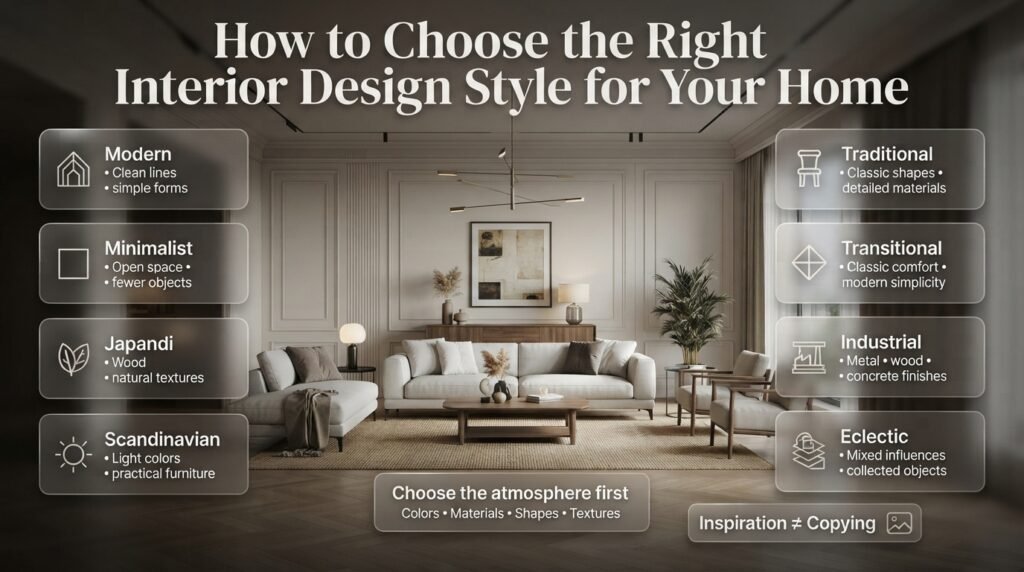
Choose a design style by identifying the atmosphere you want rather than selecting a label first. Think about colors, materials, furniture shapes, textures, and the level of decoration you naturally prefer.
Popular directions include:
| Interior Style | Main Characteristics | Overall Feeling |
|---|---|---|
| Modern | Clean lines, simple forms, restrained decoration | Clean and current |
| Contemporary | Flexible, refined, mixed materials | Sophisticated |
| Minimalist | Limited objects, simple forms, open space | Calm |
| Japandi | Wood, natural textures, simplicity | Warm and peaceful |
| Scandinavian | Light colors, wood, practical furniture | Bright and comfortable |
| Traditional | Classic shapes, detailed materials | Formal and timeless |
| Transitional | Traditional comfort + modern simplicity | Balanced |
| Industrial | Metal, wood, concrete-inspired finishes | Urban |
| Organic Modern | Natural materials and soft forms | Relaxed |
| Eclectic | Multiple influences and collected objects | Personal |
You don’t have to follow one style perfectly.
In fact, homes often look more natural when different influences are combined carefully.
For example, you might have:
- A contemporary sofa
- A traditional wooden console
- A natural fiber rug
- Modern lighting
- Vintage artwork
The room can still look cohesive if the colors, proportions, and materials relate to one another.
Avoid choosing a style based only on photographs
A photograph doesn’t show:
- How comfortable the sofa is
- How difficult the material is to clean
- How much storage the room has
- How the space works at night
- How furniture affects circulation
- Whether the style suits your lifestyle
Use inspiration images to identify what you like, not to copy an entire room.
How Do You Create a Whole-Home Color Palette?
Choose the main color direction for the home before selecting individual room colors. The palette doesn’t have to be identical in every room, but repeating a few colors, materials, or finishes creates visual continuity.
A simple whole-home palette might include:
- Warm white or cream as a base
- Natural wood as a recurring material
- Beige or taupe as a secondary neutral
- Muted green as an accent
- Black or bronze in small details
Then individual rooms can interpret that palette differently.
For example:
Living room: beige + wood + olive
Bedroom: cream + wood + muted green
Kitchen: warm white + wood + black
Bathroom: warm stone + cream + bronze
The rooms aren’t identical, but they feel related.
Should every room use the same colors?
No.
Using exactly the same colors everywhere can make the house feel repetitive.
Instead, repeat relationships.
If your home uses warm wood throughout, that wood can connect different rooms even when the wall colors change.
If you use a particular accent color in the living room, it might appear as a small cushion or artwork detail in another room.
Test paint before committing
Paint samples under different lighting conditions.
Look at them:
- In morning daylight
- In afternoon daylight
- At night
- Under warm artificial lighting
- Beside your flooring
- Beside furniture
- Near curtains
Paint colors can appear noticeably different depending on natural and artificial light, so testing them in the actual room is more reliable than judging a small color card alone.
⚠ Common Mistake: Choosing a wall color because it looks attractive in a showroom or online photograph without checking how it behaves in your own room.
What Are the Best Living Room Interior Ideas?
The best living room interiors begin with conversation, circulation, comfort, and a clear focal point. Decoration comes after the seating arrangement has been solved.
Start with the largest piece.
Usually that’s:
- A sofa
- A sectional
- A pair of sofas
- A sofa and chairs
Then determine where people will sit and how they will move through the room.
Create a defined seating zone
Instead of placing every piece around the perimeter, create a connected arrangement.
For example:
              TV / ART
        ┌─────────────────┐

             SOFA
        ┌───────────────┐
        │               │
        └───────────────┘

       CHAIR     TABLE     CHAIR

              ENTRY
The exact arrangement depends on your room.
The important principle is that the seating should feel like a group rather than unrelated furniture pushed against different walls.
Don’t forget the conversation distance
If people are sitting extremely far apart, the room becomes less social.
If everything is packed together, movement becomes difficult.
A useful starting point for major walking routes is roughly 36 inches, but the actual requirement depends on the room, household, furniture, and accessibility needs. Professional space-planning guidance similarly emphasizes clear traffic paths and furniture scaled to the room.
Choose the right coffee table
A coffee table should be accessible from the main seating without blocking movement.
Consider:
- Table height
- Table length
- Distance from seating
- Shape
- Clearance around it
- Household habits
A family with young children may benefit from softer corners.
A formal living room may accommodate a more sculptural table.
Make the rug large enough
A small rug floating under a coffee table can visually disconnect the seating arrangement.
Whenever possible, allow the rug to connect at least the major pieces of the seating group.
If budget is limited, prioritize a practical rug size over an expensive tiny rug.
How Can You Make a Small Living Room Feel Larger?

The best small living room ideas focus on reducing visual obstruction and improving proportion rather than simply filling the room with “space-saving” products.
Use appropriately scaled furniture
Small doesn’t automatically mean tiny.
A room filled with several miniature furniture pieces can actually look more crowded because every piece creates another visual interruption.
One appropriately sized sofa with one chair may work better than a sofa, loveseat, two chairs, ottoman, and several tables.
Keep pathways obvious
You should be able to understand how to move through the room immediately.
Don’t place furniture where people naturally need to walk.
Use visual lightness
Furniture with:
- Visible legs
- Slim profiles
- Open bases
- Glass or lighter surfaces
can sometimes make a room feel less visually heavy.
Use mirrors strategically
A mirror can reflect light and create additional visual depth.
The best placement isn’t automatically “opposite every window.”
Instead, consider what the mirror will reflect.
Reflecting a bright window, attractive artwork, or a well-designed part of the room can be useful.
Reflecting clutter isn’t.
📌 Quick Tip: In a small room, don’t start by asking what else you can add. Ask what can be removed without reducing comfort or functionality.
What Are the Best Bedroom Interior Ideas?
A bedroom should support rest first and decoration second. Begin with the bed position, circulation, storage, lighting, privacy, and comfort before choosing decorative details.
The bed is usually the visual and functional anchor.
Consider:
- Where the bed faces
- Window position
- Door location
- Wardrobe access
- Bedside space
- Natural light
- Nighttime lighting
- Electrical outlets
Create balanced bedside zones
Matching nightstands aren’t mandatory, but balance is helpful.
You can have:
- Two identical nightstands
- Two different nightstands with similar visual weight
- One nightstand plus a wall-mounted shelf
- One side table and one built-in solution
The goal is convenience rather than symmetry for its own sake.
Use layered bedroom lighting
A bedroom shouldn’t depend entirely on one bright ceiling fixture.
Consider:
- Ceiling or ambient lighting
- Bedside lamps
- Wall sconces
- Accent lighting
- Wardrobe lighting
This allows the room to shift from functional during the day to relaxing at night.
Keep the bedroom visually quiet
Avoid turning every wall into a feature wall.
Too many patterns, colors, decorations, and statement objects can make the bedroom feel visually active when the goal is relaxation.
Use texture instead.
A simple combination of:
- Linen
- Wood
- Upholstery
- Soft bedding
- A rug
- Curtains
can create depth without visual chaos.
How Can You Improve a Home Kitchen Interior?
A kitchen needs to look good, but its success depends heavily on workflow. Cooking, washing, preparing food, storing ingredients, and moving between appliances should feel logical.
Start with the work zones.
Think about:
- Refrigerator
- Sink
- Preparation area
- Cooktop
- Oven
- Storage
- Waste and recycling
- Small appliances
Keep frequently used items accessible
Don’t store everyday items in difficult-to-reach cabinets simply because they look cleaner.
A beautiful kitchen that makes basic cooking frustrating isn’t a successful kitchen.
Use vertical storage
If floor space is limited, consider:
- Tall cabinets
- Open shelves where appropriate
- Pantry systems
- Pull-out storage
- Wall-mounted organizers
- Upper cabinets
But don’t fill every vertical surface.
Negative space is useful too.
Keep countertops visually controlled
Countertops naturally collect objects.
Choose which appliances should remain visible and which can be stored.
If you use a coffee machine every morning, keeping it accessible may be practical.
If an appliance is used twice a month, it doesn’t necessarily need permanent countertop space.
What Are Good Dining Room Interior Ideas?
A dining room should make sitting, serving, eating, and conversation comfortable.
The dining table should be selected according to:
- Number of regular users
- Number of occasional guests
- Available room
- Chair dimensions
- Circulation
- Storage requirements
Don’t buy the table first without measuring the chairs
The table itself isn’t the only space requirement.
You also need room for:
- Pulling chairs out
- Sitting comfortably
- Walking behind seated people
- Serving food
A dining room with a beautiful table but insufficient clearance quickly becomes frustrating.
Use lighting to define the dining zone
A pendant or chandelier can visually anchor the dining table.
Its size should relate to the table and room rather than being selected independently.
⭐ Expert Tip: In an open-plan home, a dining light can act as a visual marker that tells the eye, “This is the dining area,” even when there are no physical walls.
How Should You Design a Home Office?
A home office should balance productivity with comfort. The desk and chair are the starting points, but lighting, cable management, storage, background appearance, and acoustics also matter.
Prioritize ergonomics
A beautiful desk doesn’t compensate for an uncomfortable working position.
Consider:
- Desk height
- Chair support
- Monitor position
- Screen glare
- Foot position
- Keyboard placement
Control visual distractions
If your office is part of another room, closed storage can hide paperwork and equipment.
Use shelves for things you actually want to display.
Don’t automatically turn every shelf into a storage dump.
Plan video-call backgrounds
If you regularly work remotely, the wall behind your desk becomes part of your professional environment.
A simple background can include:
- Artwork
- A small shelf
- Books
- A plant
- Architectural detail
Avoid placing dozens of unrelated objects behind you.
What Are the Best Entryway Interior Ideas?
The entryway sets the tone for the home, but its most important function is practical.
People need somewhere to put:
- Shoes
- Keys
- Bags
- Coats
- Umbrellas
- Everyday accessories
If these items don’t have a designated location, they will naturally spread into the rest of the home.
Combine open and closed storage
Open storage is convenient for everyday items.
Closed storage hides visual clutter.
A useful entryway may include:
- Bench
- Shoe storage
- Hooks
- Closed cabinet
- Mirror
- Small tray
- Wall lighting
Make the entryway easy to maintain
If putting something away requires several steps, people are less likely to do it.
The best storage solution is usually the one that fits the household’s actual habits.
How Can You Make a Bathroom Look More Elegant?
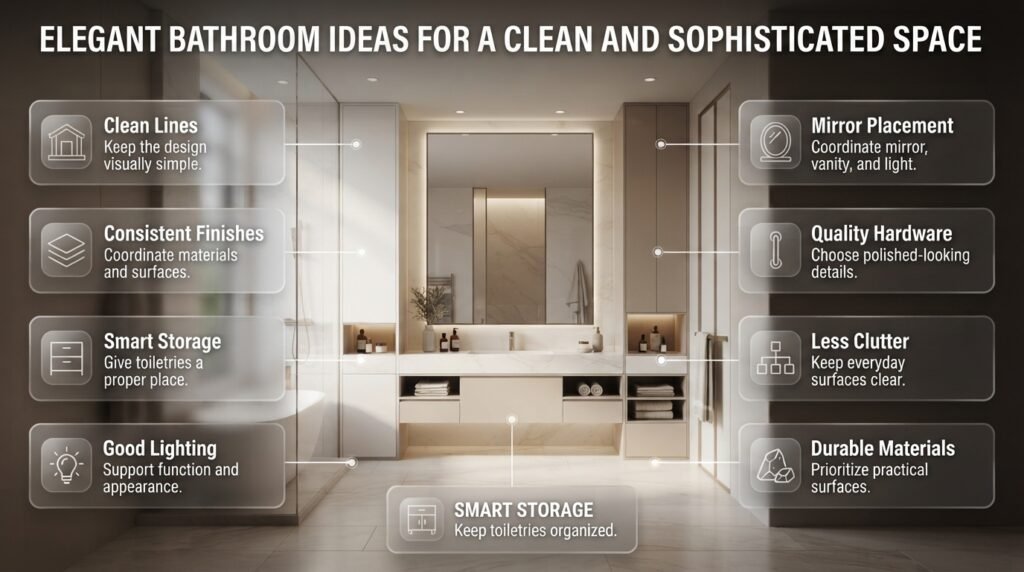
A bathroom benefits from visual simplicity, practical storage, good lighting, and durable materials.
You don’t need an enormous budget to create a polished bathroom.
Focus on:
- Clean lines
- Consistent finishes
- Well-planned storage
- Good mirror placement
- Appropriate lighting
- Quality-looking hardware
- Limited visual clutter
Use the mirror strategically
The bathroom mirror is both functional and visual.
Consider:
- Width
- Height
- Lighting around it
- Cabinet integration
- Reflection
- Cleaning requirements
Avoid choosing a mirror purely because its frame looks attractive.
It should work with the vanity and lighting.
Don’t underestimate storage
A bathroom becomes messy quickly when toiletries have nowhere to go.
Use:
- Vanity drawers
- Recessed storage
- Tall cabinets
- Mirrored cabinets
- Built-in niches where appropriate
How Do You Make Open-Plan Interiors Feel Organized?
Open-plan homes can feel spacious but sometimes lack visual definition. The solution isn’t necessarily to add walls. Instead, use furniture placement, rugs, lighting, materials, and color to establish zones.
For example:
┌─────────────────────────────────────┐
│                                     │
│       LIVING AREA                   │
│       SOFA + RUG                    │
│                                     │
│---------------- VISUAL ZONE --------│
│                                     │
│       DINING AREA                   │
│       TABLE + LIGHT                 │
│                                     │
│---------------- VISUAL ZONE --------│
│                                     │
│       KITCHEN                       │
│                                     │
└─────────────────────────────────────┘
Define zones with rugs
A rug can visually establish a living area without a physical wall.
Use lighting
Different lighting fixtures can distinguish different activities.
A pendant over the dining table and floor lamps in the living area create natural visual separation.
Use furniture orientation
The direction of a sofa can establish the edge of a living area.
Current open-plan design advice similarly emphasizes zoning through seating, rugs, lighting, color, and texture rather than relying solely on partitions.
How Important Is Lighting in Home Interior Design?
Lighting can completely change how a room looks and feels. The most effective approach is to combine general illumination with task and accent lighting rather than relying on a single ceiling fixture.
Think of lighting in layers.
Ambient lighting
This provides general illumination.
Examples:
- Ceiling fixtures
- Recessed lights
- Chandeliers
- Flush mounts
Task lighting
This helps with specific activities.
Examples:
- Desk lamps
- Reading lamps
- Under-cabinet lights
- Vanity lights
- Bedside lamps
Accent lighting
This highlights something.
Examples:
- Artwork
- Shelving
- Architectural features
- Plants
- Textured walls
Decorative lighting
The fixture itself becomes part of the design.
Examples:
- Sculptural pendants
- Statement chandeliers
- Decorative sconces
Using multiple light sources at different heights creates more visual depth than a single central fixture. Recent lighting guidance continues to recommend layered ambient, task, accent, and decorative approaches, with warm light often favored for living spaces.
💡 Pro Tip: Don’t design lighting only by asking, “Is the room bright enough?” Also ask, “Where do I want attention?” Good lighting controls the mood and visual hierarchy of the room.
How Do You Choose Interior Materials?
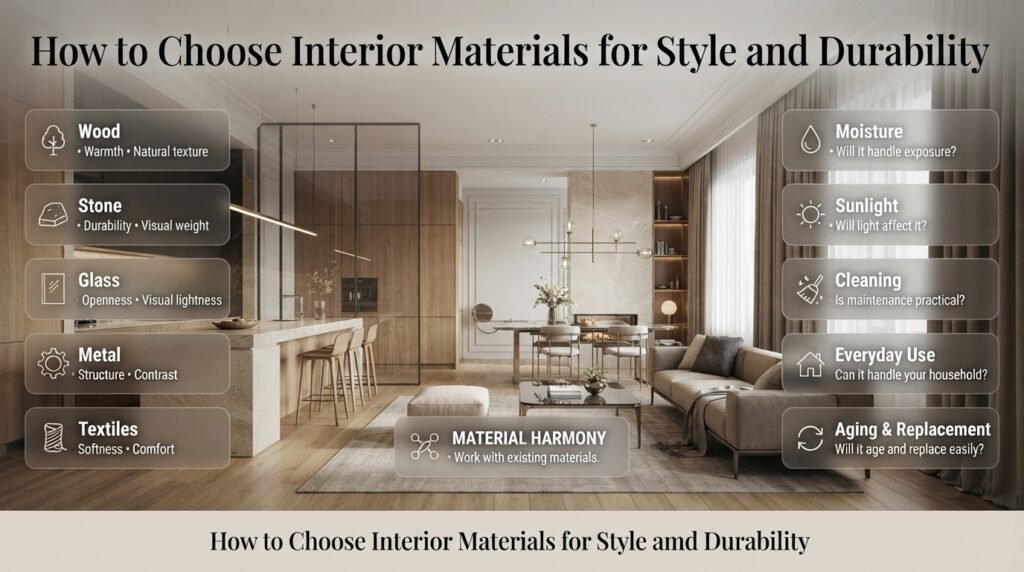
Materials influence appearance, maintenance, durability, comfort, and cost. Don’t select materials based only on how attractive they look in a showroom.
Ask:
- How often will this surface be used?
- Is it exposed to moisture?
- Is it easy to clean?
- Will sunlight affect it?
- Can it tolerate children or pets?
- Is replacement easy?
- Does it age well?
- Does it work with existing materials?
Wood
Wood adds warmth and natural texture.
It works well for:
- Flooring
- Cabinets
- Furniture
- Wall details
- Shelving
Stone
Stone can add durability and visual weight.
It may work for:
- Countertops
- Floors
- Bathroom surfaces
- Fireplace surrounds
Glass
Glass can help maintain visual openness.
Use it for:
- Shower screens
- Cabinet doors
- Tables
- Partitions
Metal
Metal introduces structure and contrast.
It can appear in:
- Hardware
- Lighting
- Furniture
- Frames
- Decorative details
Textiles
Textiles provide softness.
Use:
- Curtains
- Rugs
- Cushions
- Upholstery
- Bedding
The strongest interiors usually mix hard and soft materials rather than relying entirely on one category.
How Do You Use Texture Without Making a Room Look Busy?
Texture is especially useful when your color palette is restrained.
Imagine a neutral room containing:
- Matte painted walls
- Natural wood
- Linen curtains
- Woven rug
- Soft upholstery
- Ceramic accessories
- Metal lighting
The colors may be simple, but the room still has visual depth.
This is one reason warm, tactile interiors continue to appeal to designers: variation in texture creates richness without requiring a large number of colors.
Mix texture intentionally
Try combining:
Smooth + rough
Painted wall + woven basket
Soft + hard
Upholstery + stone table
Matte + reflective
Matte wall + glass or metal
Natural + manufactured
Wood + metal
The objective isn’t to collect as many textures as possible.
It’s to create contrast that feels controlled.
How Can You Make a Home Look More Expensive?
A sophisticated interior is usually the result of proportion, consistency, lighting, and restraint rather than simply buying expensive products.
1. Improve the lighting
Replace harsh single-source lighting with several softer layers.
2. Use larger-scale artwork
One properly sized artwork can often make a stronger statement than many tiny pieces.
3. Pay attention to curtains
Curtains can dramatically influence the perceived height and width of a room.
Where appropriate, mounting them higher and wider than the window can increase the visual sense of height and allow more daylight into the room.
4. Reduce clutter
Empty space has value.
5. Coordinate hardware
Door handles, cabinet pulls, lighting, and other visible metal elements don’t have to match perfectly, but they should feel intentional.
6. Choose furniture with good proportions
An inexpensive sofa that fits beautifully can look better than an expensive sofa that’s oversized.
7. Mix old and new
A home often gains more personality when contemporary pieces are combined with vintage or inherited objects instead of using a perfectly matched furniture set.
How Do You Decorate Without Creating Clutter?
Decorate in layers rather than filling every available surface.
Start with large visual elements:
- Furniture
- Rug
- Curtains
- Artwork
- Lighting
- Plants
- Accessories
Then step back.
You may discover that the room already feels complete.
Use the editing process
Take a photograph of the room.
Look at it on your phone.
Ask:
- What immediately attracts attention?
- Is there a focal point?
- Is anything visually unnecessary?
- Are there too many small objects?
- Is one side heavier than the other?
- Are surfaces too crowded?
Sometimes removing three objects improves the room more than buying three new ones.
📌 Quick Tip: Leave some empty space intentionally. A clear wall, open shelf, or uncluttered tabletop gives the eye somewhere to rest.
How Do You Mix Old and New Furniture?
You don’t need every piece of furniture to come from the same collection.
In fact, perfectly matched furniture can sometimes make a room feel more like a showroom than a home.
Instead, create relationships between pieces.
For example:
- Modern sofa + vintage cabinet
- Contemporary dining table + traditional chairs
- Modern bed + antique bedside table
- Minimalist lighting + classic artwork
What keeps the combination cohesive?
Use one or more of these:
- Similar wood tones
- Repeated colors
- Similar proportions
- Related materials
- Common visual weight
- Repeated metal finishes
The goal isn’t to make every item match.
The goal is to make the room make sense.
How Can You Add Personality to Your Home?
Personality comes from things that couldn’t easily belong to someone else’s home.
That might include:
- Family photographs
- Travel memories
- Artwork
- Books
- Handmade objects
- Vintage finds
- Plants
- Collections
- Cultural pieces
- Furniture with a personal story
Don’t display everything.
Choose pieces that matter.
A home becomes more convincing when it looks collected gradually rather than decorated from one shopping trip. Recent designer commentary also highlights the value of mixing old and new, meaningful objects, varied textures, and restraint.
How Can You Design a Home on a Limited Budget?
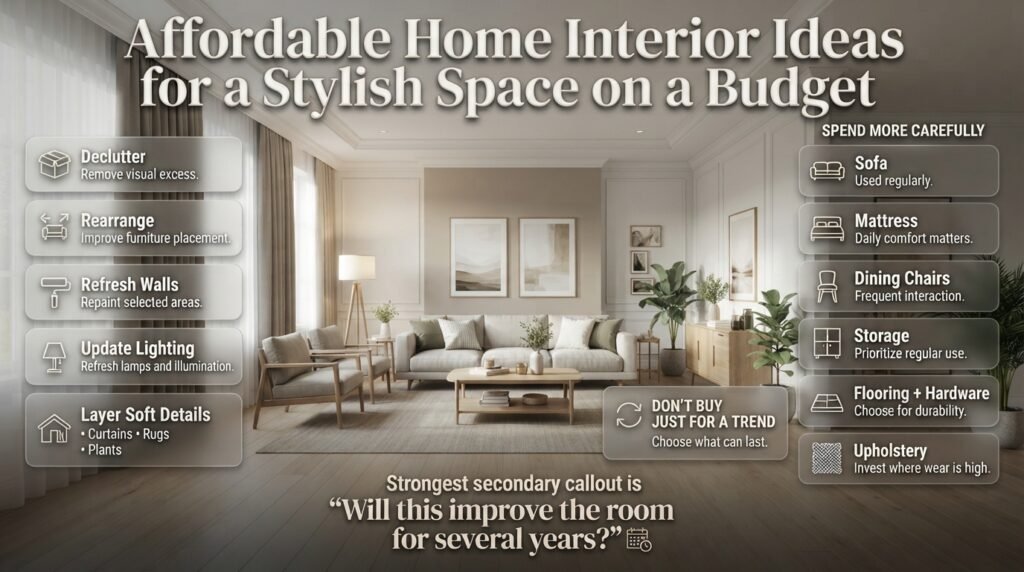
Start by separating high-impact changes from low-impact purchases.
You don’t need to renovate the entire house to change how it feels.
High-impact, relatively affordable improvements
- Decluttering
- Rearranging furniture
- Repainting selected walls
- Updating lamps
- Changing curtains
- Adding a properly sized rug
- Updating cabinet hardware
- Improving storage
- Adding plants
- Reframing artwork
Spend more carefully on
- Sofa
- Mattress
- Dining chairs
- Frequently used storage
- Flooring
- Kitchen hardware
- Durable upholstery
These are things you interact with regularly.
Don’t spend money just because a trend is popular
A trendy object that doesn’t fit your home becomes another thing you’ll eventually replace.
Instead, ask:
Will this improve the room for at least several years?
If yes, consider it.
If not, keep the purchase small and flexible.
How Do You Make a Rental Home Feel More Personal?
Rental homes often have limitations, but you can still make significant visual improvements without permanent renovation.
Consider:
- Removable wallpaper
- Temporary hooks
- Freestanding shelving
- Floor lamps
- Table lamps
- Rugs
- Curtains
- Artwork
- Plants
- Decorative mirrors
- Furniture with strong character
Focus on reversible changes
If you can’t repaint, use artwork and textiles to introduce color.
If you can’t install permanent lighting, use lamps.
If you can’t change the kitchen cabinets, update removable hardware where permitted.
If flooring is unattractive, a properly sized rug can reduce its visual dominance.
The principle is simple:
Work with the restrictions instead of fighting them.
How Can Smart Home Features Improve Interior Design?
Technology works best when it becomes less visually noticeable.
Instead of allowing cables, devices, and chargers to dominate surfaces, plan where technology will live.
Consider:
- Hidden charging stations
- Cable management
- Smart lighting
- Automated blinds
- Concealed speakers
- Smart thermostats
- Motion sensors
- Integrated entertainment systems
The goal isn’t to make the home look “technological.”
The best technology often works quietly in the background.
For example, automated lighting can help create different moods without requiring numerous visible switches or decorative devices.
How Do You Use Plants in Interior Design?
Plants add color, texture, height, and natural character.
But don’t put plants everywhere simply because “plants make a room look better.”
Choose plants according to:
- Available natural light
- Humidity
- Maintenance requirements
- Room temperature
- Available floor space
- Pet safety where relevant
Use different heights
You can combine:
- Floor plant
- Small tabletop plant
- Hanging plant
- Shelf plant
This creates visual layering.
A large plant can also fill an awkward corner without requiring another piece of furniture.
How Do You Create Better Storage Without Making a Home Look Like a Storage Area?
Good storage should reduce visible clutter while remaining easy to use.
Start by separating belongings into:
- Daily-use items
- Weekly-use items
- Seasonal items
- Rarely used items
Daily items should be easiest to access.
Rarely used belongings can be placed higher or deeper.
Use built-in storage when appropriate
Built-ins can make awkward spaces more useful.
Potential locations include:
- Under stairs
- Around doorways
- Along bedroom walls
- Entryway corners
- Home offices
- Hallways
But built-ins aren’t automatically better.
They cost more and can reduce flexibility.
Freestanding furniture may be preferable when you expect your needs or home to change.
What Are the Biggest Home Interior Mistakes?
Mistake 1: Shopping before planning
Why it happens:
Shopping feels exciting and productive.
Why it hurts:
You may end up with furniture that doesn’t fit the room.
Better approach:
Measure and plan first.
Mistake 2: Choosing furniture individually
Why it happens:
A beautiful chair looks good in the store.
Why it hurts:
It may not relate to the sofa, table, rug, or room proportions.
Better approach:
Think about the entire composition.
Mistake 3: Using too many trends
Why it happens:
Social media makes new styles look essential.
Why it hurts:
The room can quickly feel dated or visually inconsistent.
Better approach:
Use trends in flexible elements.
Mistake 4: Ignoring lighting
Why it happens:
People think lighting comes after decoration.
Why it hurts:
Even beautiful interiors can look flat or uncomfortable at night.
Better approach:
Plan lighting alongside furniture and room function.
Mistake 5: Choosing tiny rugs
Why it happens:
Smaller rugs cost less.
Why it hurts:
They can make furniture arrangements look disconnected.
Better approach:
Prioritize correct scale.
Mistake 6: Filling every wall
Why it happens:
Empty space feels unfinished.
Why it hurts:
Too much artwork creates visual noise.
Better approach:
Let some areas remain quiet.
Mistake 7: Matching everything
Why it happens:
Matching feels safe.
Why it hurts:
The room can look generic.
Better approach:
Coordinate rather than duplicate.
Mistake 8: Ignoring real-life maintenance
Why it happens:
A material looks beautiful in an inspiration photograph.
Why it hurts:
It may stain, scratch, or require maintenance you don’t have time for.
Better approach:
Choose materials based on lifestyle.
How Should You Plan a Home Interior Step by Step?
If you’re starting with an empty home or doing a major redesign, follow a clear sequence.
Step 1: Define the lifestyle
Write down how each room will be used.
Step 2: Measure the home
Create accurate dimensions.
Step 3: Identify fixed elements
Note windows, doors, plumbing, structural features, and built-ins.
Step 4: Choose the overall design direction
Decide whether the home should feel:
- Warm
- Minimal
- Traditional
- Modern
- Natural
- Formal
- Casual
Step 5: Plan furniture
Position the largest pieces first.
Step 6: Establish the color palette
Choose a connected set of colors.
Step 7: Choose materials
Coordinate wood, stone, metal, fabric, and other finishes.
Step 8: Plan lighting
Include ambient, task, accent, and decorative lighting where appropriate.
Step 9: Solve storage
Give everyday belongings logical homes.
Step 10: Add textiles
Use rugs, curtains, bedding, cushions, and upholstery to create softness.
Step 11: Add artwork and personality
Choose meaningful pieces.
Step 12: Edit
Remove anything that doesn’t improve the room.
This sequence is useful because every stage supports the next one.
You aren’t choosing curtains before knowing the furniture.
You aren’t buying artwork before understanding the wall.
You aren’t selecting accessories before solving storage.
How Do You Know When a Room Is Finished?
A room is finished when it functions comfortably, looks balanced, and doesn’t need more objects simply because there is empty space.
Ask yourself:
- Can people move comfortably?
- Is there enough seating?
- Is the lighting useful at different times?
- Is storage sufficient?
- Are colors balanced?
- Does the room have a clear focal point?
- Are surfaces unnecessarily crowded?
- Does the room reflect the people living there?
- Is there anything you added only because it was trendy?
If the answer to the last question is yes, consider removing it.
A finished room doesn’t have to look full.
Sometimes the strongest design decision is knowing when to stop.
How Can You Make Your Home Feel More Cohesive?
A cohesive home doesn’t mean every room has identical furniture or colors. It means there are enough repeated visual elements to make the entire house feel connected.
Choose a few elements to repeat.
For example:
Wood
Use a similar wood tone in:
- Living room
- Dining room
- Bedroom
Metal
Repeat one primary metal finish in:
- Lighting
- Hardware
- Small accessories
Color
Carry one accent color through different rooms in different amounts.
Texture
Natural materials can connect otherwise different rooms.
Lighting
Use a consistent warmth and general visual language.
The result is a home where each room has its own personality without feeling like it belongs to a completely different house.
For additional inspiration as you develop your overall decorating direction, BlogHomeIdeasTheHomeTrotters can be used as another source of practical home and interior ideas.
Expert Advice for Better Home Interiors
Professional-looking interiors aren’t usually created by adding more things. They’re created by making fewer decisions more carefully.
Give every room a focal point
A focal point might be:
- Fireplace
- Artwork
- Window
- Bed
- Dining light
- Architectural feature
- Feature wall
If everything is a focal point, nothing is.
Think about visual weight
A large dark cabinet has more visual weight than a small light-colored table.
If one side of the room contains several heavy elements, balance them with appropriate visual weight elsewhere.
Use repetition
Repeat:
- Color
- Shape
- Material
- Finish
- Texture
Repetition creates connection.
Create contrast
Contrast prevents the room from becoming flat.
Try:
- Light + dark
- Soft + hard
- Smooth + rough
- Matte + reflective
- Old + new
- Large + small
Don’t chase perfection
Homes are meant to be lived in.
A slightly imperfect handmade object may give a room more character than another mass-produced decorative item.
Practical Decision Table for Home Interior Projects
| If Your Problem Is… | Start With… | Avoid… |
|---|---|---|
| Room feels crowded | Furniture layout | Buying more storage without measuring |
| Room feels empty | Scale and zoning | Filling every corner |
| Room feels dark | Lighting and reflection | Only repainting immediately |
| Room feels boring | Texture and contrast | Adding random colors |
| Home feels disconnected | Repeated materials/colors | Matching every room |
| Home feels cluttered | Storage and editing | More decorative containers |
| Furniture doesn’t fit | Measurements | Guessing dimensions |
| Room feels cheap | Proportion and lighting | Buying unnecessary luxury decor |
| Home feels impersonal | Artwork and meaningful objects | Copying showroom rooms |
| Design feels dated | Flexible updates | Replacing everything |
Home Interior Ideas for Different Budgets
Low budget
Focus on:
- Decluttering
- Furniture rearrangement
- Paint
- Lighting
- Curtains
- Plants
- Artwork
- Textiles
Medium budget
Add:
- Better seating
- Quality rugs
- Improved storage
- New lighting fixtures
- Hardware upgrades
- Custom curtains
- Selected furniture pieces
Larger renovation budget
Consider:
- Built-in storage
- Flooring
- Kitchen upgrades
- Bathroom renovation
- Electrical and lighting changes
- Custom furniture
- Architectural modifications
The principle remains the same regardless of budget:
Solve the biggest problem first.
Spending more money doesn’t automatically produce a better interior.
What Are the Biggest Home Interior Trends to Consider Right Now?
The strongest interior trends aren’t simply about choosing a fashionable color or buying a trendy piece of furniture. Current design is moving toward homes that feel warmer, more personal, functional, and connected to natural materials. Instead of perfectly coordinated showroom-style rooms, homeowners are increasingly combining contemporary furniture with organic textures, vintage pieces, layered lighting, and meaningful decoration.
The important thing is to use trends selectively. A trend should improve the atmosphere or functionality of your home rather than forcing you to redesign everything whenever design preferences change.
Practical ways to use current trends:
Introduce natural wood, stone, linen, or woven textures.
Use curved or softer furniture shapes where they suit the room.
Add warmer lighting instead of relying only on bright overhead fixtures.
Mix contemporary pieces with vintage or personally meaningful objects.
Use trend-driven colors through cushions, artwork, rugs, or accessories.
Keep permanent renovations relatively timeless.
Professional advice: Treat trends as a source of inspiration, not a decorating rule. The most future-proof interior is one where the expensive, permanent elements remain relatively timeless while smaller details can change easily.
How Can I Make My Home Look More Expensive Without Spending a Lot?
A high-end-looking interior usually comes from proportion, lighting, material coordination, and visual restraint rather than the price of every individual item. A modestly furnished room can look sophisticated when the furniture fits properly, the lighting is layered, the colors work together, and unnecessary clutter has been removed.
One of the easiest improvements is to stop treating decoration as the solution to every empty space. Leaving some walls, shelves, and tabletops intentionally clear gives important objects more visual impact.
High-impact improvements to consider:
Choose furniture that is correctly scaled to the room.
Use curtains that complement the room’s height and proportions.
Replace harsh lighting with layered sources.
Select fewer, larger pieces of artwork instead of many tiny decorations.
Coordinate visible hardware and metal finishes.
Introduce natural textures such as wood, stone, linen, or woven materials.
Remove decorative items that don’t contribute to the overall design.
Invest in comfortable, frequently used furniture instead of unnecessary accessories.
Professional advice: Before spending money, photograph the room and study the image. If the space looks crowded, start by removing things. If it looks flat, consider lighting and texture. If it feels disconnected, look at color and material repetition. This approach helps you spend money on the actual problem rather than decorating blindly.
What Is the Best Way to Design a Small Home Interior?
The best small-home strategy is to maximize function while minimizing visual obstruction. A small room doesn’t necessarily need miniature furniture. In many cases, fewer appropriately scaled pieces look better and provide more usable space than a collection of small items.
Start by identifying what the room genuinely needs. If a living room only needs comfortable seating, a coffee table, lighting, and storage, don’t add additional furniture simply because there is an empty corner.
Useful small-space strategies include:
Choose furniture with dimensions appropriate to the room.
Keep major walking paths open.
Use vertical storage where floor space is limited.
Consider furniture that serves more than one purpose.
Use wall-mounted solutions when appropriate.
Choose a visually connected color palette.
Use mirrors where they create useful reflections.
Reduce unnecessary decorative objects.
Keep frequently used items easy to access.
Professional advice: Don’t measure success by how many things you managed to fit into a small room. Measure it by how comfortably the room works. A smaller home can feel significantly larger when movement is easy, storage is organized, and visual clutter is controlled.
How Do I Make Different Interior Design Styles Work Together?
Mixing design styles works best when there is a clear visual connection between the different pieces. The mistake is usually not mixing styles itself; it’s combining unrelated furniture, colors, materials, and proportions without a common thread.
A contemporary sofa can work beautifully with a traditional cabinet, for example, if the colors, scale, and materials create a relationship between them. The room should feel collected rather than accidentally assembled.
A useful approach is to choose one dominant style and introduce another style through selected furniture, artwork, lighting, or accessories.
Ways to connect different styles:
Repeat one or two colors throughout the room.
Use related wood tones.
Repeat a metal finish in small amounts.
Balance the visual weight of large furniture pieces.
Connect contrasting pieces through textiles.
Use artwork to bridge different design influences.
Avoid having several competing statement pieces.
Keep the overall color palette controlled.
Professional advice: Don’t ask whether every item “matches.” Ask whether the pieces relate. Good interiors often contain contrast, but the contrast should look intentional. Repetition creates unity while variation creates personality.
What Should I Prioritize First When Redesigning My Home?
Start with the elements that affect how you use the space every day. Layout, furniture placement, circulation, lighting, storage, and comfort should generally be addressed before decorative accessories.
A common mistake is starting with paint colors, cushions, artwork, or decorative objects because they’re easy and enjoyable to choose. But if the sofa is too large, the storage is inadequate, or the lighting is poor, those decorative changes won’t solve the underlying problem.
A practical priority order is:
Function: Decide what each room needs to accomplish.
Measurements: Record room and furniture dimensions.
Layout: Establish furniture positions and circulation.
Storage: Decide where everyday belongings will go.
Lighting: Plan ambient, task, and accent lighting.
Color: Establish the visual foundation.
Materials: Choose finishes that suit the room’s use.
Textiles: Add rugs, curtains, upholstery, and bedding.
Decoration: Finish with artwork, accessories, plants, and personal pieces.
Professional advice: Think of interior design as building from the inside out. Solve the things that are difficult or expensive to change first, then move toward flexible decorative elements. This reduces wasted spending and gives you a much stronger foundation for the finished home.
Conclusion
Creating a beautiful home interior is not about filling every room with expensive furniture, following every trend, or copying a picture from Pinterest. The best interior is one that fits the way you actually live. Good planning, balanced proportions, practical storage, suitable lighting, comfortable furniture, thoughtful colors, and personal details can make a home feel both attractive and easy to live in.
Start with the fundamentals before worrying about decorative details. Understand how each room will be used, measure the available space, establish a realistic budget, choose a consistent design direction, and then build the room layer by layer. When the foundation is right, smaller choices such as artwork, cushions, rugs, plants, and accessories become much easier.
If you want more practical inspiration for improving different parts of your home, explore the latest ideas and guides on the BlogHomeIdeasTheHomeTrotters. The goal should always be the same: create a home that looks considered, functions well, feels comfortable, and continues to work for your lifestyle over time.
Remember, great interior design does not necessarily mean having more. Sometimes the biggest improvement comes from removing unnecessary items, improving the layout, correcting the lighting, choosing better proportions, or simply giving the room enough breathing space.
The smartest approach is to make decisions based on your space, your lifestyle, your budget, and your long-term needs. Trends can provide inspiration, but a well-planned home should never feel temporary. When beauty and functionality work together, even simple interior choices can create a home that feels polished, welcoming, and genuinely yours.
13 Responses