Introduction
What to Look for Before Choosing Your Next Property | Buying a property is a major financial decision, and the excitement of finding a beautiful home can sometimes distract you from the details that matter most. A spacious living room, modern kitchen, attractive exterior, or promising location may catch your attention, but none of these features guarantees that a property is safe, affordable, or suitable for your future needs.
Understanding what to look for before choosing your next property helps you make a confident decision based on facts rather than first impressions. Whether you’re buying your first home, upgrading to a larger house, relocating to another neighborhood, or purchasing property for investment, you need to evaluate more than appearance and asking price.
The right property should fit your budget, support your lifestyle, have reliable construction, and offer a reasonable balance between present comfort and future value. It should also come with clear ownership documents and manageable maintenance responsibilities.
This guide from Blog Home Ideas TheHomeTrotters explains how to assess a property’s location, price, legal status, construction quality, layout, neighborhood, and long-term potential. You’ll also learn how to compare properties, identify warning signs, avoid common buyer mistakes, and prepare a practical checklist before making an offer.
1. What Should You Look for Before Choosing Your Next Property?
Before choosing a property, evaluate its location, total cost, structural condition, legal documentation, room layout, neighborhood, and future resale potential. The best property is not necessarily the largest or most expensive option. It’s the one that meets your essential needs, fits your finances, and offers acceptable risks and responsibilities over the period you expect to own it.
Start by identifying what you need from your next property.
For example, a family with young children may prioritize safe outdoor space, nearby schools, storage, and separate sleeping areas. Someone working remotely may need a quiet workspace, reliable internet access, and sufficient natural light. An investor may place greater importance on rental demand, operating expenses, and the ability to resell the property.
Although these buyers may look at similar houses, their priorities will be different.
Separate essential features from optional extras
Create three lists before arranging viewings.
Essential requirements
- A purchase price you can realistically afford.
- A suitable location and manageable commute.
- Sufficient bedrooms and usable living space.
- Clear legal ownership and appropriate approvals.
- Acceptable structural condition and safe utilities.
- Access to essential services.
Important preferences
- Natural light and ventilation.
- Adequate storage and parking.
- Outdoor space or a garden.
- Quiet surroundings and privacy.
- Convenient access to shops and public transport.
Optional features
- Luxury kitchen fittings.
- Decorative wall panels and premium flooring.
- Smart-home technology.
- Swimming pools and entertainment rooms.
- Designer furniture and elaborate landscaping.
This approach helps you avoid spending more simply because a property has attractive features that don’t significantly improve your daily life.
Decide which compromises are acceptable
Almost every property has limitations. One may have an excellent location but a smaller kitchen, while another offers more space but requires a longer commute.
The important question is whether a disadvantage is manageable or creates a lasting problem.
A dated bathroom can often be improved gradually. Unclear ownership, serious structural defects, or an unaffordable mortgage are much more significant concerns.
Professional advice: Establish your non-negotiable requirements before viewing properties. This gives you a consistent standard for comparing options and makes it easier to walk away when an attractive property fails an essential test.
2. Why Is Location One of the Most Important Property Factors?
Location affects convenience, transportation expenses, access to services, neighborhood conditions, and future buyer or tenant demand. Before purchasing, evaluate how easily you can reach work, schools, healthcare, shopping, and recreation. A property should suit your present routine while remaining practical if your household circumstances change.
Evaluate everyday accessibility
Think about the places you visit regularly and how often you need to reach them.
Check the distance to:
- Your workplace or main business area.
- Schools, colleges, and childcare facilities.
- Hospitals, clinics, and pharmacies.
- Grocery stores and other essential shops.
- Public transportation and major roads.
- Parks and recreational facilities.
Don’t rely entirely on advertised distances. A destination that appears close on a map may be difficult to reach because of congestion, road layouts, limited crossings, or poor transport connections.
If possible, travel the route during your normal commuting hours. This provides a more realistic understanding of the time and expense involved.
Visit the location at different times
A quiet street during a morning viewing may become noisy in the evening. Restaurants, commercial areas, schools, and busy roads can change the character of a neighborhood throughout the day.
Visit at different times to assess traffic, parking, noise, lighting, and pedestrian activity.
Also consider whether the surroundings feel comfortable for your usual activities. A property may be attractive internally but inconvenient if access roads are poorly maintained or essential services are difficult to reach.
Research future development
Planned roads, public transport connections, business districts, and community facilities can influence an area’s attractiveness. However, future development should be evaluated carefully.
Ask whether proposed projects are officially approved, funded, and scheduled. A development mentioned by a seller is not necessarily guaranteed to happen.
New construction can also bring temporary disruption, increased traffic, or changes to views and privacy.
Quick tip: Evaluate a location according to your actual routine, not simply its reputation. A less fashionable neighborhood with reliable services and convenient access may suit you better than a prestigious area with high expenses and a difficult commute.
3. How Do You Calculate the True Cost of Buying a Property?

The true cost of buying a property includes more than its advertised price. You should account for the deposit, transaction fees, financing, inspections, immediate repairs, insurance where applicable, and recurring expenses. Calculating these costs before making an offer helps you avoid purchasing a home that leaves too little money for everyday living.
Prepare a complete property budget
Begin by calculating the maximum amount you can comfortably spend without exhausting your savings.
Then identify the additional costs associated with the purchase.
| Expense | What to investigate |
|---|---|
| Purchase price | Agreed amount payable to the seller |
| Deposit | Initial contribution toward the purchase |
| Legal fees | Conveyancing and professional legal advice |
| Taxes and registration | Applicable property taxes, duties, and registration costs |
| Financing | Mortgage interest, lender fees, and related charges |
| Inspections | Building, structural, electrical, or plumbing assessments |
| Immediate repairs | Necessary work before moving in |
| Utilities | Electricity, water, heating, cooling, and internet |
| Maintenance | Routine servicing and unexpected repairs |
| Shared charges | Building management, security, or community fees |
| Emergency savings | Funds for unexpected costs or changes in income |
These expenses vary by location, property type, and financing arrangement. Confirm the relevant requirements before committing.
Calculate the monthly cost of ownership
A property may be affordable to purchase but expensive to maintain.
For example, one house might have a lower purchase price but require extensive repairs and expensive cooling. Another may cost more initially but have better insulation, recently serviced equipment, and fewer immediate maintenance requirements.
Compare both properties using realistic estimates rather than assumptions.
If you’re borrowing money, include your projected loan payment alongside food, transportation, existing debts, family expenses, savings, and other financial commitments.
A lender’s approval amount represents what it is prepared to lend under its criteria. It does not automatically establish what you should comfortably borrow.
Keep a financial reserve
Avoid using every available saving for the deposit and initial furnishing.
A reserve can help cover leaking pipes, appliance failures, urgent repairs, temporary income disruption, or unexpected transaction expenses.
Common mistake: Buyers sometimes compare properties only by their asking prices. A better approach is to estimate the total cost over the first few years, including likely maintenance and financing expenses.
4. How Can You Inspect a Property’s Structural Condition?
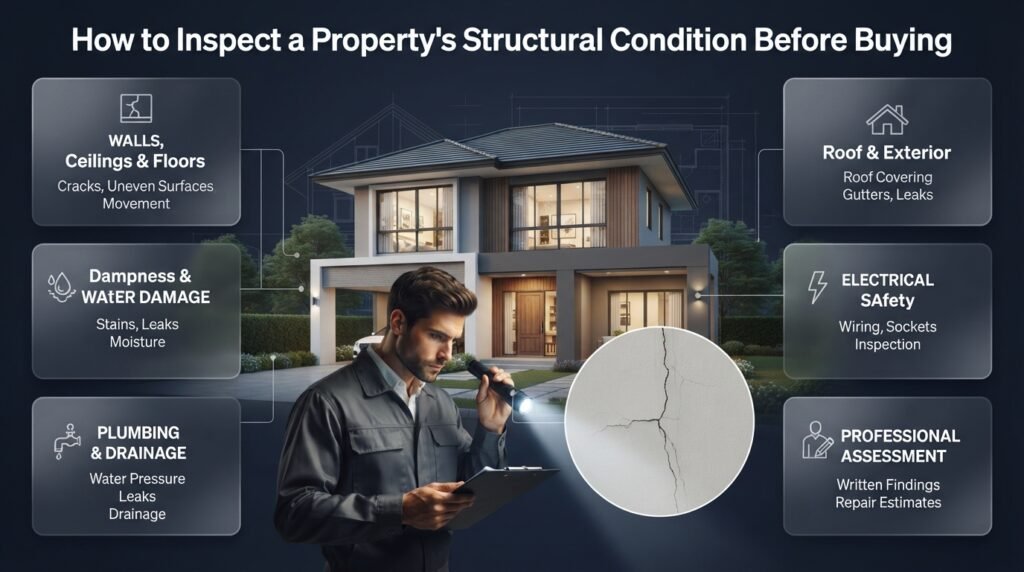
A property inspection helps identify defects that may affect safety, comfort, maintenance expenses, or resale value. Examine visible cracks, ceilings, floors, windows, drainage, plumbing, electrical installations, and the roof where accessible. For an important purchase, arrange an independent inspection by a suitably qualified professional.
Examine walls, ceilings, and floors
Look for unusual cracks, uneven surfaces, peeling paint, sagging areas, and signs of previous repairs.
Not every crack indicates a structural problem. Small surface cracks can result from ordinary material movement, drying, or changes in temperature. However, large, widening, diagonal, or recurring cracks may require professional assessment.
Check whether doors and windows open and close smoothly. Sticking frames can result from several causes, so don’t assume that a single symptom proves structural movement.
Walk through the main rooms and observe whether floors feel unusually uneven or springy.
Look for dampness and water damage
Water-related problems can damage finishes, flooring, cabinetry, and structural materials. Persistent moisture can also contribute to unpleasant odors and indoor air-quality concerns.
Inspect:
- Ceilings beneath bathrooms or roof areas.
- Walls around windows and exterior doors.
- Corners behind furniture.
- Cupboards beneath kitchen and bathroom sinks.
- Basement walls and floors, where applicable.
- Areas around water heaters and plumbing connections.
Ask the seller about previous leaks, flooding, and repairs. If an area has recently been repainted, investigate whether the work was cosmetic or part of a documented repair.
A musty smell or discolored patch doesn’t establish the exact cause, but it can justify further investigation.
Check plumbing and drainage
Turn on taps and observe the water pressure. Check whether sinks drain properly and look for visible leakage around accessible pipes.
Ask about water supply reliability, water storage arrangements, sewer connections, and any history of blocked drains.
If the property relies on a private water source or septic system, additional testing and specialist inspections may be appropriate.
Assess electrical safety
Inspect accessible switches, sockets, lighting, and the electrical distribution panel from a safe distance.
Ask whether the electrical system has been inspected and whether any upgrades or repairs were completed by qualified professionals.
Don’t remove covers, touch exposed wires, or attempt to test potentially unsafe installations yourself.
Inspect the roof and exterior
Roof leaks can lead to damaged ceilings, insulation, timber, and interior finishes.
Where accessible, look for damaged roof coverings, deteriorating gutters, blocked drainage, and visible signs of water penetration. For apartments, ask about shared roofs, lifts, exterior walls, and the responsibilities of the building management.
Expert tip: Request written estimates for significant defects. A professional assessment makes it easier to determine whether a repair is affordable, whether negotiation is appropriate, or whether the property presents too much risk.
5. Which Legal Documents Should You Check Before Buying?
Legal verification helps establish whether the seller can transfer ownership and whether restrictions, disputes, or financial claims could affect the transaction. Before making a substantial payment or signing a binding agreement, ask an independent property lawyer or qualified conveyancer to verify the relevant documents.
Confirm legal ownership
The documents required depend on the jurisdiction and property system.
They may include:
- Title deeds or official ownership records.
- Land registry extracts or equivalent registration records.
- Approved building plans and applicable permissions.
- Relevant property tax or service-charge records.
- Mortgage discharge documents, where required.
- Easements, access rights, and other restrictions.
- Documents relating to jointly owned property.
The seller’s possession of paperwork does not necessarily establish that the documents are complete or legally sufficient.
Use the appropriate official records and professional legal process to confirm ownership and identify inconsistencies.
Investigate restrictions and disputes
Ask your legal adviser to investigate issues that may affect the purchase, including outstanding mortgages, liens, boundary disputes, tenancy arrangements, planning restrictions, and unpaid obligations.
For apartments, confirm whether you are purchasing the unit itself, a share of common areas, parking rights, or other associated interests.
For newly constructed properties, verify the developer’s authority, relevant approvals, completion documentation, and applicable warranties.
Read the agreement carefully
Before signing, confirm:
- The agreed purchase price.
- The deposit amount and payment arrangements.
- The completion date.
- Responsibilities for outstanding repairs.
- Fixtures and appliances included in the sale.
- Conditions that allow termination or renegotiation.
- Any applicable inspection or financing conditions.
- The consequences of missing contractual deadlines.
The legal effect of these provisions depends on the agreement and local law.
Important: Don’t rely on verbal promises that ownership is clear or that paperwork will be completed later. Obtain independent confirmation before proceeding with a binding transaction.
6. How Do You Know Whether the Property Layout Suits Your Needs?

A suitable property layout supports your daily routines, privacy, storage needs, and future flexibility. Room dimensions, walking space, natural light, ventilation, and the relationship between living areas often matter more than the headline floor area.
Measure rooms before deciding
A bedroom may technically fit a bed while leaving little room for wardrobes or comfortable movement.
Measure important spaces and consider your existing furniture.
Check whether:
- Bedroom doors and wardrobes can open fully.
- Sofas fit without blocking circulation.
- Dining chairs can be moved comfortably.
- Kitchen appliances have adequate clearance.
- Hallways and entrances are practical.
- Storage meets your household’s needs.
For families, also consider where children will play and whether sleeping areas provide sufficient privacy.
Evaluate natural light and ventilation
Visit during daylight and observe which rooms receive direct sunlight.
Consider window orientation, neighboring buildings, privacy, and the possibility of excessive heat. Large windows can improve daylight but may also increase heat gain or reduce privacy if shading and glazing are inadequate.
Check whether rooms can be ventilated appropriately and whether bathrooms and kitchens have suitable extraction.
Think about future changes
Your needs may change because of family growth, remote work, mobility requirements, or changes in household routines.
An additional bedroom, flexible study, or accessible ground-floor living area may be useful, but these features should justify their additional purchase and maintenance costs.
For practical ideas on making rooms more functional, explore Home Interior Ideas.
7. What Should You Check About the Neighborhood?
A property’s surroundings influence privacy, convenience, noise, parking, and your overall experience of living there. Evaluate the neighborhood as carefully as the building itself, because improvements inside the property cannot resolve every problem outside it.
Assess noise and privacy
Stand outside and listen for traffic, nearby commercial activity, construction, and other recurring disturbances.
Check whether neighboring windows overlook the main living areas and whether outdoor spaces provide reasonable privacy.
If possible, visit during both busy and quiet periods.
Evaluate shared facilities
Apartment buildings and gated communities may offer security, gardens, gyms, pools, parking, and recreational facilities.
However, these amenities can involve additional expenses.
Ask about:
- Monthly or annual service charges.
- Parking allocation and visitor access.
- Building maintenance responsibilities.
- Rules for shared facilities.
- Planned repairs and improvements.
- The process for addressing resident complaints.
A well-maintained building with sensible management arrangements may be more practical than one offering more facilities but carrying substantial maintenance obligations.
Consider the wider community
Look into waste collection, street lighting, road maintenance, public services, and the availability of essential shops.
If outdoor living matters to you, consider whether the property offers usable green space or opportunities for gardening.
You can explore ideas for improving outdoor spaces in Garden and Outdoor Living Ideas.
8. Is an Older Property Better Than a Newly Built Home?
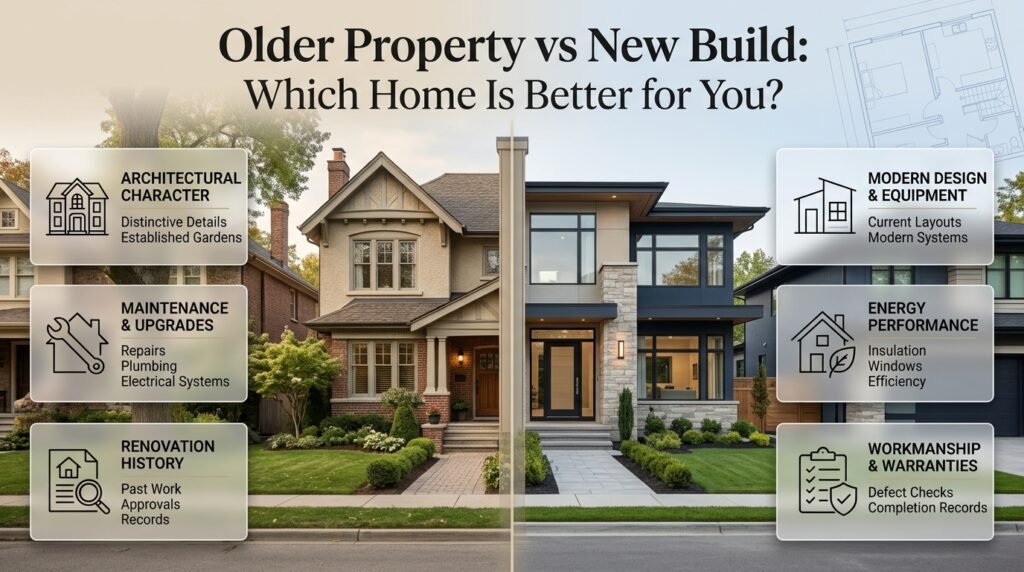
Neither an older property nor a newly built home is automatically the better choice. The right decision depends on construction quality, maintenance history, location, layout, energy performance, and your budget for repairs and improvements.
Benefits and concerns of older properties
Older properties may offer established neighborhoods, mature gardens, generous room proportions, and distinctive architectural details.
However, they may require improvements to plumbing, electrical installations, insulation, heating, cooling, windows, or drainage.
Ask for records of major repairs and determine whether alterations received the required approvals.
Pay particular attention to materials and systems that may be nearing the end of their useful life.
Benefits and concerns of new construction
New properties may provide contemporary layouts, modern equipment, improved insulation, and warranties.
Nevertheless, new construction can still contain defects involving waterproofing, workmanship, drainage, finishing, or installation.
Inspect the property before handover and establish how outstanding defects will be documented and addressed.
| Consideration | Older property | Newly built property |
|---|---|---|
| Architectural character | Often distinctive | Usually contemporary |
| Immediate maintenance | May need upgrades | May have fewer initial needs, but defects remain possible |
| Energy performance | Depends on construction and improvements | May meet newer standards |
| Surroundings | Often established | Development may still be ongoing |
| Documentation | Check renovation history | Check approvals and completion records |
| Main concern | Deterioration and outdated systems | Workmanship and unresolved defects |
For more information about residential design and construction, see Residential Architecture Ideas.
9. How Can You Estimate a Property’s Future Resale Value?
A property’s future resale value depends on location, market demand, affordability, condition, accessibility, and wider economic conditions. No feature guarantees appreciation, so buyers should use comparable sales and realistic market evidence rather than relying on promises of rapid price increases.
Research comparable properties
Compare your preferred property with similar homes in the same area.
Consider:
- Recent completed sale prices.
- Property size and usable floor area.
- Age and general condition.
- Parking and outdoor space.
- Shared facilities and recurring charges.
- Transport access and nearby services.
- Rental demand, where relevant.
Asking prices may not reflect actual transaction values. Completed sales usually provide a stronger reference point when reliable records are available.
Think about future buyers
A property with a practical layout, manageable running costs, adequate storage, and convenient access may appeal to a broader range of future buyers.
Highly personalized interiors or unusual room arrangements can appeal to specific people but may not suit everyone.
This doesn’t mean every home should be plain or generic. It means expensive personal preferences shouldn’t automatically be treated as improvements that increase resale value.
Evaluate investment potential realistically
If you’re purchasing for rental income, calculate expected income after allowing for vacancy, management, maintenance, taxes, insurance, and financing.
Consider whether the investment remains sensible if rents grow slowly or property prices remain stable.
A property can be a good home without being an exceptional investment, and a property with promising rental figures may still be unsuitable if it creates excessive financial risk.
10. Which Environmental Risks Should You Investigate?
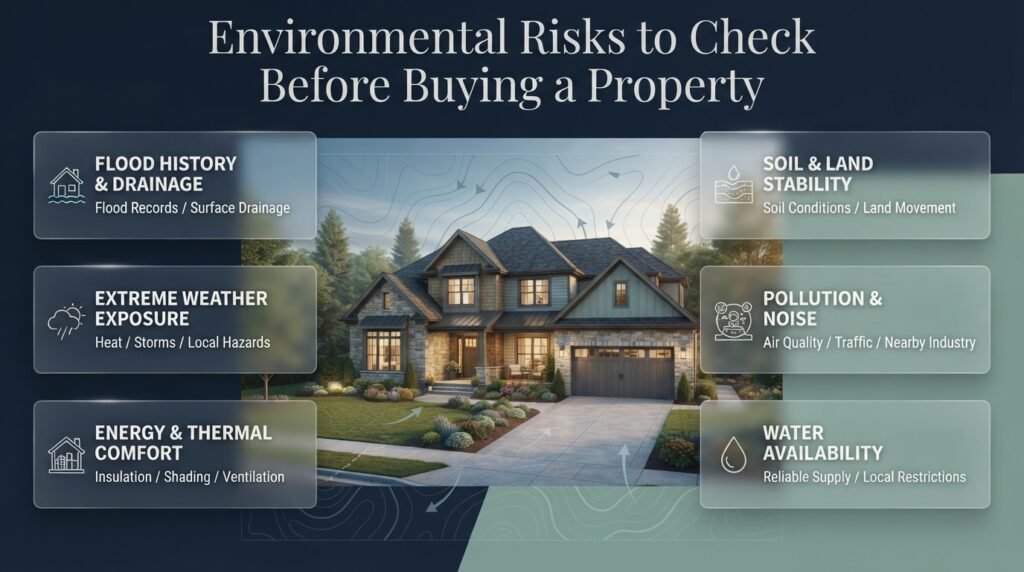
Environmental conditions can affect property safety, maintenance expenses, comfort, and long-term usability. Investigate the risks relevant to the location, including flooding, drainage, extreme weather, soil conditions, pollution, and water availability.
Check flood history and drainage
Ask whether the property or surrounding roads have experienced flooding.
Inspect the slope of the land, visible drainage arrangements, retaining walls, and signs of water collecting near the building.
Where possible, review official flood information and local planning records. A property that has never flooded during the current owner’s occupancy is not necessarily free from future risk.
Consider climate and energy efficiency
Look at insulation, window performance, shading, ventilation, and heating or cooling systems.
Poor thermal performance may increase utility expenses and make rooms uncomfortable during extreme temperatures.
If energy-saving equipment is installed, ask about its condition, ownership, warranties, and maintenance requirements.
Investigate location-specific hazards
Depending on the area, relevant risks may include:
- Soil instability or land movement.
- Wildfire exposure.
- Coastal erosion or salt-related deterioration.
- Industrial pollution.
- Persistent traffic or commercial noise.
- Water scarcity and unreliable supply.
- Restrictions affecting renovation or expansion.
Not every issue applies to every property. Focus on documented risks and obtain specialist advice when the consequences could be significant.
11. How Do You Compare Two Properties Without Letting Emotions Take Over?
Compare properties against the same criteria, then identify which one best meets your essential needs at an acceptable total cost. A consistent scoring system makes it easier to distinguish genuine advantages from attractive finishes or persuasive sales presentations.
Use this table after viewing each property.
| Evaluation factor | Property A | Property B |
|---|---|---|
| Purchase and transaction costs | ___ | ___ |
| Location and commuting | ___ | ___ |
| Structural condition | ___ | ___ |
| Legal documentation | ___ | ___ |
| Layout and storage | ___ | ___ |
| Natural light and ventilation | ___ | ___ |
| Monthly running costs | ___ | ___ |
| Neighborhood suitability | ___ | ___ |
| Resale or rental potential | ___ | ___ |
| Immediate repairs required | ___ | ___ |
Score each category from 1 to 5, where 1 means poor and 5 means excellent. Record missing information separately instead of giving an uncertain property a high score.
Give important factors more weight
Not every category deserves equal importance.
If you’re buying a family home, safety, affordability, location, and practical living space may be more important than rental yield.
If you’re purchasing an investment, income potential, vacancy risk, maintenance costs, and resale demand may deserve greater attention.
However, serious legal or safety concerns should not be cancelled out by high scores elsewhere. A property with unresolved ownership problems isn’t automatically a good choice because it has excellent interiors.
Use a real-world example
Imagine Property A has a larger kitchen and recently installed decorative finishes but needs roof repairs. Property B has a simpler interior, a shorter commute, and documented maintenance records.
Property B may be the more sensible option if its overall costs and condition are suitable.
The purpose of comparison isn’t to find a perfect property. It’s to identify the option that best matches your priorities while minimizing unacceptable risks.
12. What Are the Most Common Mistakes Property Buyers Should Avoid?
Property-buying mistakes often occur when buyers focus on appearance, underestimate costs, or make decisions before completing essential checks. Understanding why these mistakes happen helps you develop a more disciplined approach and avoid preventable financial problems.
Mistake 1: Choosing based only on appearance
Why it happens: Fresh paint, modern furniture, attractive lighting, and stylish kitchens create a strong first impression.
Why it’s harmful: Cosmetic improvements may distract you from poor construction, limited storage, or expensive repairs.
How to avoid it: Inspect the underlying building, measure rooms, and arrange an independent assessment where appropriate.
Mistake 2: Underestimating the budget
Why it happens: Buyers concentrate on the purchase price and deposit while overlooking transaction fees and recurring expenses.
Why it’s harmful: Unexpected costs may leave insufficient money for repairs, bills, or essential savings.
How to avoid it: Calculate the complete purchase cost and maintain a financial reserve.
Mistake 3: Skipping legal verification
Why it happens: Buyers trust verbal assurances or assume that documents supplied by the seller must be correct.
Why it’s harmful: Ownership disputes, restrictions, or unresolved financial claims can jeopardize a transaction.
How to avoid it: Ask an independent legal professional to verify ownership, permissions, restrictions, and contractual obligations.
Mistake 4: Ignoring neighborhood conditions
Why it happens: A brief viewing doesn’t reveal how the area functions throughout the day.
Why it’s harmful: Noise, congestion, parking difficulties, or inconvenient access can become lasting frustrations.
How to avoid it: Visit at different times and test your usual travel routes.
Mistake 5: Assuming property prices will always rise
Why it happens: Buyers hear optimistic predictions about future development or market demand.
Why it’s harmful: Property values can stagnate or decline, leaving investors with lower returns than expected.
How to avoid it: Research completed sales, realistic demand, and local market conditions.
Mistake 6: Rushing because another buyer may be interested
Why it happens: Buyers worry that delaying an offer means losing the property.
Why it’s harmful: Pressure can lead to incomplete inspections, overlooked documents, or unfavorable contractual commitments.
How to avoid it: Prepare your budget and checklist in advance, understand the deadlines, and investigate significant concerns before committing.
Mistake 7: Overlooking maintenance responsibilities
Why it happens: Buyers imagine how they will use the property without considering the work needed to keep it in good condition.
Why it’s harmful: Roof repairs, drainage problems, exterior deterioration, and equipment failures can create substantial costs.
How to avoid it: Review maintenance records, inspect major systems, and estimate future repair requirements.
13. What Do Experienced Property Buyers Check Before Making an Offer?

A disciplined buyer combines financial planning, physical inspection, legal verification, and local research before committing. The goal is not to eliminate every possible uncertainty but to identify significant risks and understand their likely cost and consequences.
Use the following checklist before making an offer.
Financial checks
- Confirm the asking price against comparable properties.
- Calculate purchase costs, taxes, and professional fees.
- Review financing terms and monthly affordability.
- Estimate immediate repairs and ongoing maintenance.
- Maintain sufficient savings for unexpected expenses.
Physical inspection
- Check visible cracks and signs of movement.
- Look for dampness, leaks, and water damage.
- Inspect accessible plumbing and electrical installations.
- Examine the roof and exterior where possible.
- Measure rooms and evaluate furniture placement.
- Check windows, doors, drainage, and ventilation.
Legal and administrative checks
- Verify ownership independently.
- Review approved plans and applicable permissions.
- Investigate restrictions, disputes, and financial claims.
- Confirm taxes, service charges, and shared responsibilities.
- Read the purchase agreement carefully.
- Understand the completion process and contractual deadlines.
Location and future-use checks
- Visit at different times of day.
- Test your regular commute.
- Evaluate parking, noise, and nearby amenities.
- Investigate relevant environmental risks.
- Research local development plans.
- Consider resale demand and future household needs.
Ask the seller useful questions
Rather than asking only whether the property has any problems, use specific questions that encourage clear answers.
For example:
- When were the roof and major building systems last inspected?
- Have there been previous leaks, flooding, or significant repairs?
- Were renovations completed with the required permissions?
- Which fixtures and appliances are included?
- What are the recurring utility and service costs?
- Are any major building repairs planned?
- Are there outstanding disputes or obligations affecting the property?
Request supporting documentation for important claims. If an answer is unclear or a defect appears significant, seek independent advice rather than relying on reassurance.
Expert recommendation: If an inspection reveals a serious issue, obtain a written assessment and repair estimate. You can then decide whether to negotiate the price, request further investigation, or withdraw if your contractual rights permit it.
For further practical guidance about construction and renovation decisions, visit Build & Renovate Construction.
14. How Should You Prepare for Life After Buying the Property?
Choosing a property involves more than completing the purchase. Think about the first months of ownership, the maintenance work you’ll need to organize, the cost of furnishing, and the changes that will make the home comfortable without creating unnecessary financial pressure.
Plan improvements in stages
Separate essential repairs from cosmetic improvements.
First priority: Address safety issues, active leaks, faulty electrical systems, drainage problems, and other defects that could worsen if neglected.
Second priority: Improve practical features such as storage, lighting, ventilation, and inefficient equipment.
Third priority: Consider decorative changes such as new wall finishes, furniture, landscaping, and premium fittings.
This order helps you spend money where it matters most rather than exhausting your budget on appearance.
Understand the ongoing workload
Houses with gardens, pools, large exterior areas, or complex equipment may require more time and maintenance than smaller properties.
Apartments may reduce some individual maintenance responsibilities but introduce shared management fees and building rules.
Choose a property whose responsibilities match your available time, budget, and willingness to manage repairs.
Consider flexibility and comfort
A property that works well today should also accommodate reasonable changes in your lifestyle.
For example, a flexible spare room could later become a home office, while accessible storage and a practical entrance may make everyday routines easier.
For ideas about balancing appearance with practical living, explore Modern Home Ideas That Balance Design, Comfort & Everyday Living.
Small, carefully chosen improvements can also make a property feel more comfortable without requiring an expensive renovation. The Small Interior Changes That Can Transform the Feel of Your Home guide offers additional inspiration for making thoughtful changes.
15. How Can You Make a Confident Final Property Decision?
A confident property decision comes from evidence, realistic expectations, and a clear understanding of your priorities. Once you’ve completed your inspections and research, review the advantages, disadvantages, and outstanding questions before deciding whether to proceed.
Ask yourself five final questions:
- Can I comfortably afford this property? Include the full purchase cost, recurring expenses, and likely repairs.
- Is the building in acceptable condition? Investigate significant defects and understand the cost of resolving them.
- Is the legal position clear? Obtain independent verification of ownership and relevant documentation.
- Does the property suit my lifestyle? Consider the location, layout, privacy, and everyday convenience.
- Would I still choose it after considering its disadvantages? Look beyond attractive photographs and imagine living with its practical limitations.
If you cannot answer one of these questions confidently, identify the missing information before proceeding.
Sometimes the right decision is to negotiate. In other situations, additional inspections are necessary. Occasionally, walking away is the most responsible choice.
A property that appears to be a bargain may become expensive if it requires major repairs or carries unresolved legal risks. Likewise, a more expensive property may offer better overall value if its condition, location, and running costs are more suitable.
For broader inspiration about designing and improving residential spaces, Home Modern Architecture Uses Form Light & Space explores how architectural decisions influence the experience of a home.
If you’re also considering a move to another region or country, practical research into the destination, local services, and everyday lifestyle can help you assess whether the location fits your plans. The Travel Places and Destinations guide provides additional destination-related ideas.
The final decision should reflect your actual needs and financial position, not pressure from a seller, a predicted market trend, or the fear of missing out.
What Should You Look for Before Choosing Your Next Property?
Before choosing your next property, focus on its location, total purchase cost, structural condition, legal documentation, and suitability for your lifestyle. These factors determine whether the property will meet your needs, remain affordable over time, and provide reasonable long-term value. Rather than making a decision based on attractive interiors or a seller’s promises, evaluate the property as a complete investment and living space.
A practical approach is to identify your essential requirements before arranging viewings. Consider your daily commute, household size, storage needs, access to essential services, and expected maintenance expenses. During the inspection, look for visible defects and ask about previous repairs. Have the ownership documents checked independently before making a binding commitment.
Important points to consider:
Location: Check transport links, nearby amenities, traffic, and neighborhood conditions.
Affordability: Calculate the purchase price, transaction fees, repairs, and ongoing expenses.
Property condition: Inspect for dampness, cracks, plumbing problems, and other potential defects.
Legal status: Verify ownership records, required permissions, and contractual obligations.
Future suitability: Consider whether the layout and location will continue to meet your needs.
How Do You Know If a Property Is Worth Its Asking Price?
Start by researching recently completed sales rather than relying exclusively on online listings. Properties advertised at similar prices may differ significantly in actual condition or usable space. If the property requires a new roof, plumbing repairs, or other substantial work, include those expenses when assessing its overall cost.
For a high-value purchase, an independent valuation may provide additional confidence. Avoid paying a premium solely because a seller predicts that the neighborhood will become more desirable. Future development and property appreciation are never guaranteed.
Practical ways to assess the price:
Compare recent sale prices of similar nearby properties.
Consider the property’s age, condition, layout, and usable floor area.
Estimate the cost of essential repairs and improvements.
Review ongoing expenses, including service charges and maintenance.
Seek an independent valuation if the asking price appears unusually high.
What Documents Should You Check Before Buying a Property?
Before purchasing a property, verify the documents that establish legal ownership, confirm the seller’s authority to transfer the property, and identify restrictions or obligations affecting the transaction. The exact paperwork varies by country and property type, so an independent property lawyer or qualified conveyancer should confirm which records are required for your purchase.
Begin with the official ownership or title records and check that the seller’s details match the relevant documentation. Depending on the circumstances, you may also need approved building plans, permits, property tax records, mortgage discharge documents, or evidence that applicable service charges have been paid.
Pay particular attention to unclear ownership, boundary disputes, unauthorized alterations, outstanding financial claims, and contractual conditions. If you’re buying an apartment or newly constructed property, check the applicable rights to shared facilities, building approvals, completion documents, and warranties.
Documents and legal checks to prioritize:
Official title deeds or ownership registration records.
Approved plans and relevant building permissions, where applicable.
Property tax and service-charge records.
Mortgage discharge documents or information about registered claims.
Purchase agreement, payment terms, and completion conditions.
Relevant warranties and completion documents for new construction.
Never assume that documents are valid simply because the seller or agent provides them. Independent verification before committing can help prevent costly legal complications.
Is It Better to Buy a New Property or an Older Property?
The better choice depends on construction quality, location, maintenance history, total cost, and your personal requirements. A newly built property may offer modern layouts, contemporary equipment, and applicable warranties, while an older home may provide established surroundings, mature gardens, or architectural features that are difficult to find in new developments.
However, neither option guarantees better value. A new property can have workmanship defects, incomplete finishing, or drainage problems. An older property may need upgrades to its electrical system, plumbing, insulation, windows, or roof. The cost of addressing these issues can significantly affect your budget.
Instead of choosing based on age alone, arrange an appropriate inspection and investigate the property’s maintenance history. For a new home, review the developer’s documentation and defect-reporting process. For an older home, pay particular attention to major building systems and previous renovations.
Compare these factors before deciding:
Construction quality: Assess the actual condition rather than relying on the property’s age.
Maintenance expenses: Estimate immediate repairs and future upkeep.
Energy efficiency: Check insulation, ventilation, windows, and heating or cooling systems.
Documentation: Verify ownership, approvals, and renovation records where applicable.
Long-term suitability: Consider location, room layout, and future household requirements.
The most suitable property is the one that offers the right balance of condition, affordability, convenience, and long-term practicality.
How Can You Avoid Costly Mistakes When Choosing Your Next Property?
You can reduce the risk of expensive property-buying mistakes by setting a realistic budget, arranging appropriate inspections, verifying legal documents, researching the neighborhood, and avoiding rushed decisions. Buyers often focus on appearance or fear losing a desirable property, which can cause them to overlook defects, underestimate expenses, or accept unfavorable terms.
Before viewing properties, determine your maximum comfortable budget and identify the features you genuinely need. During viewings, inspect the building carefully and ask specific questions about previous repairs, water damage, utilities, and maintenance responsibilities. If a problem appears significant, obtain a professional assessment and a written estimate rather than guessing what the repair might cost.
You should also investigate the neighborhood at different times of day and compare the property with similar homes. Before signing an agreement, make sure you understand the payment schedule, completion date, contractual obligations, and any conditions that may affect your ability to withdraw.
Essential steps to protect your decision:
Prepare a complete budget that includes fees, repairs, and recurring expenses.
Arrange an independent inspection for potential structural or maintenance issues.
Verify ownership and relevant legal documents through appropriate professionals.
Visit the neighborhood more than once to assess traffic, noise, and accessibility.
Compare prices using recent sales of similar properties.
Avoid making a binding commitment before understanding the contract and significant risks.
A careful buying process takes time, but it can help you avoid preventable expenses and choose a property that suits both your financial circumstances and your everyday life.
Conclusion
Choosing your next property is a significant decision that requires more than comparing prices, viewing attractive interiors, or selecting a convenient location. The right property should support your lifestyle, fit comfortably within your budget, offer long-term value, and meet your practical needs both now and in the future. Taking the time to evaluate these factors can help you make a confident and well-informed decision.
Before making a commitment, assess the location, neighborhood, structural condition, layout, natural lighting, ventilation, utilities, maintenance requirements, and potential resale value. Review all relevant legal documents, confirm ownership details, investigate any restrictions, and understand the complete cost of purchasing and maintaining the property. A professional inspection and appropriate legal guidance can also help identify issues that may not be visible during an ordinary viewing.
Remember that the most expensive property is not necessarily the best investment, and the most attractive one may not be the most practical choice. Focus on finding a balance between affordability, comfort, safety, functionality, and future potential. Avoid rushing into a purchase because of pressure from sellers or fear of missing an opportunity. Comparing suitable options and asking the right questions can prevent costly mistakes.
Ultimately, the best property is one that meets your priorities while remaining financially manageable over the long term. By following a structured evaluation process, researching carefully, and looking beyond first impressions, you can choose a property that provides lasting value, supports your everyday needs, and offers greater peace of mind for years to come.