Introduction
Property and Real Estate Guide | Buying property is one of the biggest financial decisions most people make, yet many buyers begin searching for houses, apartments, or plots before understanding the real costs, legal requirements, and risks involved. A property may look attractive, fit your budget, and sit in a promising neighborhood, but hidden repair expenses, ownership disputes, or weak rental demand can turn an exciting purchase into a costly mistake.
This property and real estate guide explains how to evaluate properties, understand market prices, prepare a realistic budget, complete legal checks, and make better decisions when buying, selling, or investing in real estate. Whether you’re purchasing your first home, exploring rental income, or considering land for future development, the goal is to help you make decisions based on reliable information rather than assumptions.
For additional inspiration on creating comfortable, functional living spaces, visit Blog Home Ideas TheHomeTrotters. Understanding how a property functions as a living environment can help you assess its long-term suitability beyond its appearance or asking price.
What Is Property and Real Estate?
Property and real estate generally refer to land, permanent buildings, and the ownership rights associated with them. These assets include houses, apartments, commercial premises, warehouses, agricultural land, and undeveloped plots. People purchase real estate for personal use, rental income, business activities, development, or potential long-term appreciation.
Real estate is different from many other assets because it combines a physical structure with a legal interest in land. A building’s appearance is only one part of its value. Ownership status, permitted use, access rights, location, maintenance requirements, and local demand can be equally important.
For example, two houses may have similar floor areas and modern interiors but different market values because one has better road access, verified ownership, and lower maintenance costs. The other may have unresolved legal issues or require expensive structural repairs.
Understanding these differences helps buyers evaluate the complete property rather than focusing exclusively on its advertised features.
What Are the Main Types of Real Estate?
Real estate is commonly divided into four main categories. Each category serves different purposes and involves different financial responsibilities.
| Property type | Common examples | Typical purpose | Important consideration |
|---|---|---|---|
| Residential real estate | Houses, apartments, townhouses | Living or renting | Affordability, location, and maintenance |
| Commercial real estate | Shops, offices, business premises | Business use or rental income | Tenant demand and lease conditions |
| Industrial real estate | Factories, warehouses, distribution facilities | Manufacturing and storage | Access, infrastructure, and permitted use |
| Land | Residential plots, agricultural land, development sites | Building, farming, or holding | Title, access, zoning, and development approvals |
Residential property is often the most familiar category for first-time buyers. It can provide housing stability or generate rental income, depending on the buyer’s circumstances.
Commercial real estate requires closer attention to business demand, lease structures, and operating expenses. A shop in a busy commercial district may attract tenants, but its profitability still depends on purchase price, rent, vacancy periods, and other costs.
Industrial properties are generally influenced by transport access, logistics networks, building specifications, and the needs of particular industries.
Land investment can offer development opportunities, but a low purchase price does not guarantee future value. A plot without approved access, essential utilities, or permission for the intended use may be difficult or expensive to develop.
Expert tip: Choose the type of property that matches your objective. A family home, a rental apartment, and a development plot should not be evaluated using exactly the same criteria.
Why Does Location Matter When Buying Property?
Location influences property demand, convenience, rental potential, resale opportunities, and everyday living costs. Properties with similar construction quality can have different prices because of their access to transport, employment, schools, healthcare, shopping, and other essential services.
However, a popular neighborhood does not automatically make every property a good investment. Buyers must consider the purchase price, local supply, property condition, future maintenance, and whether the area suits their actual needs.
Which Location Factors Should You Check?
Before selecting a property, evaluate the surrounding neighborhood as carefully as the building itself.
- Transport access: Check nearby roads, public transportation, commuting times, and access to employment centers.
- Essential facilities: Consider hospitals, schools, grocery stores, parks, and other services.
- Safety and comfort: Review credible local information and visit the area at different times.
- Infrastructure: Investigate water supply, drainage, electricity, internet availability, and road conditions.
- Future development: Research officially documented projects rather than relying on informal promises.
- Environmental risks: Consider flooding, drainage problems, pollution, excessive noise, and other location-specific hazards.
- Neighborhood maintenance: Look at street conditions, building upkeep, vacant properties, and access to everyday services.
Imagine two apartments with similar floor areas. The first is close to public transport and employment centers. The second is farther away and requires a longer daily commute.
The second apartment may have a lower purchase price, but additional transport expenses and weaker rental demand could reduce its overall appeal. The first apartment may justify a higher price if the convenience and demand support it.
How Can You Research a Neighborhood Properly?
Start by comparing recent sales of similar properties. Look at how long listings remain available, whether sellers are reducing their prices, and whether comparable homes are being rented successfully.
Visit the neighborhood in the morning, during the evening commute, and on a weekend if possible. This helps you understand traffic, noise, parking pressure, and the general atmosphere.
For a property intended for rental income, investigate the types of tenants who live or work nearby. A neighborhood popular with families may have different housing requirements from an area dominated by students or short-term business visitors.
Avoid assuming that a planned road, shopping center, or transport project will automatically increase property prices. Verify its approval status, funding, construction progress, and likely effect on the specific location.
How Do You Set a Realistic Property Budget?
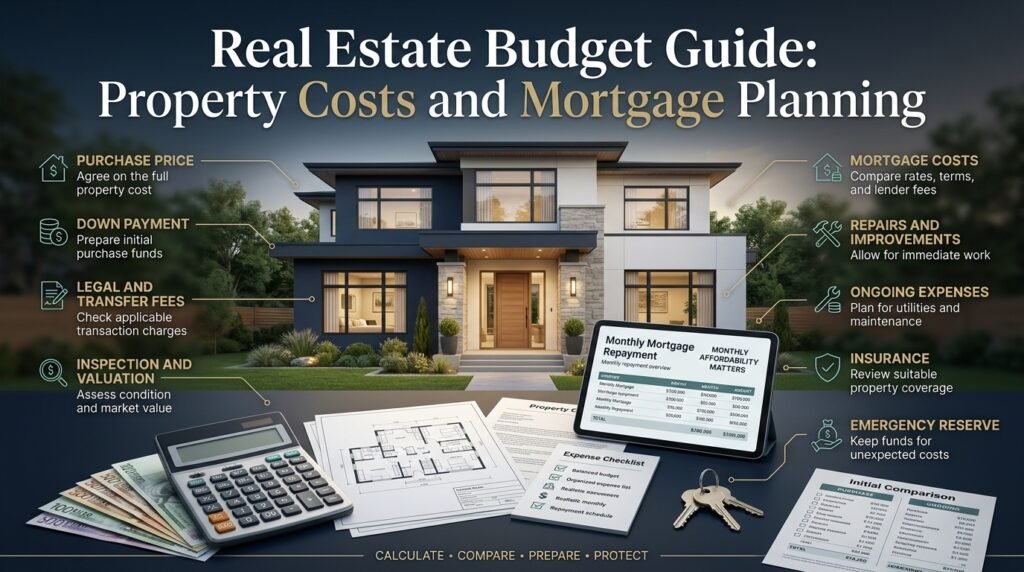
A property budget should include the complete cost of acquiring, financing, maintaining, and eventually selling the asset. The purchase price is only one component of the financial commitment.
Buyers who spend every available dollar on the initial transaction may struggle when they face repairs, registration expenses, utility connections, or unexpected changes in income.
Which Costs Should You Include?
Before making an offer, prepare a list of expected expenses.
| Expense | What to consider |
|---|---|
| Purchase price | Agreed amount payable to the seller |
| Deposit or down payment | Initial funds required under the transaction or mortgage |
| Legal fees | Document review, conveyancing, and other professional services |
| Registration and transfer | Applicable registration charges, duties, and taxes |
| Inspection and valuation | Professional assessments of condition and value |
| Financing | Interest, lender fees, and other borrowing costs |
| Repairs and improvements | Immediate maintenance and necessary upgrades |
| Insurance | Applicable building, contents, or liability coverage |
| Ongoing expenses | Utilities, service charges, taxes, and maintenance |
| Emergency reserve | Funds for unexpected costs or temporary income loss |
The amounts vary by jurisdiction and property type. Obtain estimates from the relevant professionals rather than assuming one percentage will cover every transaction.
For example, a buyer considering a property for $180,000 should calculate the purchase funds, closing costs, likely repairs, moving expenses, and an appropriate emergency reserve before deciding whether the property is affordable.
How Much Should You Borrow?
If you plan to use a mortgage, compare lenders based on more than the advertised interest rate. Review the full repayment schedule, loan duration, fees, eligibility requirements, and whether the interest rate is fixed or variable.
Calculate how the monthly payment would fit into your budget after accounting for utilities, food, transportation, existing debts, insurance, and savings.
Test your finances under less favorable conditions. Could you still afford the property if your income fell temporarily, interest rates increased, or a major repair became necessary?
Common mistake: Treating the maximum loan offered by a lender as the amount you should borrow. A lender’s approval does not mean the repayment will be comfortable for your household.
How Do You Buy Property Step by Step?
Buying property becomes easier when you divide the process into manageable stages. Each stage helps reduce a different type of risk, from overspending to purchasing a property with unresolved legal problems.
Step 1: Define Your Property Requirements
Decide whether you need a home for your family, a rental property, commercial premises, or land for future development.
Write down your essential requirements before browsing listings. These might include the number of bedrooms, preferred location, parking, accessibility, outdoor space, and maximum budget.
Separate necessities from optional features. A suitable layout and reliable utilities may matter more than expensive finishes that can be changed later.
For a family, future needs should also be considered. A home that comfortably accommodates everyone today may become unsuitable if the household grows or working arrangements change.
Step 2: Research Available Properties
Use reputable listing platforms, local agents, public records, and completed-sale information where available.
Compare properties with similar sizes, locations, ages, and conditions. Record asking prices, likely additional expenses, and any important disadvantages.
Do not rely on a single listing to determine market value. Asking prices represent sellers’ expectations, not necessarily the prices buyers are paying.
Step 3: Inspect the Property
A viewing should cover the building’s practical condition as well as its appearance.
Check for signs of moisture, damaged walls, roof leaks, poor ventilation, plumbing problems, electrical issues, and drainage defects. Ask about the age of major systems and whether significant repairs have been completed.
For apartments, examine shared facilities, building maintenance, service charges, parking, and management arrangements.
For houses, pay particular attention to the roof, foundations, external walls, boundaries, and access.
Where appropriate, arrange an independent inspection by a suitably qualified professional. A professional may identify problems that are difficult for an inexperienced buyer to recognize.
Step 4: Verify Ownership and Legal Status
Before paying a substantial deposit, establish that the seller has the authority to transfer the property and that the transaction is legally permitted.
Depending on the jurisdiction, checks may include ownership records, registration documents, mortgages, liens, disputes, building approvals, access rights, taxes, and restrictions on transfer.
A seller’s assurances are not a substitute for independent verification. If documents conflict or important information is missing, resolve the issue before proceeding.
Step 5: Make an Offer and Negotiate
Use comparable sales and documented property defects to support your offer.
Negotiation may involve the purchase price, included fixtures, repairs, completion date, or other contractual conditions. Whether the seller agrees will depend on demand, competing offers, and their circumstances.
Avoid increasing your offer simply because you have become emotionally attached to the property. Establish your maximum price before negotiations begin.
Step 6: Arrange Financing and Final Checks
If borrowing is involved, confirm the lender’s requirements and ensure the property meets any applicable valuation or lending conditions.
Review the final contract carefully, including deposit arrangements, completion deadlines, cancellation conditions, and the consequences of failing to meet an obligation.
Seek advice from a qualified local property professional if any term is unclear.
Step 7: Complete the Transaction
The completion process may involve signing final documents, transferring funds, settling applicable charges, registering the transfer, and receiving possession.
Follow the legally required process in your jurisdiction. Keep copies of the signed agreement, proof of payment, ownership documents, inspection reports, and warranties.
Once the transaction is complete, organize the records so they remain accessible for maintenance, insurance, future rental management, or resale.
How Can You Determine the Fair Market Value of a Property?
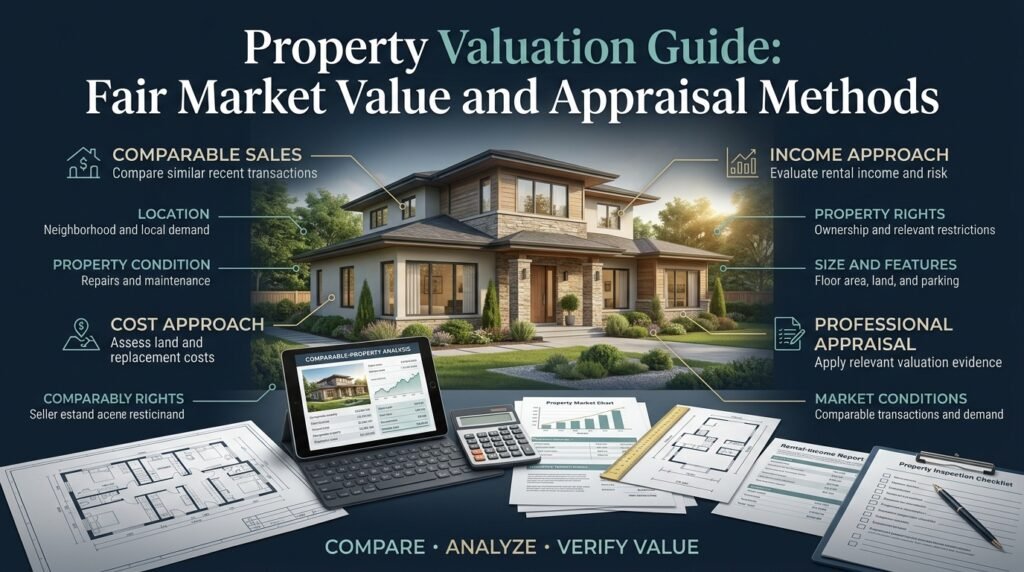
Fair market value is an estimate of the price a property could reasonably achieve between informed, willing parties under appropriate market conditions. It is not necessarily the asking price or the amount the current owner originally paid.
A reliable valuation considers comparable transactions, location, size, condition, property rights, and market demand.
What Are the Main Property Valuation Methods?
| Method | How it works | Best suited to |
|---|---|---|
| Comparable sales | Compares the property with similar recent transactions | Houses and apartments |
| Income approach | Estimates value from expected property income and market risk | Rental and commercial property |
| Cost approach | Estimates land value plus the replacement cost of improvements, adjusted for depreciation | Certain specialized or newer properties |
| Professional appraisal | Uses appropriate valuation methods and relevant evidence | Financing and significant transactions |
For a typical home, comparable sales provide a useful starting point. Adjustments may be needed for differences in floor area, land size, parking, condition, renovations, and location.
For an income-producing property, expected rental income and operating expenses may be more important.
How Do You Compare Similar Properties?
Select recent transactions involving properties that are genuinely comparable. A large renovated house should not be compared directly with a smaller property in poor condition without making appropriate adjustments.
Review:
- Sale price and transaction date.
- Land area and usable floor area.
- Property age and condition.
- Number of bedrooms and bathrooms.
- Parking, storage, and outdoor facilities.
- Street access and neighborhood characteristics.
- Ownership rights and any relevant restrictions.
Price per square foot or square meter can help compare properties, but it cannot account for every difference.
Expert tip: If several properties have similar asking prices but one has unresolved legal questions or major structural defects, investigate those issues before treating the properties as equivalent.
How Does Real Estate Investment Work?
Real estate investment involves purchasing or controlling property with the aim of generating income, benefiting from potential appreciation, or achieving both. Investors may purchase rental housing, commercial premises, land, or development opportunities.
Unlike a bank deposit, property ownership may require substantial upfront capital, ongoing maintenance, and active management. Property values and rental income can also decline.
What Are the Main Types of Real Estate Investment?

Residential rental property
An investor purchases a house or apartment and rents it to tenants. Potential returns include rental income and any increase in the property’s market value.
The owner must consider vacancies, tenant management, maintenance, insurance, legal compliance, and applicable taxes.
Commercial property
Offices, retail units, and business premises may generate rental income through commercial leases. Performance depends on location, tenant demand, lease terms, building condition, and the cost of attracting replacement tenants.
Land investment
Investors purchase land in anticipation of future demand, development, or changes in permitted use. However, land may generate no income during the holding period, while taxes, security, and other expenses continue.
Property development
Development involves constructing, converting, or substantially improving property for sale or rental. It can create value, but it also introduces construction delays, approval requirements, contractor risks, and the possibility of budget overruns.
Real estate investment trusts
Real estate investment trusts, or REITs, allow eligible investors to gain exposure to portfolios of real estate through securities. They can offer an alternative to direct property ownership, although their prices can fluctuate and their fees, tax treatment, and eligibility rules vary.
How Do You Calculate Rental Yield?
Gross rental yield compares annual rental income with the purchase price.
Formula:
Gross rental yield = (Annual rental income ÷ Purchase price) × 100
Suppose an apartment costs $150,000 and produces $12,000 in annual rent.
Gross rental yield = ($12,000 ÷ $150,000) × 100 = 8%
This does not mean the investor earns an 8% profit. The calculation excludes maintenance, vacancies, taxes, insurance, management, financing, and transaction costs.
A more detailed estimate might look like this:
| Annual income or expense | Amount |
|---|---|
| Gross rental income | $12,000 |
| Maintenance and repairs | $1,000 |
| Insurance and property taxes | $1,200 |
| Management expenses | $600 |
| Vacancy allowance | $600 |
| Net operating income | $8,600 |
The net operating income yield in this example is approximately 5.73% of the $150,000 purchase price.
This still excludes financing payments, income taxes, acquisition costs, and major capital improvements. Actual results may be higher or lower.
Pro tip: Calculate rental performance using realistic assumptions rather than the best possible outcome. Test the effect of lower rent, unexpected repairs, and a longer vacancy period before deciding whether the investment is worthwhile.
Should You Buy Property or Continue Renting?

Buying and renting serve different needs. Buying may provide housing stability, greater control over the property, and the possibility of building equity. Renting can offer flexibility and reduce responsibility for certain major repairs.
Neither option is automatically better for every household.
| Factor | Buying | Renting |
|---|---|---|
| Initial costs | Often substantial | Usually lower upfront costs |
| Monthly expenses | Mortgage and ownership costs | Rent and applicable tenant charges |
| Flexibility | Selling can take time and money | Moving may be easier at lease end |
| Maintenance | Owner generally bears responsibility | Responsibilities depend on the lease and local law |
| Potential appreciation | Property may gain or lose value | No direct ownership of the home |
| Financial risk | Exposure to property and financing risks | Exposure to rent increases and lease uncertainty |
Buying may be appropriate if you expect to remain in the area for several years, can comfortably afford the complete ownership costs, and have enough savings remaining after the transaction.
Renting may be more practical if your employment, family needs, or location could change soon or buying would leave you without an adequate emergency reserve.
How Should You Compare the Two Options?
Compare the total cost of ownership with the total cost of renting over the period you expect to stay.
Include mortgage interest, maintenance, insurance, taxes, purchase and selling costs, rent increases, and the opportunity cost of money tied up in a down payment.
Remember that mortgage principal repayment builds equity, although that equity is not immediately available as cash. Property appreciation is also uncertain and should not be treated as a guaranteed benefit.
How Can You Sell Property Successfully?
Selling property requires realistic pricing, preparation, effective marketing, and careful transaction management. A property that is clean, well-maintained, and accurately priced may attract more serious buyers, but the final result depends on market conditions.
Step 1: Set a Competitive Asking Price
Research completed sales of comparable properties and consider obtaining an independent valuation.
An excessively high asking price can discourage potential buyers and cause the property to remain on the market for longer than expected. A very low price may result in selling below the property’s reasonable market value.
Consider the property’s condition, local competition, likely negotiation range, and your preferred timeline before setting the price.
Step 2: Prepare the Property for Viewings
Concentrate on improvements that make the property easier to inspect and understand.
- Repair visible defects and leaking fixtures.
- Clean floors, windows, kitchens, and bathrooms.
- Remove unnecessary clutter.
- Improve lighting and ventilation.
- Maintain the entrance and outdoor areas.
- Organize relevant property documents.
- Address obvious safety problems.
Large renovations do not always produce a corresponding increase in the sale price. Compare the likely cost with buyer expectations before committing to expensive upgrades.
For practical ideas about construction, home improvements, and renovation planning, explore Build & Renovate Construction.
Step 3: Market the Property Accurately
Use clear photographs and an informative description covering the property’s size, layout, condition, facilities, and location.
Mention genuine advantages without exaggeration. Claims about guaranteed returns or certain future price increases can mislead buyers and weaken trust.
Choose appropriate listing platforms and consider working with a qualified local agent who understands the relevant market.
Step 4: Evaluate Offers Carefully
The highest offer is not necessarily the strongest offer. Consider the buyer’s financing, contractual conditions, proposed completion date, and ability to meet the agreed obligations.
Review the offer carefully before accepting it. If necessary, obtain legal advice about conditions that could delay or prevent completion.
Step 5: Complete the Sale
Confirm the transfer requirements, outstanding charges, tax obligations, and final settlement figures.
If you have an outstanding mortgage, coordinate with the lender to understand how the debt will be settled from the sale proceeds.
Keep records of the signed agreement, payment receipts, and transfer documents.
What Legal Checks Should You Complete Before Buying Property?
Property transactions involve legal rights and financial obligations that can continue long after the purchase. Due diligence helps identify issues before money changes hands.
Essential Property Due Diligence Checklist
Before completing a transaction, consider the following checks:
- Confirm the seller’s identity and authority to sell.
- Verify ownership through the appropriate official process.
- Investigate mortgages, liens, disputes, and other restrictions.
- Check boundaries, access rights, and shared areas.
- Confirm relevant building approvals and permits.
- Review outstanding taxes, service charges, and utility obligations.
- Arrange a physical inspection and investigate significant defects.
- Confirm that the property can legally be used for your intended purpose.
- Review the purchase agreement and payment conditions.
- Understand the registration and transfer process.
Requirements vary by property type and jurisdiction. A registered house, an apartment in a managed building, agricultural land, and a newly developed plot may require different documents and approvals.
What Should Buyers in Pakistan Know?
If you are buying property in Pakistan, pay particular attention to the relevant land-record system, development authority, housing scheme, and local legal requirements.
Depending on the property, checks may include title records, sale deeds, mutation or other ownership-transfer records, approved layout plans, applicable No Objection Certificates (NOCs), transfer eligibility, and outstanding dues.
For a private housing society, verify the society’s legal status and the specific plot or unit’s transfer eligibility with the appropriate authorities. A booking receipt, allotment letter, or property file should not automatically be treated as proof of an unencumbered, transferable ownership title.
For properties subject to mortgages, inheritance claims, litigation, or disputed boundaries, additional legal investigation may be necessary.
Consult a qualified property lawyer familiar with the relevant jurisdiction before paying a substantial deposit or signing a binding agreement. Never assume that the process is identical across all cities, provinces, or property categories.
How Does Property Design Affect Value and Livability?

A property’s layout and design influence how comfortable, practical, and attractive it is to occupants. Good design can make rooms easier to use, improve natural lighting, support privacy, and reduce unnecessary maintenance.
However, design improvements do not guarantee a particular resale price. Their value depends on local buyer preferences, workmanship, cost, and whether the improvements suit the property.
Which Interior Features Should Buyers Consider?
Look beyond decorative finishes and evaluate how the space functions.
- Room layout: Check whether the rooms support everyday activities without awkward circulation.
- Natural light: Assess window placement, privacy, and the amount of daylight.
- Ventilation: Look for effective airflow and signs of persistent moisture.
- Storage: Consider wardrobes, kitchen storage, and practical space for household items.
- Durability: Evaluate flooring, cabinetry, fixtures, and other materials.
- Maintenance: Ask whether finishes and systems are easy to repair or replace.
- Accessibility: Consider stairs, entrances, door widths, and future mobility requirements.
A property with a practical layout may suit a household better than a larger property with poorly arranged rooms. Similarly, durable finishes can reduce maintenance compared with inexpensive materials that need frequent replacement.
For additional design inspiration, see Home Interior Ideas.
Why Does Residential Architecture Matter?
Residential architecture affects a home’s layout, structural design, energy performance, appearance, and relationship with its surroundings.
When evaluating a new build or planning a renovation, consider the building’s orientation, structural system, roof design, insulation, ventilation, drainage, and the suitability of its materials for the local climate.
A design that works well in a cool climate may require adjustments in a hot or humid region. Shading, ventilation, appropriate insulation, and carefully selected materials can influence comfort and energy use.
For ideas about home layouts, architectural approaches, and building design, explore Residential Architecture Ideas.
Buyers should also confirm that the actual construction corresponds with approved plans and that any alterations have the required permissions. Attractive architectural features cannot compensate for unsafe construction or unresolved approval issues.
What Are the Most Common Real Estate Mistakes Beginners Make?
Many beginners focus on attractive features and advertised prices while overlooking the financial, legal, and practical responsibilities of ownership.
Mistake 1: Spending the Entire Budget on the Purchase
Why it happens: Buyers calculate the purchase price but underestimate additional expenses.
Why it is harmful: Unexpected repairs, fees, or temporary income loss can create financial pressure.
How to avoid it: Calculate the complete transaction cost and retain an emergency reserve.
Mistake 2: Ignoring Legal Verification
Why it happens: Buyers assume the seller’s documents are genuine or that an agent has already checked everything.
Why it is harmful: Ownership disputes, unauthorized construction, and transfer restrictions can lead to expensive problems.
How to avoid it: Verify the documents independently and obtain professional legal advice where appropriate.
Mistake 3: Depending on Guaranteed Appreciation
Why it happens: Marketing claims or other buyers suggest that property prices will inevitably increase.
Why it is harmful: Prices can stagnate or fall because of weak demand, oversupply, economic changes, or local problems.
How to avoid it: Assess current value and downside scenarios without depending on guaranteed future gains.
Mistake 4: Underestimating Maintenance
Why it happens: Fresh paint and attractive finishes make the property appear problem-free.
Why it is harmful: Roof repairs, plumbing failures, electrical defects, and structural problems can require significant spending.
How to avoid it: Arrange an appropriate inspection and maintain a realistic repair reserve.
Mistake 5: Buying Without a Clear Objective
Why it happens: Buyers follow trends or recommendations without assessing their own needs.
Why it is harmful: A property suitable for someone else’s budget or lifestyle may not work for you.
How to avoid it: Establish whether your priority is housing, rental income, development, or long-term investment before comparing properties.
Mistake 6: Miscalculating Rental Profit
Why it happens: Investors treat gross rental yield as their final return.
Why it is harmful: Vacancies, repairs, taxes, management expenses, and financing costs reduce the actual financial benefit.
How to avoid it: Prepare a detailed income-and-expense forecast and distinguish gross yield, net operating income yield, and cash flow after financing.
Mistake 7: Making Decisions Under Pressure
Why it happens: Buyers fear losing a property to another interested person.
Why it is harmful: Rushed decisions can result in inadequate inspections, poor negotiations, and missed legal problems.
How to avoid it: Establish clear conditions for proceeding and be willing to walk away if the property does not meet them.
What Expert Strategies Help You Make Better Property Decisions?
Experienced buyers use consistent methods to compare opportunities, test assumptions, and manage risk. These practices are useful whether you are buying a home or evaluating a rental property.
Compare Properties Using Consistent Criteria
Create a comparison sheet for every serious candidate. Include asking price, estimated fair value, size, location, legal status, condition, maintenance requirements, and transaction costs.
For rental properties, add expected rent, vacancy assumptions, operating expenses, and financing costs.
Using the same criteria helps you avoid being distracted by attractive finishes or persuasive sales presentations.
Separate Facts From Predictions
A completed sale, verified ownership record, or documented repair estimate can be checked. A claim that a new road will double property prices is a prediction.
Investigate development claims by looking for official approvals, funding, construction progress, and credible evidence of local demand. Even an approved project can be delayed or have less effect on prices than expected.
Understand Liquidity Before Investing
Liquidity refers to how easily an asset can be converted into cash without a substantial loss of value.
Real estate is generally less liquid than publicly traded investments. A sale may take months, and legal complications or weak demand can extend the timeline.
If you may need your money quickly, avoid tying all your available savings up in a single property.
Negotiate With Evidence
Use comparable sales, documented defects, realistic repair estimates, and relevant financing conditions to support your offer.
A seller may be more willing to negotiate when your position is supported by clear information rather than an arbitrary request for a discount.
Remain prepared to walk away if the price, condition, or legal status does not meet your requirements.
Keep Records From Day One
Maintain organized copies of contracts, ownership records, inspections, warranties, invoices, tax documents, rental agreements, and maintenance records.
These documents help with ongoing management and can establish the property’s history when you refinance, rent, or sell it.
What Should You Check Before Buying a Property?
Before buying a property, you should evaluate its legal ownership, physical condition, location, market value, and total cost of ownership. A property may look attractive and fit your budget, but hidden structural problems, disputed ownership, unpaid charges, or restrictions on its use can create serious financial difficulties later. Taking time to investigate these details helps you make a more informed decision and reduces the risk of expensive surprises.
Start by verifying the seller’s ownership documents through the appropriate official channels. Arrange a professional inspection when necessary, compare the asking price with recent sales of similar properties, and calculate the additional costs associated with the purchase. If you’re buying land or property in a housing society, confirm its legal status, transfer eligibility, and relevant development approvals before making a payment.
Important checks before making a purchase:
Legal ownership: Confirm that the seller has the authority to transfer the property and investigate any mortgages, liens, or disputes.
Property condition: Inspect the structure, roof, plumbing, electrical systems, ventilation, and signs of moisture.
Market value: Compare similar properties using recent completed sales rather than relying only on advertised prices.
Additional expenses: Budget for taxes, registration, legal fees, repairs, maintenance, and applicable service charges.
Location and accessibility: Evaluate transport, utilities, nearby facilities, neighborhood conditions, and future suitability.
The most reliable approach is to complete your legal and financial checks before committing to a binding agreement. Professional advice can be particularly valuable when documents are incomplete, ownership is complicated, or the transaction involves a substantial amount of money.
Is Real Estate a Good Investment for Beginners?
Real estate can be a suitable investment for beginners who understand the local market, have sufficient financial reserves, and choose a property that matches their investment objectives. It may generate rental income, offer potential long-term appreciation, or provide a combination of both. However, property investment is not guaranteed to be profitable, and returns depend on purchase price, demand, operating expenses, financing, and market conditions.
Beginners should avoid purchasing property simply because prices appear to be rising or other investors recommend a particular location. Instead, investigate actual sales, realistic rental demand, expected maintenance costs, and the property’s legal status. A property with strong marketing may still perform poorly if it remains vacant, requires expensive repairs, or has been purchased at an inflated price.
Factors to evaluate before investing:
Rental potential: Research achievable rents for comparable properties and consider the likelihood of vacancies.
Total investment cost: Include the purchase price, transaction fees, initial repairs, financing costs, and ongoing expenses.
Expected return: Calculate rental yield and estimate net operating income rather than relying exclusively on gross rent.
Market demand: Examine employment opportunities, transport access, local amenities, and the availability of competing properties.
Financial security: Maintain an emergency reserve so unexpected repairs or periods without rental income do not create financial pressure.
For example, an apartment generating attractive annual rent may initially appear profitable. However, after accounting for maintenance, insurance, taxes, management fees, and vacancies, the actual return could be considerably lower.
A sensible beginner strategy is to research one market thoroughly, compare several properties, and use conservative financial estimates. Never rely on guaranteed appreciation, and avoid investing money that you may need for essential expenses in the near future.
How Do You Determine the Fair Market Value of a Property?
Fair market value is an estimate of what a property could reasonably sell for under appropriate market conditions between informed, willing parties. It can differ from the seller’s asking price, the original purchase price, or an agent’s initial estimate. Determining a realistic value helps buyers avoid overpaying and enables sellers to set a competitive asking price.
The most practical starting point is to compare recent completed sales of similar properties in the same neighborhood. Look for properties with comparable floor areas, land sizes, construction quality, age, layouts, and facilities. Differences in parking, renovations, access, and legal status may justify adjustments to the estimated value.
For rental properties, income potential can also help establish value. Professional valuers may use comparable sales, income-based calculations, replacement costs, or a combination of methods depending on the property type.
Steps to estimate property value:
Research completed transactions: Focus on what buyers actually paid, not just current listing prices.
Compare similar properties: Consider location, size, condition, age, and facilities.
Assess necessary repairs: Estimate the cost of addressing structural defects, outdated systems, or significant maintenance issues.
Review market conditions: Consider supply, demand, financing conditions, and how quickly comparable properties are selling.
Obtain a professional valuation: For high-value purchases, complex properties, or uncertain markets, seek an independent assessment where appropriate.
For example, two apartments in the same building may have different values because one has a renovated interior, better views, and dedicated parking. A simple comparison of their floor areas would not fully explain the price difference.
Remember that a valuation is an estimate, not a promise of future resale value. Property prices can rise or fall, so your decision should be based on current evidence, affordability, and the property’s suitability for your intended use.
Is Buying Property Better Than Renting in the Long Term?
Buying property can be beneficial for people seeking housing stability and the opportunity to build equity, while renting may be more practical for those who need flexibility or want to avoid the upfront costs and responsibilities of ownership. The better option depends on your financial position, expected length of stay, local property prices, rental costs, and future plans.
When you buy a property with a mortgage, part of each repayment may reduce the outstanding loan balance, gradually building equity. However, homeowners must also account for interest, maintenance, insurance, taxes, transaction expenses, and the possibility that the property’s value may decline. Equity is also not the same as readily available cash because selling or borrowing against a property involves additional conditions and costs.
Renting generally requires less upfront capital and can make relocating easier. It may allow you to keep savings available for other priorities, although rental payments can increase and tenants have less control over certain aspects of the property.
Compare these factors before deciding:
Length of stay: Buying may be more attractive when you expect to remain in the same area for several years, although the appropriate period depends on local costs.
Initial affordability: Consider the deposit, legal fees, taxes, moving costs, and emergency savings required for ownership.
Monthly expenses: Compare rent with the complete cost of owning, not just the mortgage payment.
Flexibility: Renting may suit people whose employment, family circumstances, or location could change.
Long-term financial goals: Consider how property ownership fits with your savings, other investments, and financial obligations.
A useful method is to compare the expected total costs of renting and buying over the same period. Include likely maintenance, mortgage interest, transaction fees, rent increases, and the potential opportunity cost of using savings for a deposit.
Neither option is automatically the better financial decision. Choose the arrangement that fits your circumstances without placing unnecessary pressure on your budget.
What Are the Biggest Mistakes to Avoid When Investing in Property?
The biggest property investment mistakes usually involve inadequate research, unrealistic financial expectations, poor legal verification, and underestimating ongoing expenses. Many beginners focus on a property’s advertised price or expected appreciation without calculating how much money they may need to maintain it, finance it, or manage periods without rental income.
One common mistake is assuming that property prices always increase. Although some properties appreciate over time, market conditions can change because of interest rates, economic pressures, oversupply, infrastructure problems, or declining local demand. Investors who depend entirely on future price increases may face difficulties if they need to sell during an unfavorable market.
Another frequent problem is confusing gross rental yield with actual profit. Rental income must cover relevant operating expenses, and financed properties also require careful cash-flow analysis.
Common mistakes and how to avoid them:
Skipping legal checks: Verify ownership, transfer eligibility, approvals, and relevant restrictions before paying a deposit.
Overpaying: Compare completed sales and obtain an independent valuation when appropriate.
Ignoring expenses: Account for repairs, taxes, insurance, vacancies, management, and financing costs.
Depending on appreciation: Evaluate whether the property makes financial sense without assuming prices will rise.
Using all available savings: Maintain sufficient reserves for unexpected expenses and periods of reduced income.
Rushing into a purchase: Take time to inspect the property, research the neighborhood, and review the agreement.
Choosing the wrong location: Investigate actual buyer or tenant demand rather than relying on promotional claims about future development.
For example, an investor may purchase an inexpensive apartment expecting strong rental income, only to discover that similar units remain vacant for months and maintenance costs are higher than anticipated. A realistic forecast would help identify these risks before the purchase.
The best way to reduce these mistakes is to establish clear investment criteria, verify information independently, calculate realistic returns, and remain willing to reject a property that does not meet your requirements. Careful preparation cannot eliminate every risk, but it can help you avoid preventable financial and legal problems.
Conclusion: Making Smarter Property and Real Estate Decisions
Making the right property decision requires more than comparing prices or choosing a location that looks attractive. Whether you are buying your first home, selling an existing property, renting a residential space, or exploring real estate as a long-term investment, success depends on careful research, realistic budgeting, legal verification, and a clear understanding of your goals. A property that appears affordable at first may involve additional expenses, maintenance challenges, or legal complications, so evaluating the complete picture is essential before making a commitment.
The most effective approach is to focus on long-term value rather than short-term excitement. Research the local market, compare similar properties, inspect the building’s condition, calculate all ownership costs, and verify the relevant documents before signing an agreement. If you are purchasing for investment purposes, consider rental demand, vacancy periods, ongoing expenses, resale potential, and the risks associated with changing market conditions. For homeowners, practical design, efficient space planning, and appropriate renovation choices can also improve everyday comfort and support the property’s future appeal.
Keep these principles in mind when making your next property decision:
- Set a realistic budget: Include taxes, legal fees, maintenance, insurance where applicable, and unexpected expenses.
- Choose location carefully: Evaluate accessibility, essential services, infrastructure, neighbourhood conditions, and future development plans.
- Verify legal ownership: Confirm title documents, approvals, outstanding dues, and applicable local requirements with qualified professionals.
- Compare before committing: Review comparable properties and negotiate based on evidence rather than emotion.
- Think long term: Assess how the property will serve your financial objectives, lifestyle needs, and future plans.
Ultimately, informed decisions help reduce avoidable risks and make property ownership or investment more manageable. Use this property and real estate guide as a starting point, continue researching your local market, and seek independent legal or financial advice when necessary. With a structured plan and realistic expectations, you can approach your next property decision with greater confidence and build a stronger foundation for your future.
5 Responses