Introduction
Home Organization | Have you ever bought something you already owned simply because you couldn’t find it? Perhaps your kitchen drawers are full of utensils, your wardrobe is difficult to manage, or your dining table has gradually become a place for bills, shopping bags, and everyday belongings. These situations are common, especially when a home has limited storage or several people share the same space.
Home organization is about creating practical systems that help you store belongings, find what you need, and keep everyday mess under control. It isn’t about making your house look perfect every day. It’s about making your home easier to live in, whether you have a small apartment, a family house, or a busy household with children and pets.
The biggest mistake people make is trying to solve every problem by buying more storage products. In reality, better organization often starts with understanding why clutter develops, identifying what you genuinely need, and deciding where each item should belong. A simple system that works with your daily routine is usually more valuable than an expensive collection of matching containers.
In this guide, you’ll discover how to organize your home room by room, manage paperwork and household supplies, make better use of small spaces, involve family members, and maintain your progress without spending hours cleaning. You’ll also learn how to avoid common organizing mistakes and choose solutions that suit your budget and lifestyle.
For more practical inspiration on improving everyday living spaces, explore Blog Home Ideas TheHomeTrotters, where home improvement, organization, and lifestyle ideas come together.
What Is Home Organization, and How Does It Improve Everyday Life?
Home organization means arranging belongings, storage areas, and household routines so that everything has a practical place. It involves deciding what to keep, grouping related items, making essential belongings easy to access, and establishing habits that prevent unnecessary clutter from returning.
A well-organized home doesn’t have to be minimalist. You can own books, decorations, kitchen equipment, children’s toys, hobby supplies, and sentimental possessions without creating constant mess. The important factor is whether your belongings fit your available space and whether your storage arrangements make sense.
For example, imagine that your family regularly loses keys, school bags, and charging cables. You could spend money replacing these items, or you could create a small household station with separate locations for keys, bags, and electronic accessories. The second solution addresses the cause of the problem rather than repeatedly dealing with its consequences.
Why does organization matter?
An organized home can make ordinary activities more convenient. You spend less time searching for belongings, have clearer work surfaces, and can identify household supplies before buying replacements.
It can also make cleaning easier. When objects have assigned locations, you can clear a room without deciding where everything should go each time.
The most important benefits include:
- Less wasted time: Frequently used belongings are easier to locate.
- Better use of space: Cupboards, drawers, and shelves serve clear purposes.
- Fewer duplicate purchases: You can see which supplies you already own.
- Simpler cleaning: Clear surfaces and accessible floors are easier to maintain.
- Improved household cooperation: Family members understand where shared belongings belong.
- More practical spending: You can identify genuine storage needs before purchasing organizers.
- Greater flexibility: A well-planned system can adapt when household routines change.
However, organization isn’t a one-time achievement. Household needs change, and even a good system requires occasional adjustment. The aim is to make maintenance easy enough that you can continue doing it during busy weeks.
How Do You Organize Your Home When Everything Feels Messy?
When several rooms need attention, the amount of work can feel overwhelming. The most effective approach is to stop treating the house as one enormous project and divide it into small, manageable tasks.
Step 1: Identify the areas causing the most problems
Walk through your home and notice where clutter repeatedly appears. Don’t focus only on what looks untidy. Consider which problems interfere with your daily activities.
Your list might include:
- Shoes and bags blocking the entrance.
- Kitchen counters covered with appliances and containers.
- A wardrobe filled with clothes you rarely wear.
- Paperwork scattered across the dining table.
- Children’s toys spreading into shared living areas.
- Cleaning products stored in several unrelated places.
Choose one problem that affects your routine regularly. If you struggle to prepare breakfast because the kitchen counters are crowded, that area may deserve attention before a decorative shelf in the guest room.
Practical tip: Write down the problem in one sentence. For example, “I cannot find the cleaning supplies when I need them.” This makes it easier to develop a solution that addresses the actual issue.
Step 2: Declutter before rearranging anything
Decluttering means reviewing your belongings and deciding which items deserve to remain in your home. Organizing unnecessary possessions can consume valuable space without making everyday life easier.
Start with a single drawer, shelf, or cupboard. Remove its contents and separate them into practical categories.
| Category | Appropriate action |
|---|---|
| Frequently used | Keep accessible and easy to reach |
| Occasionally used | Store in a suitable secondary location |
| Duplicate items | Keep a reasonable number for your needs |
| Useful but unwanted | Donate or sell if appropriate |
| Broken or unusable | Repair, recycle, or discard responsibly |
| Important records | Keep securely and organize for retrieval |
Don’t automatically discard something because you haven’t used it recently. Emergency supplies, seasonal equipment, legal documents, and sentimental belongings may still deserve space.
Instead, consider the item’s purpose, condition, replacement cost, and relevance to your current lifestyle.
Step 3: Group similar belongings together
Once you’ve decided what to keep, group related items. Store batteries with suitable household electrical supplies, baking equipment with baking ingredients, and stationery with other office supplies.
Grouping belongings helps reveal duplicates and makes it easier to choose suitable storage.
For instance, if scissors are scattered across five drawers, you may not need five pairs. You might simply need one main stationery location and one additional pair in a frequently used area.
Step 4: Assign a permanent location to each category
A storage location should reflect where an item is used and how often you need it.
Keep cooking utensils near the preparation area, shoes near the entrance, and everyday toiletries close to the bathroom sink or vanity. Store occasional-use items in less accessible locations, provided they remain safe and reasonably easy to retrieve.
A useful system follows a simple principle: the fewer unnecessary steps required to put something away, the more likely people are to return it to its proper place.
Step 5: Finish one small area before starting another
Avoid emptying several cupboards simultaneously. Unfinished piles can occupy useful surfaces and make the home harder to use.
Complete one area, return everything to its assigned location, and remove unwanted items before moving to the next task.
This method creates visible progress and allows you to test whether the arrangement works before repeating it elsewhere.
Step 6: Establish a realistic maintenance routine
Once a space is organized, decide how you’ll maintain it. Some areas need a daily reset, while others require attention only occasionally.
For example, kitchen counters may need clearing every evening, but a linen cupboard may need reviewing every few months.
The best routine is one that matches how quickly an area becomes cluttered.
How Can You Organize Your Home Room by Room?
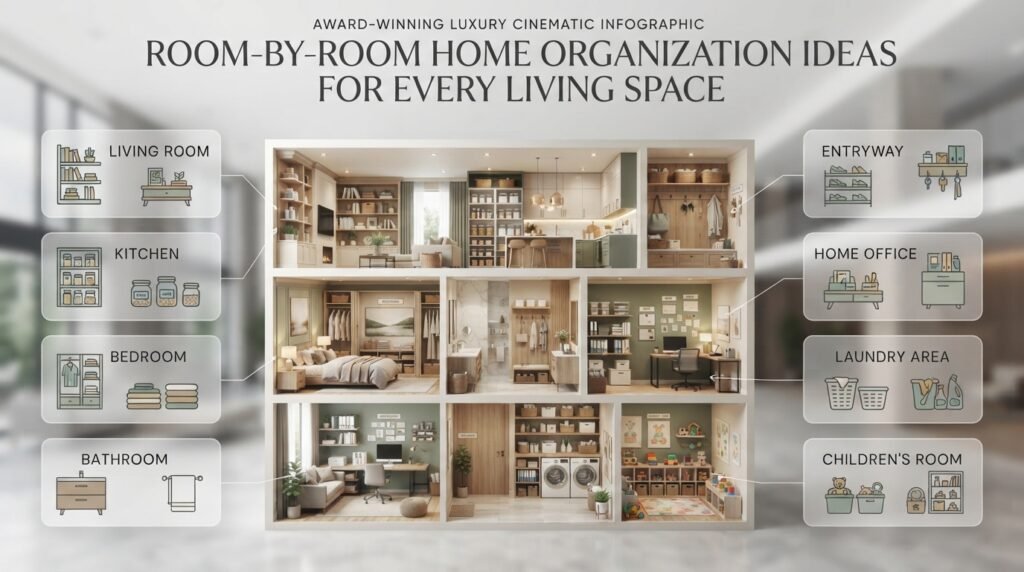
Different rooms support different activities, so they need different organizing systems. A practical home organization plan considers how each space is used rather than applying identical storage methods everywhere.
1. Living room organization
Living rooms often serve several purposes. Families may watch television, read, entertain guests, play games, and relax in the same space. Without designated storage, remote controls, blankets, magazines, toys, and electronic accessories can quickly accumulate.
Begin by identifying what genuinely belongs in the room. Items used every day should remain convenient, while belongings used only occasionally can be stored elsewhere.
Consider these practical solutions:
- Use a small basket for remote controls and frequently used accessories.
- Store blankets in an accessible cabinet or suitable basket.
- Choose a coffee table with shelves or drawers if extra storage is needed.
- Use closed cabinets for miscellaneous electronics and cables.
- Keep books grouped by household member or subject.
- Establish a separate place for children’s toys that are used in the living room.
Avoid turning every available surface into a storage area. A clear coffee table or side table makes the room easier to clean and provides useful space for everyday activities.
If your living room has limited floor space, review furniture placement before purchasing another cabinet. Sometimes moving a rarely used piece of furniture creates more practical space than adding storage.
For further room-planning inspiration, see Living Room Ideas.
2. Kitchen organization
The kitchen can become difficult to manage because it contains many small items with different purposes. Utensils, food containers, spices, appliances, cleaning products, and groceries all compete for storage.
The solution is to organize the kitchen according to activities.
| Functional zone | Items to keep nearby |
|---|---|
| Food preparation | Cutting boards, knives, mixing bowls |
| Cooking | Pots, pans, cooking utensils |
| Baking | Baking trays, measuring tools, ingredients |
| Food storage | Suitable containers, wraps, pantry supplies |
| Serving | Plates, bowls, glasses, serving dishes |
| Cleaning | Dish soap, sponges, appropriate cleaning supplies |
Keep frequently used equipment near the area where you need it. Store occasional-use appliances in cupboards when doing so leaves more useful counter space.
Review your food storage regularly. Place older products toward the front, check expiration dates, and avoid buying large quantities of ingredients that your household rarely uses.
Drawer dividers can separate utensils, while shelf risers may help you access items stored at the back of cupboards. Before buying either product, measure the available space.
Common mistake: Keeping every kitchen appliance on the counter because it might be useful someday. If an appliance is used only occasionally, storing it safely in a cupboard may free valuable preparation space.
For more kitchen planning inspiration, explore Kitchen Ideas.
3. Bedroom organization
Bedrooms can become cluttered when clothing, laundry, personal belongings, and unfinished tasks accumulate in one place. A functional bedroom should support rest while making dressing and putting belongings away straightforward.
Start with your wardrobe. Group clothes by category and keep frequently worn garments easy to reach. Separate clean clothing from laundry and avoid using chairs as permanent storage for items that haven’t been put away.
Useful strategies include:
- Use drawer dividers for socks, underwear, and small accessories.
- Keep a laundry hamper close to where clothes are changed.
- Store seasonal clothing separately when wardrobe space is limited.
- Use under-bed storage for appropriate items that aren’t needed daily.
- Keep bedside surfaces limited to useful personal belongings.
- Review clothing that no longer fits or suits your lifestyle.
When storing clothes for an extended period, make sure they’re clean and completely dry. Choose containers appropriate for the fabric and storage environment.
Don’t automatically buy additional wardrobe organizers. First determine whether the main problem is insufficient space, too many belongings, poor categorization, or inconvenient shelving.
For more bedroom planning ideas, visit Bedroom Ideas.
4. Bathroom organization
Bathrooms often have limited storage and contain many small products. Skincare items, toiletries, grooming accessories, towels, and cleaning supplies can easily overcrowd the vanity.
Group products according to how they’re used. Keep everyday essentials accessible, while backup supplies can remain in a separate cupboard or suitable storage container.
Practical bathroom organization ideas include:
- Use dividers to separate small products in drawers.
- Store towels in a clean, dry location.
- Use suitable shelves for frequently accessed essentials.
- Keep under-sink storage compatible with plumbing and ventilation.
- Review personal-care products regularly.
- Dispose of expired products according to appropriate guidance.
Don’t store every backup product beside the sink. Keeping only daily essentials within reach makes the bathroom easier to clean and use.
Moisture is an important consideration. Select storage materials suited to the environment and avoid placing moisture-sensitive belongings where condensation or leaks could damage them.
For more ideas about making bathroom spaces practical, see Bathroom Ideas.
5. Entryway organization
The entrance is often where clutter begins. Shoes, coats, bags, keys, umbrellas, and delivery packages can accumulate because people don’t have a convenient place to put them when they arrive.
Create a simple landing zone.
A shoe rack or suitable cabinet can keep footwear together. Hooks can hold frequently used bags and coats, while a small tray can collect keys and other pocket-sized belongings.
If the entrance is narrow, use wall-mounted storage where suitable and avoid blocking the walking route. Keep everyday items easy to access rather than hiding everything in a storage area that people find inconvenient.
For families, individual hooks or baskets can help each person manage their belongings independently.
6. Home office organization
A home office needs enough clear space for work, writing, studying, or managing household paperwork. Too many loose documents and electronic accessories can make even a large desk difficult to use.
Begin by removing items that don’t support your work. Keep essential stationery accessible, store documents in clearly identified folders, and group electronic accessories together.
Create separate locations for:
- Current projects and active paperwork.
- Stationery and frequently used office supplies.
- Chargers, cables, and electronic accessories.
- Reference materials.
- Records that must be retained.
Review documents periodically rather than allowing them to accumulate indefinitely. Protect confidential records and store important documents securely.
Cable organizers can help keep wires together, but make sure they don’t obstruct ventilation, damage cables, or create trip hazards.
7. Laundry and utility areas
Laundry areas often contain detergent, cleaning equipment, baskets, spare supplies, and clothes at different stages of washing.
The simplest solution is to create separate locations for dirty laundry, clean laundry, washing products, and household cleaning supplies.
If space allows, use clearly separated baskets for different laundry categories. Keep frequently used products within easy reach, and store chemicals securely according to their labels.
Avoid stacking supplies so high that items become difficult to retrieve. Make sure heavy products are stored safely and that pathways to appliances remain clear.
8. Children’s rooms and play areas
Children’s belongings change as they grow, so their storage systems should be easy to adjust.
Use accessible bins for toys, shelves for books, and separate locations for art materials or small building pieces. Label containers with words or pictures when this helps children identify where items belong.
Avoid placing heavy storage boxes on high shelves or using unstable furniture. Secure tall furniture appropriately and keep small objects away from children who could choke on them.
A short tidy-up routine works better when the system is simple. Children should be able to understand where toys go without having to sort dozens of tiny categories.
How Can You Organize a Small Home With Limited Storage?
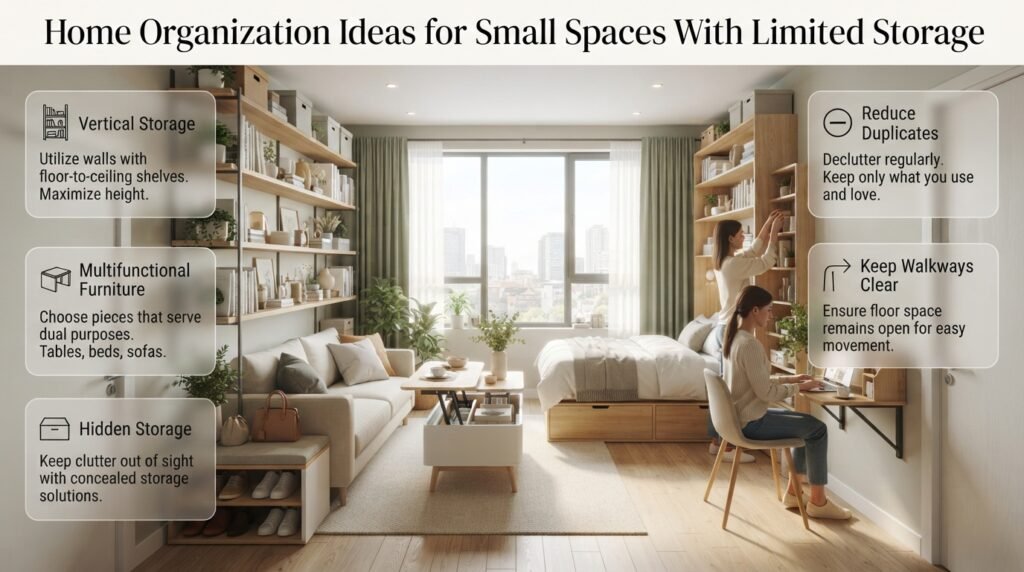
Small homes need organization systems that use space efficiently without making rooms difficult to move through. The aim isn’t to fill every empty corner. It’s to make the available space work harder while preserving access and comfort.
Use vertical storage carefully
Walls can provide useful storage for books, selected accessories, kitchen supplies, and household essentials. Shelves, hooks, and wall-mounted organizers may free up floor space when installed appropriately.
Before mounting anything, check the wall construction, use suitable fixings, and follow the product’s weight limits. Avoid placing heavy objects above areas where people regularly sit or sleep unless the installation is designed for that use.
Choose furniture with a useful secondary function
Multifunctional furniture can be helpful in apartments and compact rooms.
| Furniture | Possible use |
|---|---|
| Storage bench | Seating and entryway storage |
| Bed with drawers | Clothing or spare bedding |
| Coffee table with shelves | Books and living room accessories |
| Storage ottoman | Blankets and suitable small belongings |
| Folding desk | Compact work area |
| Bedside table with drawers | Personal essentials and small accessories |
Measure the furniture before purchasing it. Consider how drawers open, whether doors can swing fully, and whether the item will block a walkway or electrical outlet.
Use under-bed and overlooked spaces
Under-bed containers can hold seasonal clothing, spare bedding, and other suitable belongings. Under-stair storage may accommodate books, cleaning supplies, or household equipment.
However, hidden spaces should not become unmanageable dumping grounds. Label containers and avoid storing items that are difficult to retrieve or unsuitable for the environment.
Reduce unnecessary duplicates
Limited storage often makes duplicate belongings more noticeable. Review products such as kitchen utensils, stationery, toiletries, and cleaning supplies to determine whether the quantities you keep reflect actual household needs.
Keep reasonable backups of essentials, but avoid purchasing extra items simply because they’re on sale.
Protect clear walking areas
Storage should never make your home less usable. Avoid blocking entrances, windows, ventilation, appliance access, or emergency routes.
A smaller number of well-chosen storage solutions is often more effective than covering every wall and corner with shelves.
For wider inspiration on adapting living spaces to different layouts, explore Home Interior Ideas.
How Should You Organize Paperwork, Documents, and Household Supplies?
Household paperwork is easy to overlook because individual documents take up little space. Over time, however, receipts, warranties, school notices, bills, manuals, and official records can form confusing piles.
Create a simple filing system based on the way you retrieve information.
Sort documents by purpose
Useful categories may include:
- Property and housing documents.
- Bills and financial records.
- School and education paperwork.
- Appliance manuals and warranties.
- Medical or insurance records.
- Current tasks requiring action.
- Documents that must be retained for legal or administrative reasons.
The appropriate retention period depends on the document and your circumstances. Check relevant requirements before disposing of important records.
Separate active paperwork from archived documents
Keep documents that require immediate attention in a clearly defined action tray or folder. Move completed records into their appropriate storage categories.
Review the action folder regularly so that important deadlines don’t disappear beneath unrelated papers.
Create a household supply station
Designate one suitable location for commonly used supplies such as batteries, tape, scissors, spare light bulbs, and basic stationery.
Keep potentially hazardous products separate from food and out of reach of children. Store chemicals according to their instructions, and avoid mixing cleaning products.
A central supply location reduces duplicate purchases and makes it easier to see when essential items need replacing.
Decide what deserves digital storage
Where appropriate, digital copies can reduce paper clutter. However, digitizing documents should not replace keeping originals when they’re legally or practically necessary.
Use secure storage for sensitive records, protect access to important files, and maintain suitable backups. Avoid keeping confidential information in an unsecured folder simply for convenience.
Which Home Organization Products Are Worth Buying?
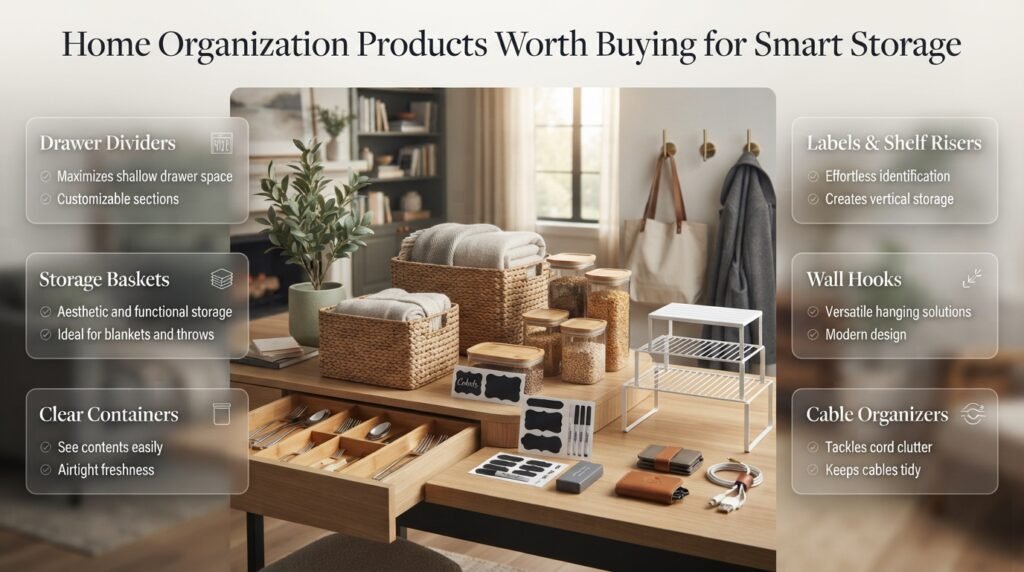
The best organizers solve a specific problem. Before purchasing anything, determine what needs to be stored, where it will go, and how frequently you need to access it.
| Product | Best use | What to consider |
|---|---|---|
| Drawer dividers | Small accessories and utensils | Size, adjustability, cleaning |
| Storage baskets | Blankets, toys, and everyday items | Capacity and ease of handling |
| Clear containers | Identifying stored belongings | Material and secure closure |
| Labels | Recognizing categories quickly | Readability and durability |
| Shelf risers | Using available cupboard height | Stability and clearance |
| Wall hooks | Bags, coats, and towels | Mounting method and weight capacity |
| Cable organizers | Grouping electronic wires | Cable compatibility and safety |
Should you use open or closed storage?
Open storage allows quick access and displays belongings, while closed storage conceals items and often creates a visually calmer appearance.
Open shelves work well for selected books, frequently used items, or attractive baskets. Cabinets and drawers are useful for miscellaneous accessories, paperwork, and supplies that don’t need to remain visible.
A combination usually provides the most flexibility.
How can you avoid wasting money on organizers?
Measure shelves and drawers before shopping. Consider whether existing containers can be reused and whether the proposed organizer makes the task easier.
Avoid buying a complete set simply because the products match. A well-sized, inexpensive divider can be more useful than a decorative organizer that wastes space.
Expert tip: Organize your belongings first, then measure what remains. This helps you purchase the right storage instead of trying to force your possessions into products that don’t suit them.
How Can You Maintain an Organized Home With a Busy Schedule?
A sustainable system depends on short, repeatable habits. You don’t need to spend hours tidying every day if you prevent small problems from becoming large ones.
Create a 10-minute daily reset
Choose a time that suits your household, such as after dinner or before bedtime.
Use those minutes to return misplaced items, clear important surfaces, collect laundry, and prepare essential belongings for the following morning.
A simple routine might look like this:
- Return shoes, bags, and coats to their designated places.
- Clear the dining table and kitchen counters.
- Put away clean dishes.
- Collect laundry and misplaced belongings.
- Prepare items needed for the next day.
You don’t have to finish every household task during this reset. Focus on the areas that make the greatest difference to the following day’s routine.
Use a weekly maintenance plan
Assign one manageable task to different days rather than trying to reorganize the entire house every weekend.
| Day | Example task |
|---|---|
| Monday | Review kitchen supplies |
| Tuesday | Reset laundry and clothing storage |
| Wednesday | Sort paperwork and desk items |
| Thursday | Check bathroom supplies |
| Friday | Tidy living room storage |
| Saturday | Complete one larger organizing task |
| Sunday | Prepare for the coming week |
Adjust the schedule according to your responsibilities. Some weeks will require less maintenance, while others may need more attention.
Make organization a shared responsibility
When several people live together, one person shouldn’t have to manage every belonging.
Agree on straightforward responsibilities. Children can return toys to labeled baskets, adults can manage shared supplies, and each person can maintain their own everyday belongings.
If a system repeatedly fails, discuss whether it is inconvenient rather than simply blaming people for not following it.
Review what comes into your home
Organization also depends on managing incoming items.
Before buying something, check whether you already own a similar product and whether you have suitable storage. Review shopping bags, delivery packaging, and unwanted paperwork promptly so they don’t accumulate.
A small donation box can also help you collect usable items you no longer need. Review it regularly and arrange appropriate donation or disposal rather than allowing it to become permanent storage.
What Are the Most Common Home Organization Mistakes?
Many organizing projects become frustrating because people focus on appearance instead of creating systems that work in everyday life.
Mistake 1: Buying storage before decluttering
Why it happens: Attractive baskets and containers make a room appear easier to organize.
Why it’s harmful: You may end up storing unnecessary items and spending money on products that don’t fit your space.
How to avoid it: Declutter first, group the belongings you intend to keep, and measure the storage area before shopping.
Mistake 2: Starting too many areas at once
Why it happens: People want to see a dramatic improvement across the entire home.
Why it’s harmful: Several unfinished piles can make the house less usable and increase frustration.
How to avoid it: Complete one drawer, cupboard, or room section before moving to the next.
Mistake 3: Creating overly complicated systems
Why it happens: Detailed categories and elaborate storage arrangements can seem appealing.
Why it’s harmful: If returning an item requires too many steps, the system becomes difficult to maintain.
How to avoid it: Keep categories understandable and make everyday belongings easy to access.
Mistake 4: Hiding clutter in unlabeled boxes
Why it happens: Putting items out of sight creates an immediate feeling of tidiness.
Why it’s harmful: You may forget what’s inside and eventually purchase duplicate items.
How to avoid it: Sort belongings before storing them and label containers when the contents aren’t obvious.
Mistake 5: Ignoring household habits
Why it happens: One person creates an arrangement without considering how other people use the space.
Why it’s harmful: Family members may return items to the most convenient location, even when that isn’t the assigned one.
How to avoid it: Involve the people who use the area and choose a system that matches their routines.
Mistake 6: Expecting perfection every day
Why it happens: Images of spotless homes can create unrealistic expectations.
Why it’s harmful: Ordinary mess may feel like failure, making people less motivated to maintain their progress.
How to avoid it: Focus on functional priorities, such as accessible surfaces, safe walkways, and easy-to-find belongings.
Mistake 7: Keeping everything because it might be useful
Why it happens: People worry that they will regret letting go of an item.
Why it’s harmful: Excessive storage can make useful belongings harder to find.
How to avoid it: Evaluate the likelihood of future use, the cost of replacement, and the space required. Retain emergency supplies and meaningful possessions when justified, but make deliberate decisions about duplicates and unnecessary items.
How Can Home Organization Work With Interior Design?

Organization and interior design support one another, but they solve different problems. Organization determines how belongings are stored and accessed, while interior design considers furniture placement, lighting, colors, materials, and the overall experience of a room.
A beautiful space may still be inconvenient if cupboards are difficult to reach or furniture blocks walking routes. Likewise, an organized room can feel unfinished if the lighting is poor or its layout doesn’t support the activities taking place there.
When planning both, consider these principles:
- Furniture placement: Keep doorways and walking paths accessible.
- Visual balance: Avoid overcrowding shelves and surfaces.
- Lighting: Ensure wardrobes, storage areas, and workspaces are easy to use.
- Materials: Select storage suited to the room’s moisture and cleaning requirements.
- Consistency: Coordinate finishes where doing so improves the overall appearance.
- Flexibility: Choose arrangements that can adapt to changing household needs.
If you’re planning a broader home improvement project, think about storage before purchasing furniture or beginning renovations. Early planning can help you identify where built-in cabinets, shelves, or utility storage would provide the most value.
For more ideas about combining practical layouts with attractive interiors, explore Residential Architecture Ideas.
If you’re making substantial changes to your property, Build & Renovate Construction can provide further inspiration for planning and improvement projects.
How Can You Organize Your Home for Changing Family Needs?
A home that works well today may need a different arrangement next year. Children grow, hobbies change, people begin working from home, and household equipment increases or decreases.
Rather than designing every storage area for a permanent purpose, create systems that can be adjusted.
Plan for changing children’s belongings
Children’s toys, books, clothing, and school supplies change as they grow. Review their storage occasionally and remove items that are no longer needed, while keeping meaningful possessions that deserve to be retained.
Adjust shelf heights, baskets, and storage categories to match their current abilities. Keep frequently used belongings accessible and heavier objects stored safely.
Make room for new work or hobbies
If a family member starts working from home or develops a new hobby, review the available space before adding furniture.
An existing desk, cupboard, or spare shelf may accommodate the new activity. If a separate area is necessary, identify what can be relocated or stored more efficiently.
Reassess seasonal belongings
Seasonal clothing, holiday decorations, gardening equipment, and outdoor accessories may not need everyday access.
Store them in suitable locations, label containers, and keep them protected from moisture, pests, and other sources of damage.
If you have outdoor equipment or seasonal supplies, practical inspiration from Garden and Outdoor Living Ideas may help you think about how indoor storage connects with outdoor activities.
Keep property maintenance supplies organized
Homeowners often accumulate paint supplies, repair tools, spare fittings, and maintenance products. Group these items by purpose and keep them in an appropriate storage area.
Store hazardous products securely, follow manufacturer instructions, and keep tools away from children. Review old supplies before purchasing replacements, but don’t use products that have deteriorated or become unsafe.
For additional household upkeep guidance, explore Property Care & Maintenance.
How Does Home Organization Help With Moving or Renovating?
Moving house and renovating can expose how many belongings have accumulated over time. Organizing before these projects can reduce unnecessary packing, help you estimate storage requirements, and make it easier to plan the layout of your new or improved space.
Declutter before packing
Review each room before placing items into boxes. Separate essentials, items to donate, belongings to sell, and things that need special handling.
Avoid packing objects you already know you don’t want to keep. Moving unnecessary possessions adds work and may increase transport or storage costs.
Label boxes according to their destination
Use labels that identify both the room and the general contents. For example, “Kitchen — everyday plates” is more useful than simply “Kitchen.”
Keep essential items in a separate, clearly identified box so they’re accessible during the first few days after moving.
Plan storage before buying furniture
Measure rooms and identify where everyday belongings will be stored. This helps you choose furniture that suits the available space rather than discovering later that cupboards are too small or drawers cannot open properly.
For broader property-related planning, see Property and Real Estate Guide.
If you’re travelling or spending time away from home, make sure essential supplies, keys, and household instructions remain organized and accessible to the appropriate people. For travel planning inspiration, visit Travel Places and Destinations.
What Do Experienced Organizers Recommend for Long-Term Results?
The most useful organizing methods are simple enough to repeat and flexible enough to survive changes in routine. You don’t need a complex system for every object in your home.
Organize according to frequency of use
Keep everyday items within easy reach and move occasional-use belongings to suitable secondary storage. This reduces unnecessary movement and makes frequently used areas easier to manage.
Create functional zones
A zone is an area dedicated to a particular activity or category of belongings.
A kitchen might have preparation, cooking, and serving zones. A home office might have separate locations for current projects, stationery, and archived documents.
Zones make it easier to identify where items belong and recognize when something has been misplaced.
Leave some storage capacity unused
Filling every cupboard to capacity leaves little room for new needs or changes in household routines.
Where possible, leave some flexibility in frequently used storage areas. This doesn’t mean wasting space; it means avoiding arrangements that become difficult to maintain as soon as a new item enters the home.
Choose convenience over appearance alone
Matching containers can create a consistent look, but they aren’t automatically the best choice. A practical drawer organizer or accessible basket may provide more value than an expensive product that looks attractive but is difficult to use.
Review systems when problems return
If clutter repeatedly accumulates in one location, examine why it happens. Perhaps the assigned storage is too far away, the container is too small, or several people use the area differently.
Change the arrangement when necessary instead of assuming that more effort is always the answer.
For further inspiration on making everyday living spaces comfortable and functional, visit Create a Home That Feels Beautiful.
What is the best way to organize your home without feeling overwhelmed?
The best approach is to divide your home into small, manageable areas and organize them one at a time. Trying to declutter every room in a single day can create unnecessary stress, especially when you have work, family responsibilities, and other daily commitments. Start with one drawer, cupboard, or countertop that regularly causes problems. Once that area is organized, move on to the next.
A practical system begins with removing unnecessary belongings, grouping similar items, and assigning each group a convenient storage location. You don’t need to purchase new organizers immediately. First, understand what you own and how you use it.
Practical points to follow:
Set aside 15–20 minutes for one small organizing task.
Separate belongings into keep, donate, relocate, and discard categories.
Finish one area before opening another cupboard or drawer.
Focus on making your space functional rather than achieving perfection.
How can I keep my home organized when I have a busy lifestyle?
Maintaining an organized home becomes easier when tidying is part of your normal routine rather than a major weekend project. The most effective systems reduce the effort required to put things away. If everyday belongings have convenient, clearly defined locations, you can manage clutter before it spreads throughout the house.
For example, keep keys near the entrance, laundry baskets where clothes are changed, and frequently used kitchen items close to the areas where meals are prepared. These small adjustments make everyday tasks more convenient.
Practical points to follow:
Spend 10 minutes each evening returning misplaced items.
Clear kitchen counters and dining tables after use.
Prepare bags, clothing, and essential belongings for the next morning.
Assign simple responsibilities to other household members.
Review clutter-prone areas weekly instead of waiting for them to become overwhelming.
The goal is to create a routine that remains realistic even during your busiest weeks.
What are the best home organization ideas for small spaces?
Small homes benefit from smart storage, fewer unnecessary belongings, and furniture that serves more than one purpose. Instead of filling every corner with containers, concentrate on making existing space easier to use. Vertical shelves, under-bed storage, wall hooks, and multifunctional furniture can increase storage capacity without unnecessarily reducing floor space.
It’s equally important to keep frequently used items accessible. A storage solution isn’t helpful if you must move several boxes to reach something you use every day.
Practical points to follow:
Use wall-mounted shelves where installation is safe and appropriate.
Choose storage benches or beds with drawers when they suit your needs.
Store seasonal belongings separately from everyday essentials.
Measure cupboards and drawers before purchasing organizers.
Keep entrances, walkways, and frequently used surfaces clear.
A small home can be highly functional when each storage area has a defined purpose and the arrangement suits your daily routine.
Should I declutter my home before buying storage organizers?
Decluttering should generally come before purchasing storage products because you need to know what you’re keeping before deciding how to store it. Buying containers too early can waste money and create additional clutter, particularly when the products don’t fit your cupboards or don’t suit the items you own.
Start by reviewing your belongings, removing items you no longer need, and grouping the remaining possessions by category. Then measure your available storage space and choose products that solve a specific problem.
Practical points to follow:
Review existing belongings before shopping.
Reuse suitable boxes, baskets, and containers whenever possible.
Measure the interior dimensions of cupboards and drawers.
Choose clear containers when visibility matters and closed storage when concealing clutter is more useful.
Buy only the organizers that improve accessibility or make maintenance easier.
Remember that good organization depends more on sensible decisions and consistent habits than on expensive storage products.
How do I stop clutter from coming back after organizing my home?
Clutter often returns when belongings don’t have convenient storage locations or when an organizing system is too complicated to maintain. The solution is to make everyday tidying simple and identify the habits that repeatedly create mess.
For instance, if shoes continually accumulate near the entrance, the shoe rack may be too small or inconveniently located. If paperwork covers the dining table, a dedicated document tray near the place where mail is opened may solve the problem more effectively than repeatedly clearing the table.
Practical points to follow:
Give frequently used belongings permanent, convenient locations.
Return items after use instead of postponing every task until evening.
Review incoming purchases and avoid unnecessary duplicates.
Create a short daily reset and a manageable weekly maintenance routine.
Adjust storage arrangements whenever the same clutter problem repeatedly returns.
An organized home doesn’t need to remain spotless every moment. What matters is having a practical system that makes it easy to restore order when everyday life gets busy.
Conclusion
Effective home organization is not about making every room look perfect or hiding all your belongings out of sight. It is about creating a practical living environment where everything has a place, everyday tasks feel easier, and your home supports your lifestyle. Whether you live in a spacious house or a small apartment, simple changes can make a meaningful difference in how you use and enjoy your space.
Start by decluttering one area at a time, keeping only the items you genuinely need, and assigning a specific place to everyday essentials. Use vertical storage, drawer dividers, labeled containers, and multifunctional furniture where they solve a real problem. Most importantly, choose organizing systems that are easy for everyone in your household to maintain. A simple system that works consistently is more valuable than an elaborate setup that becomes difficult to manage.
Remember that an organized home is built through small, repeatable habits rather than one major cleaning session. Spend a few minutes returning items to their designated places, review belongings regularly, and adjust your storage solutions as your needs change. With a thoughtful approach, you can reduce clutter, make better use of available space, and create a home that feels calmer, cleaner, and more comfortable every day.
2 Responses