Introduction
Living Room Ideas | The living room is often the busiest space in a home, yet it can be one of the hardest rooms to arrange. A sofa may look perfect in a showroom but feel oversized in your house. A beautiful rug may leave the seating area looking disconnected, while carefully chosen decorations can still make the room feel cluttered. The right living room ideas should solve these everyday problems rather than simply make a room look attractive in photographs.
A successful living room balances appearance, comfort, movement, lighting, storage, and the way people actually use the space. You do not need expensive furniture or a complete renovation to achieve that balance. Sometimes, changing the sofa position, adjusting the lighting, introducing a better color combination, or removing unnecessary accessories can make a noticeable difference.
This guide explores practical living room design ideas for small apartments, spacious family homes, open-plan layouts, rental properties, and rooms with unusual shapes. You will learn how to choose furniture, combine colors and textures, plan lighting, organize storage, decorate walls, and improve your existing room without wasting money. Each recommendation focuses on decisions that make the space more comfortable and easier to maintain.
1. How Do You Choose Living Room Ideas That Suit Your Home?
The best living room ideas are those that match your available space, household routine, budget, and preferred style. Before buying furniture or choosing decorative accessories, identify what the room needs to accomplish. A family room used for daily relaxation requires different arrangements from a formal sitting room designed mainly for entertaining guests.
Start by observing the room for a few days. Notice where people naturally sit, which areas receive daylight, where clutter accumulates, and whether anyone struggles to move between furniture pieces. These observations provide a more reliable starting point than copying a design photograph.
Identify your living room’s primary purpose
A room can support several activities, but one or two usually dominate. Decide which activities deserve the most space before selecting furniture.
- Family relaxation: Prioritize comfortable seating, durable upholstery, accessible tables, and storage for everyday items.
- Entertaining guests: Arrange seats so people can talk comfortably without shouting across the room.
- Reading and quiet activities: Include a supportive chair, a useful reading light, and a small table.
- Television and gaming: Consider screen position, viewing distance, glare, cable management, and seating depth.
- Working from home: Create a dedicated work zone that does not interfere with the main seating area.
- Flexible family use: Choose movable tables, adaptable seating, and storage that makes tidying easier.
A household with young children might benefit from rounded coffee-table corners and washable fabrics. Someone who regularly hosts friends may prefer additional occasional chairs rather than a very large sectional sofa.
Measure the room before making decisions
Record the room’s length, width, ceiling height, door positions, window dimensions, and locations of fixed features such as radiators or built-in cabinets.
Measure existing furniture too. Its actual footprint, including reclining mechanisms and extended footrests, matters more than the dimensions of the main seating cushion.
Use masking tape to outline proposed furniture on the floor. This simple exercise helps reveal whether a sofa blocks a doorway, a coffee table sits too close to a seat, or an armchair interrupts the route to another room.
💡 Pro Tip: Photograph the room from each corner before rearranging it. The photographs often reveal visual imbalances that are difficult to notice while standing inside the space.
2. What Are the Best Living Room Layout Ideas?
A good living room layout creates comfortable seating, clear walking routes, and a natural visual focus. The ideal arrangement depends on the room’s shape, entrances, windows, and main activities. Rather than automatically pushing every piece of furniture against the walls, organize the room around how people interact and move through it.
Arrange furniture around a focal point
A focal point gives the room a visual anchor. It could be a fireplace, a large window, a television, a distinctive artwork, or an attractive architectural feature.
Position the primary seating so it relates naturally to that feature. However, do not sacrifice comfort simply to make every seat face the same direction.
For example, a living room with a fireplace and television on different walls may benefit from a slightly angled sofa and a movable armchair. This allows people to enjoy conversation without making the room feel like a cinema.
Create a conversation-friendly seating arrangement
Conversation areas work best when people can see one another without twisting their bodies or raising their voices.
Try these arrangements:
- Place a sofa opposite two compact armchairs.
- Position two sofas facing each other when the room is wide enough.
- Angle one or two chairs toward the main sofa in an irregular room.
- Use a small side table between occasional chairs to create a shared resting point.
As a starting point, keep the main seating group reasonably compact. A coffee table approximately 14–18 inches from the front edge of the sofa is often practical, although the ideal distance depends on legroom, table shape, and household needs.
Preserve clear walking routes
A visually attractive arrangement becomes frustrating when people must squeeze between chairs or walk around the coffee table to reach the doorway.
Aim for a comfortable main route, often around 30–36 inches where the room permits. Secondary passages may be narrower in compact homes, but they should still allow people to pass without repeatedly moving furniture.
Check access to windows, balconies, storage cabinets, and frequently used doors. Include enough clearance for drawers, reclining seats, and cabinet doors to open fully.
Use zoning in open-plan living rooms
Open-plan spaces often combine cooking, dining, and relaxation in one large area. Without visual boundaries, the living room can feel undefined.
Create separation through furniture placement, lighting, rugs, or a consistent change in texture. A sofa with its back toward the dining area can establish a boundary without blocking daylight.
A low bookcase may provide storage and partial separation, while a pendant light can distinguish the dining table from the lounge.
For more ideas about how a building’s shape and spatial organization affect interiors, explore residential architecture ideas.
3. Which Living Room Furniture Ideas Make the Biggest Difference?
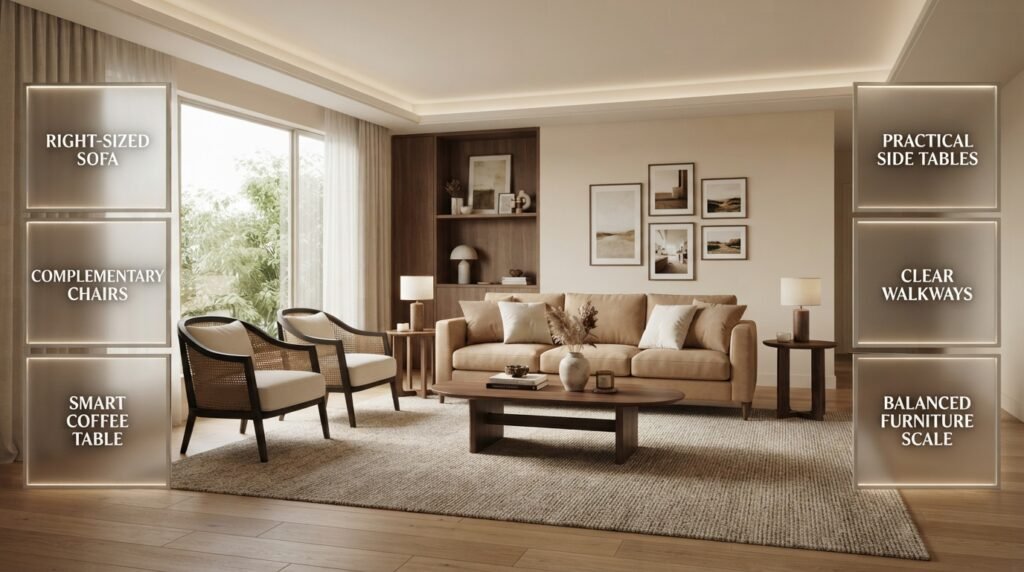
Furniture has the greatest influence on how a living room functions because it determines seating capacity, circulation, storage, and the overall visual weight of the space. Choose pieces according to their dimensions and everyday usefulness, not just their appearance.
Choose the right sofa size
The sofa is often the largest item in the room, so its proportions matter. A deep, oversized sectional may suit a spacious family room but overwhelm a narrow apartment.
Before purchasing, compare the sofa’s width, depth, height, arm thickness, and overall shape with the available floor area. Consider whether the room needs a two-seater, three-seater, sectional, loveseat, or a sofa combined with individual chairs.
A compact sofa with slim arms may provide more usable seating than a wider model with bulky sides. Raised legs can also make a small room feel visually lighter by revealing more floor beneath the furniture.
Select chairs that complement the sofa
Additional seating should improve flexibility rather than make the room crowded. An accent chair can introduce a different texture, color, or silhouette without requiring a complete furniture replacement.
Choose chairs that suit the room’s scale. Two large armchairs may look impressive but leave little space for a coffee table. A pair of compact upholstered chairs may work better in the same footprint.
If guests visit frequently, consider lightweight chairs that can be moved into the conversation area when needed.
Match the coffee table to the seating
The coffee table should be easy to reach from the main seats without obstructing movement. Its height is generally most comfortable when close to the sofa seat height or slightly lower.
Different shapes solve different problems:
| Coffee-table shape | Best suited to | Main consideration |
|---|---|---|
| Rectangular | Long sofas and larger seating groups | Needs sufficient passage space |
| Round | Compact rooms and curved arrangements | Check usable tabletop area |
| Oval | Narrow layouts with softer edges | Ensure it is not too long |
| Nesting tables | Flexible, multi-purpose rooms | Smaller tables need a storage place |
| Storage table | Homes with frequent clutter | Avoid making the table visually bulky |
A round table can make movement around a compact seating group easier, particularly where children frequently walk through the room.
Use side tables strategically
Side tables provide a place for drinks, reading glasses, lamps, and small everyday objects. They are most useful when positioned within comfortable reach of a seat.
You do not need matching tables on both ends of the sofa. A compact wooden table on one side and a small metal table on the other can look intentional if their proportions or finishes relate to other elements in the room.
⚠ Common Mistake: Buying furniture individually without considering the complete arrangement. Before purchasing a new item, check its dimensions against the sofa, rug, tables, and walking routes that already exist.
4. What Colors Make a Living Room Look Better?
The most effective living room color schemes create a relationship between walls, flooring, furniture, and accessories. Neutral colors can provide a calm background, while stronger shades introduce personality. The right combination depends on natural light, room size, existing finishes, and the mood you want to create.
Build a balanced color palette
A practical starting point is to choose three connected color roles:
- Base color: The main wall or large-surface color.
- Supporting color: A shade used in upholstery, curtains, rugs, or larger accessories.
- Accent color: A stronger color introduced through cushions, artwork, ceramics, or a smaller chair.
This is a flexible design method rather than a strict rule. A room can use more colors successfully when their undertones and visual intensity work together.
For example, warm white walls, a medium-brown sofa, natural wood, and muted olive cushions create a relaxed palette. A charcoal sofa with soft gray walls and rust-colored accessories produces a more dramatic result.
Choose between warm and cool neutrals
Warm neutrals include creamy white, beige, sand, and many taupe shades. They can make a room feel welcoming, especially when paired with wood and textured fabrics.
Cool neutrals include blue-gray, crisp white, and cooler stone shades. They can create a clean, contemporary appearance but may feel stark when combined with harsh lighting and very glossy surfaces.
Always test paint samples in the actual room. A color can look different beside warm flooring or under a north-facing window. Observe the sample during morning, afternoon, and evening before committing.
Introduce color without repainting everything
If repainting is not practical, use accessories to introduce a new palette. Cushions, throws, lampshades, artwork, and smaller upholstered pieces can change the room’s character at relatively low cost.
Repeat a selected accent color in several places so it feels connected to the overall design. For example, muted blue might appear in a cushion, a small artwork detail, and a ceramic vase.
Avoid matching every item exactly. Slight differences in shade, material, and pattern create depth.
Should you use dark colors in a small living room?
Dark colors can work beautifully in small rooms when used intentionally. A deep green wall behind a sofa can create depth, while dark curtains can frame a bright window.
The important factors are contrast, daylight, surface finish, and the amount of visual clutter. If the room has limited natural light, balance deeper colors with layered lighting, lighter textiles, or reflective surfaces.
A dark room does not automatically need white walls. It needs a thoughtful relationship between light and dark elements.
For additional inspiration on coordinated interior palettes and room styling, see home interior ideas.
5. How Can Lighting Transform a Living Room?
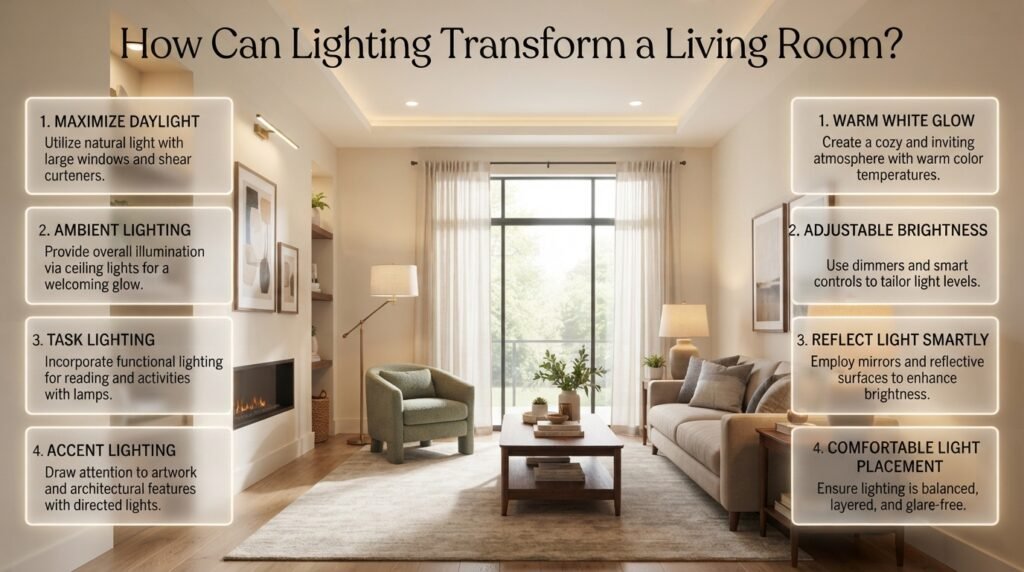
Good living room lighting combines general illumination, focused task lighting, and softer accent lighting. Using several light sources makes the room more adaptable than relying on one bright ceiling fixture. It also allows you to adjust the atmosphere for reading, entertaining, watching television, or relaxing in the evening.
Start with natural daylight
Observe how sunlight enters the room and whether curtains, tall furniture, or dark window coverings block it.
Use lightweight curtains when privacy requirements allow. Keep bulky furniture away from windows if it unnecessarily reduces daylight or restricts access.
Mirrors can reflect light into darker areas, but placement matters. Position a mirror where it reflects a bright window, an attractive view, or a well-lit part of the room rather than an untidy corner.
Layer three types of lighting
Ambient lighting provides the general light needed to move around the room. Ceiling fixtures and well-positioned recessed lights commonly perform this role.
Task lighting supports specific activities. Floor lamps beside reading chairs, table lamps near a sofa, and adjustable lights near a work area can make tasks more comfortable.
Accent lighting highlights artwork, shelves, architectural details, or plants. It adds visual depth without requiring every part of the room to be equally bright.
A living room might use a ceiling fixture for cleaning, a floor lamp for reading, and a table lamp for relaxed evening use. Each source serves a different purpose.
Select suitable light color and brightness
Warm white lighting often creates a relaxed residential atmosphere, while neutral white can be useful in rooms that serve as workspaces as well as lounges.
For many living rooms, bulbs around 2700K–3000K provide a comfortable warm appearance. However, consistency matters: mixing very warm and very cool bulbs in the same visible area can make the room feel disjointed.
Choose brightness according to room size and activities. Dimmable lighting is particularly useful because the room may need stronger illumination for cleaning and softer light for an evening gathering.
⭐ Expert Tip: Test lamps from seated eye level. A bulb that looks comfortable when standing may shine directly into your eyes when you sit on the sofa.
6. What Are the Best Small Living Room Ideas?
Small living rooms benefit from furniture that serves a clear purpose, visual continuity, and carefully planned circulation. The goal is not to squeeze the maximum number of objects into the room. It is to make essential activities comfortable while keeping the space visually open.
Use furniture with a lighter visual footprint
Furniture with exposed legs, open bases, slim frames, or transparent surfaces often feels less imposing than solid pieces that cover large areas of floor.
For example, a sofa raised on legs and a narrow side table may create a more open appearance than a low, bulky sofa paired with a large cabinet.
However, do not choose delicate furniture if the household needs substantial durability. Visual lightness should not come at the expense of stability or comfort.
Make use of vertical space
Walls can provide useful storage without taking up additional floor area. Floating shelves, tall cabinets, wall-mounted lights, and vertical artwork can draw the eye upward.
Place frequently used objects within easy reach. Reserve higher shelves for lightweight decorative items or belongings that are rarely needed.
Avoid filling every available wall with shelves. A few well-organized storage areas usually look calmer than multiple small displays.
Choose flexible furniture
In a small room, adaptability can be more valuable than adding another permanent piece.
Consider:
- Nesting tables that separate when guests arrive.
- An ottoman that provides seating, a footrest, or concealed storage.
- A compact desk that doubles as a console.
- A movable accent chair that can be repositioned.
- A storage bench that replaces a separate seat and cabinet.
Choose multifunctional pieces according to actual needs. A storage ottoman is useful when it holds items you regularly use, but less helpful if opening it becomes inconvenient.
Use rugs to define the seating area
A rug can make a small living room feel more organized by visually grouping the sofa, chairs, and coffee table.
Select a size that relates to the furniture rather than automatically buying the smallest available option. Ideally, the front legs of the main seating pieces can rest on the rug if the room allows.
A rug that is too small may make the furniture arrangement feel disconnected. Before buying, mark the proposed rug dimensions on the floor and check how the edges align with the seats.
Reduce visual clutter
Small rooms can become crowded when every surface holds decorations. Give everyday objects designated storage places and leave some surfaces clear.
Use a simple rule: display the items you enjoy looking at, and store the items you mainly need to use.
A small room can feel generous when it is well organized, even if its dimensions never change.
7. Which Wall Decor Ideas Work Best in a Living Room?
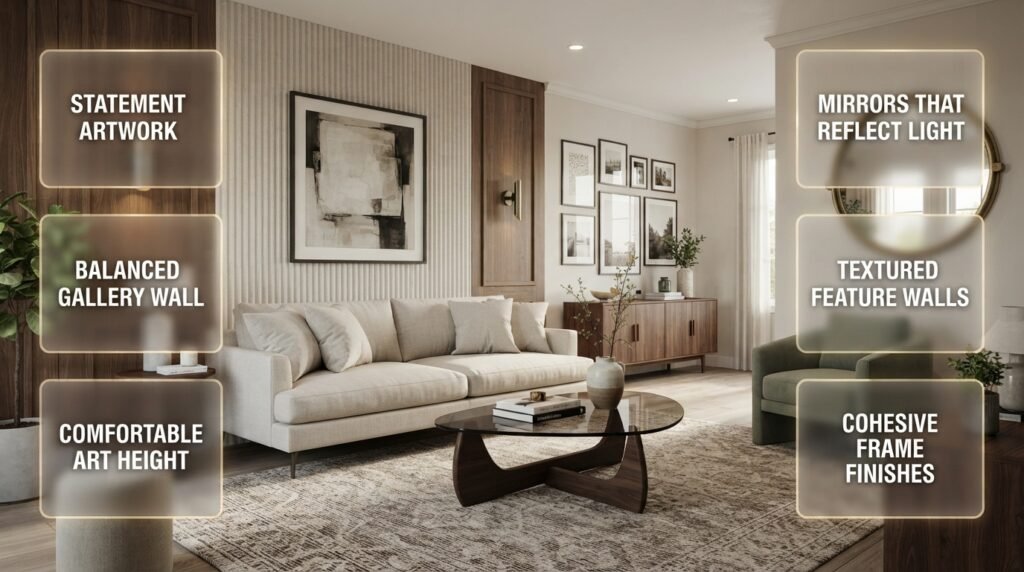
Living room wall decor should complement the furniture arrangement, reinforce the chosen style, and make use of the available wall area. Artwork, mirrors, shelving, textured finishes, and carefully selected collections can add personality without making the room feel crowded.
Hang artwork at a comfortable height
Artwork should relate to the people viewing it and the furniture beneath it. A common starting point is to place the center of a picture around 57–60 inches from the floor, then adjust according to the room and the artwork’s size.
When hanging artwork above a sofa, leave a visual gap between the frame and the furniture. The piece should feel connected to the seating without appearing to rest directly on the sofa back.
For larger walls, one substantial artwork may create a cleaner result than many unrelated small frames.
Create a balanced gallery wall
A gallery wall can display family photographs, illustrations, prints, or personal collections. Before hanging anything, arrange the frames on the floor or create paper templates.
Look for a shared element, such as similar frame finishes, a consistent color palette, or a common subject. The artwork does not need to match perfectly, but the overall grouping should have a recognizable structure.
Maintain relatively consistent spacing between frames. Uneven gaps can make a carefully chosen collection appear accidental.
Use mirrors with purpose
Mirrors can reflect daylight, expand the visual impression of a room, and create an attractive focal point.
Choose a mirror large enough to relate to the wall or furniture nearby. A very small mirror above a wide sofa can look disconnected unless it forms part of a larger composition.
Check what the mirror reflects before installing it. Reflecting a window or attractive artwork may improve the room, while reflecting clutter can make the space feel busier.
Add texture through wall finishes
Paint, wallpaper, timber details, and subtle textured finishes can add interest without introducing many decorative objects.
A feature wall works best when it has a clear relationship with the room. It might emphasize the fireplace, frame the main sofa, or distinguish a reading nook.
For advice on making modest changes that influence the atmosphere of an entire home, explore small interior changes that can transform the feel of your home.
8. How Do You Make a Living Room Feel Cozy Without Cluttering It?
A cozy living room combines comfortable seating, soft lighting, tactile materials, and a sense of personal character. It should feel inviting without requiring piles of cushions, excessive decorations, or furniture that is difficult to maintain.
Combine different textures
Texture creates depth when colors are relatively simple. Pair a smooth leather sofa with a woven rug, a knitted throw, linen curtains, or a textured cushion.
Natural materials such as wood, wool, cotton, linen, and rattan can add warmth. Metal, glass, and polished stone introduce contrast.
The aim is to balance surfaces rather than collect as many materials as possible. A few deliberate contrasts usually look more refined than a mixture of unrelated finishes.
Add soft furnishings selectively
Cushions and throws are useful because they can change the appearance of a room without requiring major purchases.
Choose cushion sizes and patterns that complement the sofa. A combination of plain fabrics, one subtle pattern, and a more textured material often provides enough variation.
Keep throws accessible but manageable. If they are constantly slipping off the sofa or covering every seat, the arrangement may need simplifying.
Bring in plants where conditions allow
Plants can introduce color, natural shapes, and visual movement. Choose species according to available daylight, temperature, humidity, and the amount of care you can realistically provide.
A larger floor plant may fill an empty corner more effectively than several tiny pots scattered across tables. In low-light rooms, research suitable plants before purchasing rather than assuming every indoor plant will thrive.
Consider pets and children when choosing plant varieties and placing pots. Use stable containers and protect surfaces from excess water.
Display personal objects with intention
Books, travel souvenirs, family photographs, and handmade objects can make a living room feel individual. Group similar items rather than spreading everything across every available surface.
For example, a shelf might hold a short stack of books, one framed photograph, and a small ceramic object. Leave some space around the grouping so each item remains visible.
Personal style becomes stronger when the room reflects meaningful choices instead of simply following a trend.
9. What Living Room Ideas Work for Different Interior Styles?
A living room style should guide your choices without forcing every item to match. Start with a general direction, then select furniture, colors, materials, and accessories that suit your home. A consistent design language makes the room feel intentional, even when the furniture comes from different places.
Modern living room ideas
Modern living rooms often feature clean lines, functional furniture, restrained decoration, and a thoughtful combination of materials. The style does not require every surface to be white or every piece of furniture to have sharp edges.
A contemporary sofa, simple artwork, natural wood, and carefully positioned lighting can create a modern atmosphere without making the room feel cold.
To achieve this look:
- Limit unnecessary decorative objects.
- Choose furniture with well-defined proportions.
- Combine smooth surfaces with tactile fabrics.
- Use lighting to highlight important architectural features.
- Keep cables and everyday clutter organized.
Minimalist living room ideas
Minimalism focuses on usefulness, visual clarity, and intentional choices. It is especially helpful for people who find crowded rooms distracting or difficult to maintain.
Choose a small number of furniture pieces that serve essential purposes. Use closed storage for objects that would otherwise remain scattered across surfaces.
Minimalism does not mean removing everything that makes a room comfortable. A supportive sofa, warm lighting, a good rug, and a few personal objects can make a minimalist space feel welcoming.
Japandi-inspired living rooms
Japandi combines the simplicity often associated with Japanese interiors with the warmth of Scandinavian design. Natural materials, subdued colors, functional furniture, and a restrained decorative approach are central to the look.
Try pale oak, warm neutral walls, linen curtains, a low-profile sofa, and a few handmade accessories. Avoid overcrowding shelves with decorative objects that compete for attention.
The key is to prioritize quality, calmness, and practical use rather than reproducing a showroom scene.
Traditional and transitional living rooms
Traditional interiors often feature classic furniture shapes, decorative details, rich materials, and established patterns. Transitional rooms combine these familiar elements with simpler contemporary pieces.
For a balanced result, pair a classic upholstered sofa with a contemporary coffee table or use traditional artwork against a restrained wall color.
This approach is particularly useful when you want to retain inherited furniture without making the entire room feel dated.
For more inspiration on connecting architectural character with interior style, read home modern architecture uses form, light and space.
10. How Can You Decorate a Living Room on a Budget?
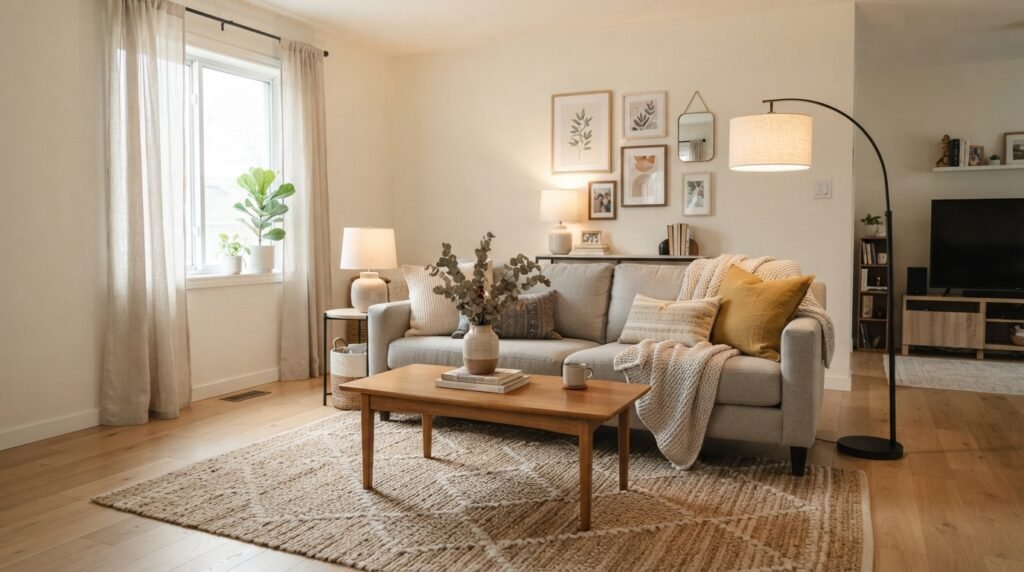
Budget-friendly living room improvements begin with identifying what is actually wrong with the existing arrangement. Replacing furniture before solving layout problems can waste money. A better approach is to improve the room in stages, starting with changes that have the greatest practical impact.
Rearrange before buying
Move the sofa, chairs, and tables into a more useful configuration before purchasing replacements. Sometimes, the room feels crowded because the furniture is positioned poorly rather than because there is too much of it.
Try moving the sofa away from the wall, changing the direction of a chair, or relocating a table that interrupts circulation.
Take photographs before and after each arrangement. Comparing them makes it easier to decide whether a change improves the room.
Refresh existing furniture
Furniture does not always need replacing when its appearance becomes tired.
Depending on its condition, you might clean upholstery, repair loose hardware, refinish a wooden table, replace worn cushion covers, or change the legs on a suitable piece.
Before attempting a repair, check the material and construction. Delicate finishes and damaged upholstery may require professional attention rather than aggressive cleaning or improvised treatments.
Prioritize purchases
If your budget is limited, spend first on items that affect comfort, durability, or everyday use.
| Priority | Purchase or improvement | Why it matters |
|---|---|---|
| High | Functional seating | Supports daily comfort |
| High | Suitable lighting | Improves visibility and atmosphere |
| High | Practical storage | Reduces recurring clutter |
| Medium | Correctly sized rug | Connects the seating arrangement |
| Medium | Curtains or blinds | Supports privacy and light control |
| Optional | Decorative accessories | Adds personality and finishing detail |
The order may change according to your needs. For example, someone with uncomfortable seating should prioritize a sofa over decorative accessories.
Shop secondhand carefully
Pre-owned furniture can offer good value, particularly for solid wood tables, bookshelves, occasional chairs, and decorative pieces.
Inspect joints, stability, upholstery condition, odors, and signs of moisture or pests. Measure the item and your entrance route before arranging collection.
A low price is not necessarily a bargain if the item needs expensive repairs or cannot fit through the doorway.
Improve the room gradually
A staged approach makes it easier to evaluate each change before spending more.
- Rearrange the furniture.
- Remove unnecessary items.
- Improve lighting.
- Correct curtain or rug proportions.
- Introduce a coordinated color accent.
- Add selected artwork or accessories.
For wider renovation decisions, the build and renovate construction guide can help you think beyond decoration and consider improvements to the home itself.
11. How Do You Keep a Living Room Organized?
An organized living room is easier to enjoy when every frequently used object has a convenient place. The best storage system works with household habits rather than relying on everyone to remember a complicated tidying routine.
Match storage to the clutter
Different items need different storage solutions. Remotes, chargers, and small accessories benefit from shallow drawers or trays. Blankets may fit into a storage ottoman, while books and display objects can use open shelving.
Create separate places for items that belong elsewhere in the home. A small basket near the entrance can temporarily collect belongings that need to be returned to other rooms.
Avoid buying storage containers before sorting the objects they will hold. Otherwise, you may simply organize things you no longer need.
Keep frequently used surfaces manageable
Coffee tables and side tables often collect cups, paperwork, chargers, toys, and miscellaneous belongings. Limit the permanent items on each surface and create an easy place for everything else.
For example, a coffee table might hold a small tray and one decorative object, while a nearby drawer stores remotes and charging cables.
The goal is not to keep the room permanently untouched. It is to make restoring order quick and realistic.
Establish a short reset routine
A five-minute evening reset can help prevent clutter from accumulating.
- Return loose items to their designated storage.
- Fold or reposition throws.
- Remove cups and dishes.
- Straighten cushions if necessary.
- Check that the main walking routes remain clear.
If the room becomes messy again immediately, reconsider the storage system. Frequently used belongings should be easy to put away without moving several other objects first.
For advice on maintaining a property beyond its appearance, explore property care and maintenance.
12. What Living Room Ideas Work for Homes With Outdoor Views?
A living room connected to a garden, balcony, terrace, or attractive landscape can feel more spacious when the indoor arrangement acknowledges that connection. The goal is to make the view part of the room’s experience without sacrificing privacy, comfort, or practical furniture placement.
Arrange seating to make the most of the view
If a window overlooks a garden, consider orienting an armchair or part of the sofa toward it. You do not need to make every seat face outdoors; a small change in furniture direction may be enough.
Avoid placing tall storage units directly in front of the most attractive part of the view unless space constraints leave no alternative.
Connect indoor and outdoor colors
Repeat a few outdoor colors inside the room. Green cushions, natural wood, woven textures, or earthy ceramics can create a subtle relationship between the living room and the landscape.
Choose materials that suit the amount of sunlight entering through the windows. Direct sun can fade some fabrics and artwork over time, so consider suitable window coverings and material durability.
Make balcony access practical
Keep the route to a balcony or patio clear. Curtains should open comfortably, and furniture should not obstruct doors or prevent safe movement.
For inspiration on making outdoor spaces more usable, visit garden and outdoor living ideas.
13. What Common Living Room Design Mistakes Should You Avoid?
Many living room problems come from decisions that seem reasonable individually but do not work well together. Recognizing these mistakes before purchasing furniture or decorating can save time, money, and frustration.
Buying furniture without measuring
Why it happens: A sofa or chair looks attractive in a showroom or online photograph.
Why it causes problems: The piece may overwhelm the room, block doors, or leave insufficient clearance around tables.
How to avoid it: Measure the room, the furniture, and the route into the house. Mark the furniture footprint on the floor before purchasing.
Choosing a rug that is too small
Why it happens: A smaller rug appears more affordable and easier to fit.
Why it causes problems: The rug may look disconnected from the seating and make the arrangement feel fragmented.
How to avoid it: Measure the entire seating group and test the proposed rug size with tape. Check where the sofa and chair legs will sit.
Relying on one ceiling light
Why it happens: A single fixture seems sufficient for general illumination.
Why it causes problems: The room may feel flat at night, with shadows in reading areas and insufficient light for particular activities.
How to avoid it: Add floor lamps, table lamps, or targeted accent lighting where needed.
Pushing every item against the walls
Why it happens: People assume this automatically creates more space.
Why it causes problems: A large empty center can make the room feel disconnected, and conversation may become less comfortable.
How to avoid it: Test a more integrated seating arrangement when the room dimensions permit. Keep a clear route around the furniture rather than focusing only on the distance from the walls.
Following trends without considering everyday needs
Why it happens: Popular interiors make particular colors, materials, or furniture shapes look irresistible.
Why it causes problems: Trend-led choices may be uncomfortable, impractical, or expensive to maintain.
How to avoid it: Use trends in replaceable elements such as cushion covers, artwork, or small accessories. Make major purchases according to comfort, quality, and long-term suitability.
Overdecorating every surface
Why it happens: Empty surfaces can seem unfinished, especially when viewed in isolation.
Why it causes problems: Too many objects compete for attention and create additional cleaning work.
How to avoid it: Group accessories, leave breathing room, and keep decorative items that have personal or visual value.
Ignoring household habits
Why it happens: A room is designed for appearance rather than actual daily behavior.
Why it causes problems: People leave belongings on the nearest available surface, move furniture repeatedly, or avoid using certain seats.
How to avoid it: Observe how the room is used. Put storage near the objects it needs to contain and preserve comfortable access to frequently used areas.
14. What Do Interior Professionals Consider Before Finalizing a Living Room?
A professional-looking living room is rarely the result of expensive accessories alone. It usually comes from getting the relationships between furniture, circulation, lighting, color, and materials right before adding the finishing touches.
Evaluate the room as a complete composition
Look at the room from the entrance, the sofa, and the main circulation route. Each viewpoint reveals different problems.
From the entrance, check whether the room has a clear visual focus. From the sofa, consider glare, artwork height, and the comfort of the seating arrangement. From the walking route, identify furniture corners or objects that interrupt movement.
A room should function from multiple viewpoints, not just the angle used for a photograph.
Balance visual weight
Visual weight describes how strongly an object attracts attention. A large dark sofa may carry more visual weight than a smaller pale chair, even when both occupy similar floor areas.
Balance can come from size, color, shape, texture, and placement. A substantial sofa may feel more integrated when balanced by a large artwork, a suitable rug, or a well-proportioned chair.
You do not need matching furniture on both sides of the room. You need a distribution that feels intentional.
Repeat materials without making everything identical
Repeating a material or finish creates continuity. Wood might appear in the coffee table, shelving, and a picture frame. Black metal might connect a floor lamp with a side table.
However, identical finishes everywhere can make a room feel overly coordinated. Vary the materials slightly while keeping the overall palette connected.
Test decisions before making permanent changes
Use temporary arrangements to evaluate furniture positions, rug dimensions, artwork placement, and accent colors.
Paint samples should be viewed in different lighting conditions. Furniture should be tested for comfort, not judged solely by appearance. Curtains should be measured for the actual window and desired fullness.
This process reduces the likelihood of expensive corrections.
For broader ideas on creating a cohesive and attractive home, explore create a home that feels beautiful.
15. How Should You Plan a Living Room Makeover Step by Step?
A structured makeover helps you spend money in the right order and prevents attractive individual purchases from producing an awkward overall arrangement.
Step 1: Define the problem
Write down the three biggest problems with your current room. These might include insufficient seating, poor lighting, a cramped walkway, a lack of storage, or a dated color scheme.
Prioritize the issues that affect daily comfort rather than the ones that are easiest to photograph.
Step 2: Establish your budget
Separate essential spending from optional decoration. Include delivery, installation, repairs, and any necessary electrical or building work.
Keep a contingency for unexpected expenses, particularly if the project involves repainting, flooring, or structural changes.
Step 3: Plan the layout
Measure the room and map the fixed features. Position the sofa and other large pieces first, then check circulation and access.
Only after the main layout works should you select smaller tables, lamps, rugs, and decorative objects.
Step 4: Finalize the color and material palette
Choose wall colors and large furniture finishes before adding accent accessories. Check how these choices look in the room’s actual daylight and evening lighting.
Consider cleaning requirements and durability, especially in homes with pets, children, or frequent visitors.
Step 5: Improve lighting and storage
Identify dark corners, reading areas, and surfaces that regularly collect clutter. Add appropriate lighting and practical storage instead of relying on decoration to solve functional problems.
Step 6: Finish with personal details
Introduce artwork, plants, cushions, books, and meaningful objects after the larger decisions are complete.
Step back and remove anything that feels unnecessary. A well-designed room does not need to display every attractive item you own.
If your project extends to choosing a property or evaluating its layout before moving in, the property and real estate guide offers a useful starting point. You can also review what to look for before choosing your next property before making a major housing decision.
What are the best living room ideas for a modern and stylish home?
The best living room ideas combine attractive design with everyday comfort and functionality. A modern living room does not need expensive furniture or complicated decoration. Instead, focus on a balanced layout, a coordinated color palette, comfortable seating, layered lighting, and a few carefully selected accessories. Neutral walls paired with natural wood, textured fabrics, and subtle accent colors can create a sophisticated look without making the space feel cold or impersonal.
Start by choosing a focal point, such as the main sofa, a fireplace, a large window, or a statement artwork. Arrange the furniture around this feature, ensuring that people can move comfortably through the room. Introduce personality through cushions, rugs, plants, and decorative objects that complement the overall design rather than compete for attention.
Practical ideas to consider:
Choose furniture with proportions that suit the room instead of following trends blindly.
Combine warm lighting with natural materials to create a welcoming atmosphere.
Use two or three connected colors to establish visual consistency.
Keep decorative accessories selective and meaningful.
Invest in comfortable seating and useful storage before purchasing optional decorations.
The most successful modern living rooms feel intentional, comfortable, and easy to maintain—not simply attractive in photographs.
How can I make a small living room look bigger and more spacious?
A small living room can feel considerably more spacious when furniture placement, lighting, color, and storage work together. The goal is to improve the room’s visual openness without sacrificing the seating and practical features you need. Start by measuring the available floor area and identifying anything that blocks the main walking routes, restricts daylight, or makes the room feel unnecessarily crowded.
Choose a sofa that leaves enough space for other essential furniture. Models with slim arms and raised legs can create a lighter visual appearance, while nesting tables or storage ottomans offer flexibility without requiring several permanent pieces. A well-positioned mirror may also help reflect daylight and create a greater sense of depth.
Practical ideas to consider:
Keep the main route between doors and seating clear.
Use vertical shelves or wall-mounted lighting to reduce the need for additional floor furniture.
Select a rug that visually connects the main seating arrangement.
Use curtains that complement the walls to create a more continuous appearance.
Store everyday belongings in designated places instead of leaving them on tables.
Avoid oversized furniture and excessive decorative accessories.
Light colors can help, but they are not the only solution. A small living room with appropriate furniture proportions, clear circulation, and good lighting can feel more comfortable than a larger room with a poor layout.
Which colors are best for living room walls, furniture, and decoration?
The best living room color scheme depends on natural light, room dimensions, existing flooring, furniture finishes, and the atmosphere you want to create. Warm neutrals such as cream, beige, and soft taupe often produce a relaxed environment, while cooler grays and muted blues can create a more contemporary appearance. Earthy greens, terracotta, and warm browns can introduce depth without making the room feel overly decorative.
A useful approach is to select a base color for the walls, a supporting color for larger furniture or textiles, and an accent color for smaller accessories. This creates a connection between different elements without requiring every item to match exactly.
Before painting, test sample colors on the actual walls. Daylight, artificial lighting, and nearby materials can change how a shade appears. A color that looks warm in a store may appear noticeably cooler in a room with limited sunlight.
Practical ideas to consider:
Use warm neutrals when you want a flexible, welcoming background.
Introduce stronger shades through cushions, artwork, or an accent chair.
Coordinate wall colors with the undertones of your flooring and major furniture.
Repeat accent colors in a few places to create visual continuity.
Test paint samples in the morning, afternoon, and evening before making a final decision.
Rather than choosing a color because it is currently popular, select one that works with your home’s lighting and the furniture you intend to keep.
How should I arrange furniture in a living room for comfort and functionality?
A functional living room layout should support conversation, provide comfortable access to seating, and preserve clear routes between entrances and other parts of the home. The arrangement should reflect how the room is used, whether for family relaxation, watching television, reading, entertaining guests, or a combination of activities.
Begin with the largest piece, usually the sofa. Position it in relation to the room’s focal point, then add chairs and tables according to the available space. A sofa facing two chairs can create a welcoming conversation area, while an L-shaped sectional may work well for family use when its dimensions suit the room.
Pay attention to the distance between furniture pieces. A coffee table approximately 14–18 inches from the sofa is a useful starting point, but the final spacing should accommodate comfortable legroom and movement. Also check that doors can open fully and that people can reach windows, cabinets, and frequently used areas without squeezing between furniture.
Practical ideas to consider:
Measure the room and furniture before moving or buying anything.
Position seating so people can converse comfortably.
Maintain a clear main walking route wherever possible.
Use rugs to define seating zones in open-plan spaces.
Avoid placing every piece against a wall if a more balanced arrangement is possible.
Test the proposed layout with temporary floor markings before committing.
A successful layout is one that feels natural when people use the room. If guests must move furniture to sit comfortably or household members repeatedly walk around obstacles, the arrangement needs adjustment.
How can I decorate my living room on a budget without making it look cheap?
Creating a stylish living room on a limited budget is mainly about making thoughtful choices rather than buying more decorations. Before spending money, identify what makes the room feel unfinished or uncomfortable. The problem may be poor lighting, an awkward furniture arrangement, worn textiles, or unnecessary clutter rather than a lack of expensive furniture.
Start by rearranging the pieces you already own. Moving a chair, changing the direction of the sofa, or repositioning artwork can improve the room without adding to your expenses. Next, refresh selected details with new cushion covers, a suitable throw, a secondhand side table, or a lamp that provides better lighting.
Choose a consistent color palette and repeat a few materials or finishes throughout the room. This helps inexpensive items feel connected to the overall design. However, avoid buying several low-quality accessories simply because they are affordable; a few useful, well-chosen pieces often create a more polished result.
Practical ideas to consider:
Rearrange existing furniture before considering replacements.
Clean or repair furniture that is still structurally sound.
Shop carefully for secondhand wooden furniture and decorative pieces.
Improve lighting before investing heavily in accessories.
Refresh textiles using colors that complement your existing furniture.
Set a budget for essential improvements and postpone nonessential purchases.
The key is to spend where it improves comfort, function, or durability. A room with sensible proportions, good lighting, clean surfaces, and a coordinated palette can look refined without a major renovation.
Conclusion
The best living room ideas are those that combine style, comfort, and functionality in a way that suits your everyday life. Whether you have a small apartment or a spacious family home, you can create an inviting interior by making thoughtful decisions about furniture placement, color combinations, lighting, storage, and decoration. A beautiful living room does not depend on expensive purchases; it depends on understanding your space and using it wisely.
Start with the essentials. Measure your room, choose furniture that fits comfortably, maintain clear walking routes, and create a balanced lighting plan. Then introduce textures, artwork, plants, and accessories that reflect your personality without overcrowding the space. If you’re working with a limited budget, rearranging existing furniture and making a few targeted improvements can produce noticeable results.
Remember that your living room should support the way you relax, entertain guests, and spend time with family. Instead of following every design trend, focus on practical choices that remain useful and attractive over time.
For more inspiration, explore Blog Home Ideas TheHomeTrotters and discover practical ways to improve your home, enhance your interiors, and make everyday living more enjoyable. Start with one meaningful change today, and gradually transform your living room into a comfortable, welcoming space that truly feels like home.
5 Responses